
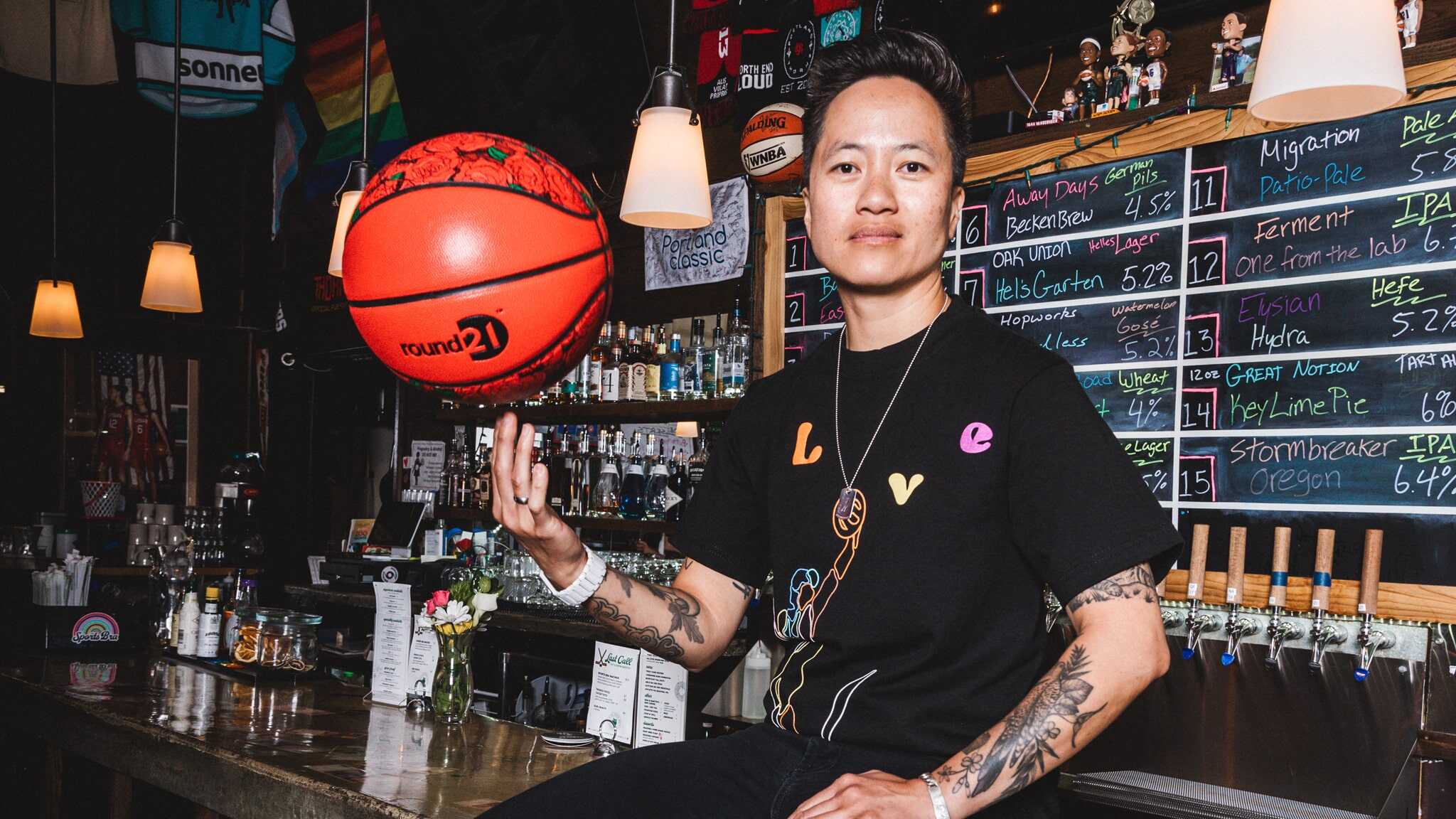
Jenny Nguyen is expanding The Sports Bra bar because everyone watches women’s sports
How the Vietnamese American opened the first bar dedicated to women’s sports in Portland, Oregon and is now franchising around the country
Jenny Nguyen, founder of The Sports Bra, the first sports bar dedicated to women’s sports.
Round21
Words by Helen Li
Ask Jenny Nguyen about basketball and she’ll have a lot of opinions. The Sports Bra bar founder is unafraid to talk about WNBA collective bargaining and the transformation at basketball games now since the pandemic.
“Whatever they did, they should write a manual,” she says, referencing the marketing and engagement efforts spearheaded by the WNBA Golden State Valkyries president Jess Smith. Smith led the National Women’s Soccer League’s successful Angel City Football Club expansion in Los Angeles prior to her role in the Bay Area. “She’s very, very good. She’s also all about sharing because she understands the rising tide.”
The rising tide, where one team’s success can lift all ships, is also a philosophy that guides Nguyen now in her franchising efforts for The Sports Bra. Founded in Portland in April 2022, The Sports Bra became the first sports bar dedicated to women’s sports. Following in its footsteps, women’s sports bars started popping up all over: Untamed Spirits in Los Angeles, Watch Me! Sports Bar in Long Beach, A Bar of Her Own in Minneapolis, and Rough and Tumble in Seattle. The viewership for women’s sports is also growing. Women’s sports are projected to earn $2.35 billion globally in 2025, a 25 percent increase from $1.88 billion last year, according to a report from Deloitte.
When Nguyen first had the idea for the bar, she could not get a loan and had to launch a GoFundMe. Now, the bar is franchising out its brand across the country (with interest from across the world). Nguyen sat down with JoySauce to share about her experiences growing up in Portland, combining her love of food and sports, and how she is staying grounded as a CEO.
This interview has been edited for clarity and length.

From left, Alexis Ohanian and Jenny Nguyen in front of The Sports Bra in Portland, Oregon.
FLI Social
Helen Li: Walk me through what a day-to-day schedule is like for you.
Jenny Nguyen: I'm still learning my role. Having come up in kitchens, I started as a prep, pantry cook, dishwasher, and worked my way up over 15 years to become an executive chef. When I was the executive chef, I was a hiring manager as well. So I spent seven and a half years building teams, mentoring, still super hands-on. There's nobody that is “below me” in the totem pole of how the chef world works that I don't know how to do their job.
Going from operations into a CEO role has been challenging for me. A majority of the folks on our corporate team have decades of experience in their fields. I have a Dream Team. Every day is different. I used to be on the same schedule as the bar, but two years ago, I hired my replacement and weaned myself out of there. I try to be there to just touch base with everybody once in a while. I do a lot of traveling. I do a lot of interviews, mentorship around my team. There's hundreds of emails and appearances. I'll try to go to events. Networking. The other night I went to the Portland Art Museum where there was a gala. I ended up meeting some really influential folks in downtown Portland, and now we're working with them to do some really cool stuff.
HL: How has being a daughter of Vietnamese immigrants shaped your perspective?
JN: For any kind of second-generation Asian American, there is that kind of that heavy weight, and to be an only child, that feels even more immense. They came over in 1975 during the war from very different backgrounds. Mom came from a super-wealthy family, very powerful. Dad, opposite. They fell in love in St. Paul, Minneapolis and then they moved to Portland.
I always had a tricky relationship with my parents because of who I am. I fell in love with basketball at a really young age. Mom was just like, “Girls don't play sports.” I came out to my family when I was 17, and that was a difficult conversation. I went to school, I enrolled at college in a pre-med program, and my sophomore year, I told my parents I wanted to be a chef. That conversation went very badly, as you can imagine.
I was 40 years old, and I told my parents I wanted to open The Sports Bra and they did everything in their power to change my mind. I had spent my whole life what felt like disappointing them, but it's not disappointment. It's their fears placed upon me. But our relationship has dramatically changed after opening The Sports Bra. They just didn't understand it (at first), until the doors opened. They saw the community pouring in. They saw the kind of emails, letters, and DMs. Now I have the best relationship ever with them. It’s pretty fantastic. And for the first time, they really 1,000 percent support it.

As a queer Vietnamese American woman, Jenny Nguyen built The Sports Bra as a space she has always wanted.
Jessica Vanterpool
HL: How does your queer identity intersect with The Sports Bra and what it has become?
JN: I want it to be a place that I've always dreamed of. Whenever it got to any decisions about details or menu or bathrooms or stools, I thought, “What have I always wanted? What has always been missing?” Creating space for folks like the LGBTQIA+ community, creating space that's welcoming to BIPOC. And it ended up that I was creating a space for myself. I didn't know I was doing that as I was doing it, until we opened. And then people told me about it, and I was just like, “Oh, right, I'm a queer Vietnamese woman who opened a sports bar.” I guess that is pretty rare, and why the space feels the way it does—because I built it for me.
HL: You once played basketball for a community college but then tore your ACL. How has that shaped your outlook as an entrepreneur?
JN: You don't have to play sports to be a great human being, but there are so many lessons to be learned.
When it came to that injury, I was 19 years old. It was two weeks before my first freshman college basketball game. I had lived and breathed basketball up until that moment, and so I had wrapped my identity into basketball. What's crazy is that a lot of folks didn't know, but I was also an artist. I drew a lot, I wrote poetry, all of that stuff. But nobody knew that. Everyone just knew me as a basketball player, and that's the way I liked it. And so when I blew out my knee, I felt like an immense dark valley—some may call it depression. I was skipping rehab. I was having a really difficult time.
I leaned hard into poetry, storywriting, art. I went to college pre-med and while going through the motions, I started to miss mom's food. And so I asked mom if I could get some recipes that she cooked at home. And that's how I fell in love with cooking. I ended up cooking in the dorms for a bunch of people and loving it. It was super random.

The interior of The Sports Bra.
Jessica Vanterpool
HL: Moving on to franchising, how did you decide on the cities of St. Louis, Las Vegas, Indianapolis, and Boston?
JN: There are two schools of thought when it comes to franchising a business. One is to start where you are regionally, and then work your way out. The other thought is to find specific locations where you feel your business would thrive, and then only open applications in those locations. We hired one of the best franchise consulting agencies on the planet to help us get this thing off the ground.
We talked through it and I was just like, “I don't think either of those are going to work for us.” And so we are franchising in a non-traditional way, where we opened up to the entire country. We believed that we needed to find the right people first. Place, second. To me, The Sports Bra is so mission and value driven and so community oriented that we needed to find the right people who fully embodied what The Sports Bra is, and also were committed to their communities in those locations
We found these four franchise groups or individuals that we felt embodied the mission values of The Sports Bra and had the backbone of what it takes to franchise in their communities. And what is really beautiful is that we wanted a range to kind of show the breadth of what The Sports Bra community is like.
HL: Are you and all of the other women’s sports bar owners in a group chat? What are the challenges that you are all commonly trying to figure out and solve?
JN: Yeah, there's definitely a group chat. There's a Slack channel that all of us are on, and different folks. There are people who just host watch parties, people who are just interested in the space, but mostly it's bar owners, or going to be bar owners, and then watch party organizers—because those are huge events too—and it's awesome. I basically am in there poking around. There's so much stuff happening, so much involvement, and there's so many people who are chiming in, I don't know if it's necessary for me to say my piece. It's anything from navigating petitions around the WNBA CBA (collective bargaining agreement), and how do we support the players, to does anyone have an employee handbook they're willing to share.
From the moment we announced we were going to open, there were already conversations from folks around the globe, around spaces like this, around women's sports. I actually had one person request in an email to open in Saigon. Several from Japan. And the Asian countries less, but places like Australia, all about it, Canada, all about it, France, Italy, Spain, Brazil, Chile, South Africa. We've kind of seen a full gamut, but really only one from Saigon that really touched my heart.
I actually met a guy here who organizes a lot of stuff around basketball and Asian basketball. He's a Vietnamese fella, and he's actually kind of looped me in to try to promote girls basketball in Saigon through a nonprofit program, like an ambassadorship. I'm not entirely sure I have the capacity for it, but I told them that I'd be happy—more than happy—to advise or be on some kind of a board for it.

The exterior of The Sports Bra bar.
Jessica Vanterpool
Published on September 12, 2025
Words by Helen Li
Helen Li is a journalist and fact-checker based in Los Angeles. Her work has been featured in the Los Angeles Times, The Guardian, Rest of World, Semafor, and Business Insider. In her free time, she appreciates a good hike, watches NCAA gymnastics, and occasionally dives into Reddit rabbit holes where she finds fascinating stories. She also just completed her first women's rugby 15s season. You can reach her on Signal @hliwrites.99.