
Myra Molloy finds freedom in ‘Girls Like Girls’
The actress discusses the cathartic experience of working on the film with Hayley Kiyoko and learning to let go of perfection
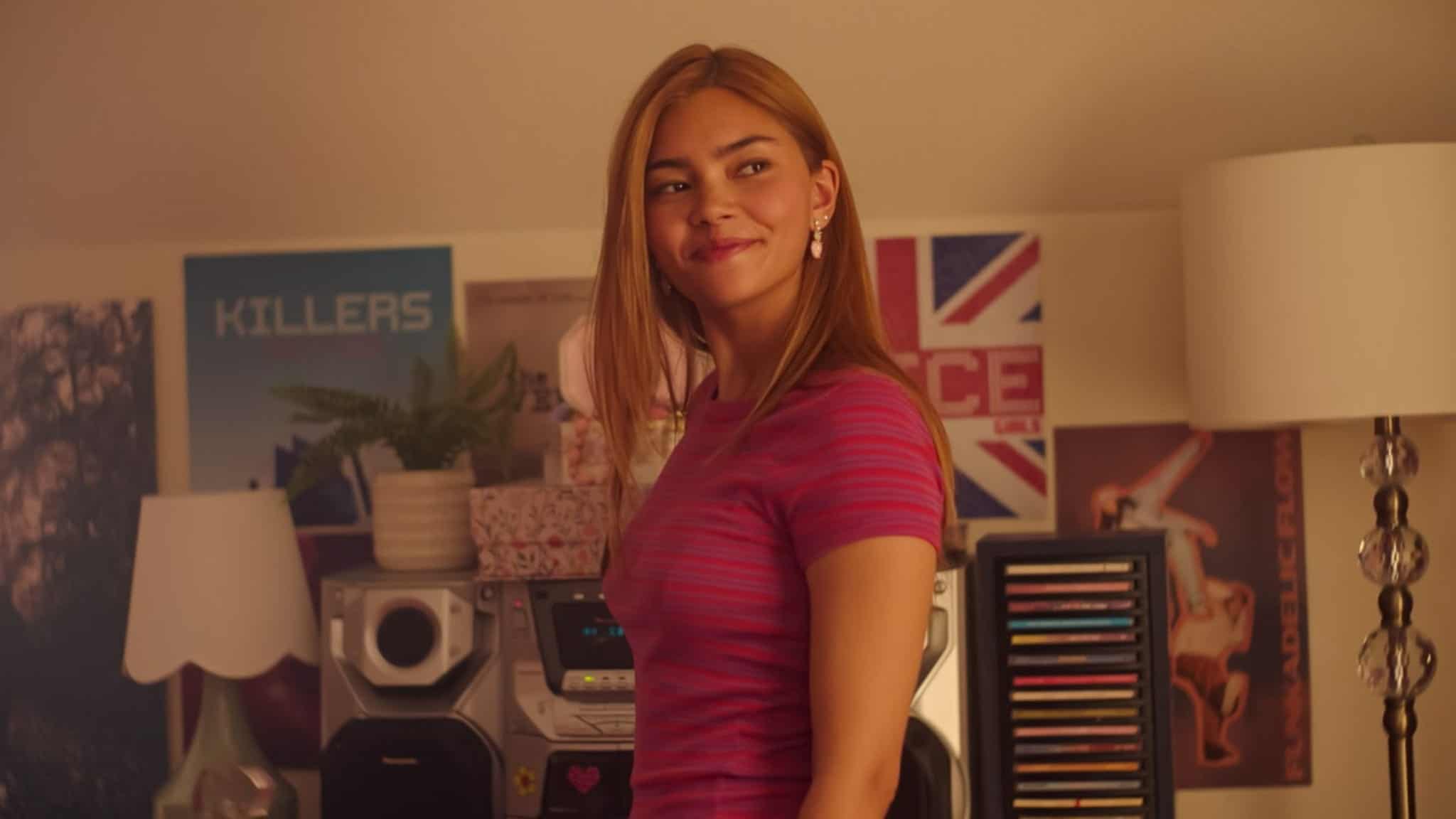
Myra Molloy as Sonya in "Girls Like Girls."
Focus Features

Words by Daniel Anderson
Nearly a decade after Hayley Kiyoko’s “Girls Like Girls” became an LGBTQ+ anthem, the story has grown from a music video into a book, a feature film and now an accompanying album. Kiyoko’s 2015 music video, which followed two teenage girls falling in love, became a landmark moment for queer representation and laid the foundation for a much larger story.
Now, in her feature directorial debut, Kiyoko expands that world onto the big screen with Girls Like Girls, starring Myra Molloy as Sonya and Maya DeCosta as Coley. The film follows Coley, a teenager grappling with her sexuality after moving to Oregon with her father, and her relationship with Sonya, a seemingly confident girl who is navigating her own struggles with identity and self-worth.
For Molloy, who was born and raised in Thailand, playing Sonya meant stepping into a story about first love, vulnerability and learning to accept yourself.
After promoting the film in her native Thailand, Molloy spoke with JoySauce about bringing Sonya to life, working with Kiyoko and what the experience taught her about herself.
This interview has been edited for clarity and length.
Daniel Anderson: First of all, how was Thailand? And what was it like promoting Girls Like Girls there and seeing the reaction from an international audience?
Myra Molloy: Thailand was incredible. Thailand is the place I was born and raised, and there's such a huge queer community there—a community that I grew up in. It was cool to have this homecoming. It was surreal, and going with Hayley was surreal, too. She has so many fans there that she hasn't been able to reach physically yet, so seeing the love the fans have for her and being able to see the response to the film was really special. We did the junket and press in Thai, talked about the movie in Thai, and I got to come home in a different capacity. I've worked there my whole life, and people know me as a certain thing, so being able to come home with such a special film and with Hayley, and to do it in Thai for a community that embraces this so much and sees it as their story too, I was like, “Wow. Life is so weird sometimes.”
DA: You've mentioned in past interviews that playing Sonya was cathartic for you and made you reflect on parts of your younger self. What do you understand now about yourself in hindsight, having had the opportunity to look back on that time?
MM: Coming onto that film, my personal life was going crazy. I was going through a breakup from a long-term relationship, and earlier that year I had also had a very traumatic work experience. Everything was just so hard.
I'm especially hard on myself, and I think Sonya is also extremely hard on herself. She self-imposes all these expectations and judgments from other people and has this battle with her self-worth and identity. Being able to explore that over the course of the summer in such a safe environment, through such a nuanced and complex character, was incredibly cathartic for me.
By the end of the film, I also had that release of, "Being myself and who I am is more than enough." All the pressures I felt that year and all the shortcomings I felt, I was like, “No, this is not who you are. This is not who you're supposed to be. All you're supposed to do is exist, listen to your heart and your intuition, and live that out.” Life is so short. I feel like that was reflected on screen because Sonya had that arc as well. It's cool when art imitates life—or life imitates art—perfectly in the moment.

Maya da Costa as Coley and Myra Molloy as Sonya in "Girls Like Girls."
Focus Features
DA: That actually leads into one of my favorite exchanges at the end, when Sonya says, "All I do is run," and she's told, "You could stop." It reminded me of the film Perfect Days, which I know you love, and its idea that, "next time is next time, now is now." Was there something about this experience that allowed you to slow down and let things catch up with you?
MM: That's so beautiful and so true. I feel like we hear that so much, but do we actually ever take the time to sit down and really reflect on what that means? Are we actually actively living by those words? Even you saying that just now, I need to hear that right now. I need these experiences and things in life to catch up with me so I can fully appreciate what's going on.
But I think in the world that we live in, with social media and all the fanfare all the time, we feel like relevance is such a currency, and I really want to unsubscribe from that because it doesn't mean anything. The struggle and striving to remain relevant, remain in the spotlight, constantly be at the top or constantly be top of mind—it's just too much. I don't think we're built to exist that way.
DA: Were you hypercompetitive when you were younger?
MM: I'm hypercompetitive now. I'm hypercompetitive with myself. It's been this self-imposed thing I've had ever since I was a kid. I feel like I have so much to prove because I know what I'm capable of, and I just need the platform and the people around me to prove it.
Hayley is such a prime example of that person in my life. I may feel like I've been working my whole life, but I'm not in the rooms I want to be in yet, or I'm not in the projects I want to be in yet. But Hayley really took a chance on me to tell this story, and it's people like her who make me excited to be even more competitive with myself.
But it is a fine line. It's fun and exciting to keep one-upping yourself, but it becomes detrimental when it's hurting you and you're thinking, "Why am I not there yet?" or "Why am I not good enough?" I'm learning to tread that line.

Coley and Sonya riding their bikes together.
DA: So much of this is obviously Hayley's story and Hayley's vision. She's talked about the different life forms this project has taken over time—the music video, the book and now the movie—and how this is the version they were able to make with the time and resources they had. How did you separate what was foundational to Sonya from what you could bring to her yourself?
MM: I fully went into this project with the mindset of, "I'm just so grateful to be here." Hayley is so wonderful, and I'm not just saying that because people say those things in interviews. Sometimes you meet people who've worked forever and you're like, "You're sure? Something's a little off about you." But no, she's just so real. Meeting her, hearing her story and seeing her passion from the beginning, I was like, all I want to do as an actor is be the perfect vehicle and sponge for Hayley to tell her story.
The story in the script was always about Coley, so I never went into it with an ego of, "Well, this is Sonya's moment, and I need to perform." All I wanted to do was be a good conduit and a good partner for Coley. I think, in the process of shooting it over 23 days, I weirdly didn't feel this pressure because I was like, “It's not about me.” In letting go, I was really able to just feel and go with what was happening in the moment.
When it came to what I wanted to bring to Sonya, it was very collaborative. Sometimes I would say to Hayley, "Can I do it this way? I really feel like she wouldn't do it this way." Then I'd do it how Hayley wanted, and she'd say, "Okay, that's really not working." I'd say, "Let me try it this way," and she'd be like, "Okay, yeah, that is much more natural."
It's a beautiful collaborative thing when you have an egoless director who's also willing to pivot a little or create something magical along the way.
DA: Sonya is flirtatious, playful, and charming, but can be aloof and mean too. How did you approach making her human and making that relationship believable for audiences?
MM: In terms of Sonya's character, I didn't want her to just be a plot device or the thing that drives Coley's story. I don't think she's a villain, but she's hard to root for because she does things she doesn't mean because she's young. She's honest, she loves Coley, and she's struggling with a lot.
On paper, it's easy to think she's just written as a b*tch. My job as an actress is to ask, “How do I bring this character to life in a humane way?” She's a human being. This isn't just some made-up girl who forces another girl to go through an awakening. She's a real person, and I wanted to give her honesty, integrity and emotional breadth. We've all experienced this. I've been a Sonya. I know Sonyas. She's still a very important part of the story.

Sonya and Coley in the car with other friends.
DA: The camera also gets incredibly close to you throughout the film—the pool scene, the dancing in the room, those really intimate shots. Can you talk about that relationship with your director of photography, Sonja Tsypin, and what it takes to perform when the camera is that close?
MM: Intimacy with the camera. Sonja Tsypin, our DP, is incredible. It was really confusing on set because we had Sonya, Sonja, Maya, Myra. It was horrible. But Sonja is so wonderful, and immediately we all got along. I think there's something to be said about literally being filmed through a female lens. This would be a very different film, and I'm sure everyone would agree, if our DP were a man.
The softness, the intimacy, and how the camera lingers on the parts that I feel like, as a woman, that's what I focus on. I feel like a man would focus on different parts. The camera was almost like a third person in the sense that this is literally through the female gaze. It felt so safe and beautifully intimate because we all had that shared language and shared understanding. Sonja and Hayley obviously worked very closely, and I just think Sonja is a genius. She was able to capture the intimacy—the eyes, the hands, all these little things that I feel really made the movie for me because that's where Myra's yearning was.
DA: What kinds of projects do you want to do next?
MM: I feel like I've just been so determined from such a young age to do stuff that I'm proud of. I think I started my career in a place where I wasn't proud of myself. As I'm approaching my 29th birthday this Friday—

Sonya and Coley in the famous "olive juice" moment.
Focus Features
DA: Happy early birthday!
MM: Thank you. I think I've really just gotten to a place in my life where I really want to do stuff I'm proud of, work with my heroes, work with really amazing writers and work on projects that I really, really believe in.
It's never been about the check for me. Thank goodness I've been so lucky to have worked every year and not had to struggle. Knock on wood. But doing Girls Like Girls really opened my eyes to a world where I can do my job and be fulfilled and really happy and proud of what I do. That's all I want to do going forward. That's all I can hope and pray for—that I get in front of the right people and that they have enough of an imagination to let me do those things.
Published on October 12, 2026
Words by Daniel Anderson
Daniel Anderson is a disabled Chinese American adoptee based in Seattle. His freelance writing specialties include K-pop, entertainment, and food. He believes that any restaurant can be a buffet, and the key to success is to take a nap each day. Follow his adventures on Instagram @danzstan.