
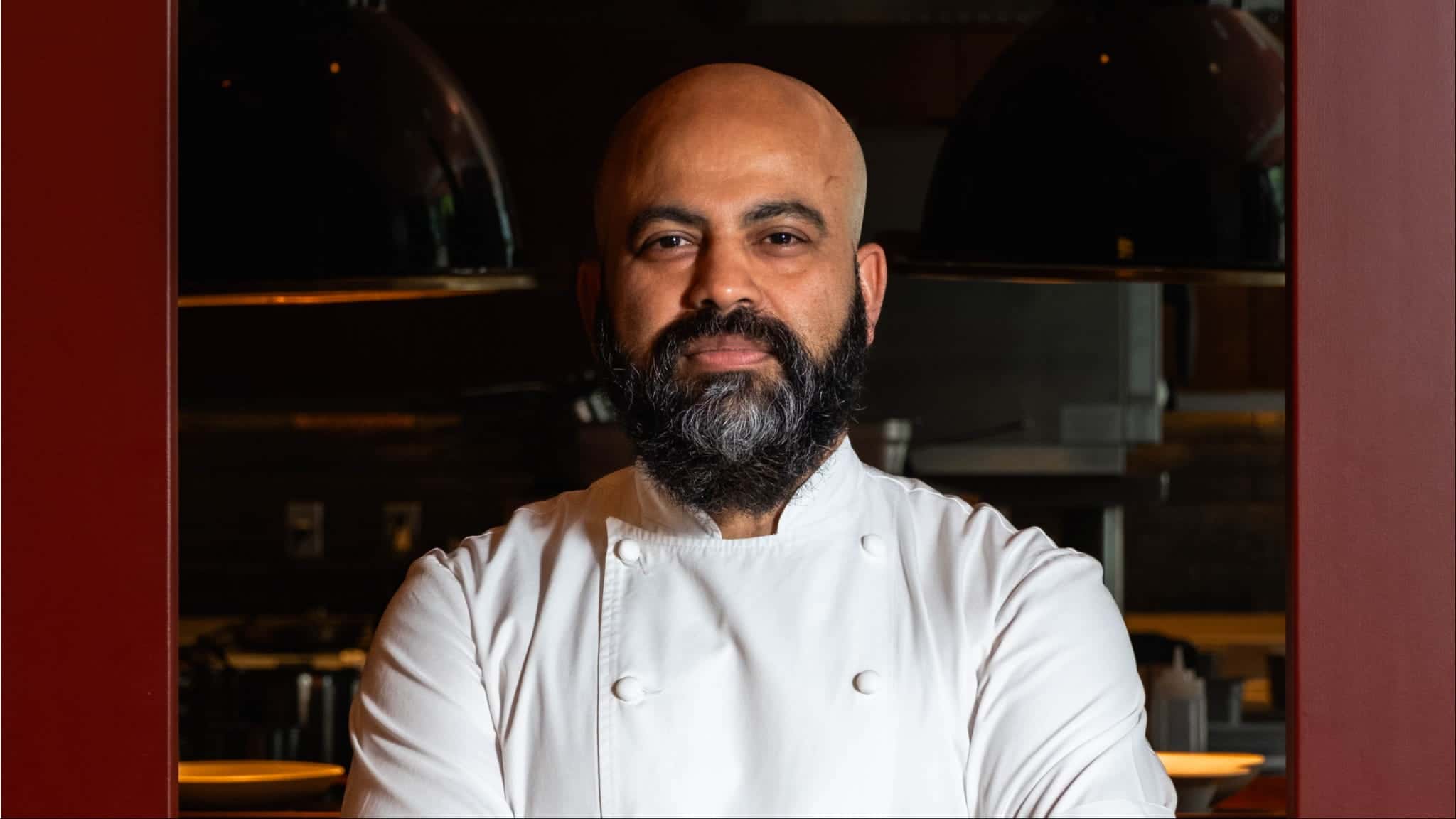
Sujan Sarkar reimagines the British chophouse through an Indian lens
The Michelin-starred chef brings Indian flavors to British chophouse classics at his New York restaurant, Elder
Chef Sujan Sarkar
Indienne

Words by Daniel Anderson
For chef Sujan Sarkar, Elder is a convergence. The new New York restaurant, which opened in August, brings together the two culinary worlds that have most shaped him: the Indian cooking he grew up with and the British food culture he immersed himself in during more than a decade spent cooking in London. Now, after establishing a growing restaurant portfolio across San Francisco, Chicago and New York, Sarkar is turning his attention to one of Britain’s most enduring dining institutions: the chophouse.
The chophouse has roots stretching back hundreds of years in London, eventually becoming an essential part of American dining culture and, particularly, New York's. The city has long been home to steakhouse institutions like Peter Luger, Keens and Delmonico's, while a newer generation of restaurants, including the Korean steakhouse Cote, has begun reimagining what the format can be. Elder enters that lineage as a British Indian chophouse—with the emphasis deliberately on British. Sarkar takes the classic format as his starting point, filtering it through his own culinary vocabulary. Prime cuts, seafood and seasonal produce share the menu with Indian spice blends, chutneys, tandoor techniques and sauces, while familiar British dishes are given unexpected new context. A Dover sole arrives with curry beurre blanc; a Wellington incorporates celeriac and kebab flavors; and premium chops and steaks are paired with sauces inspired by Indian preparations.
Even the restaurant's name points toward that intersection. Elder refers to the elderflower, a botanical with culinary traditions in both Britain and India, making the name a fitting shorthand for the restaurant's larger idea: two cultures with a complicated shared history finding common ground at the table. That same conversation extends into the dining room, where British club-like details—hunter green, walnut, brass and marble—meet references to Indian textiles and warmer, residential touches.
Sarkar's career has long been shaped by that kind of cultural cross-pollination. Before establishing his restaurant portfolio in the United States, he spent 11 years cooking in London, where he developed the technical foundation that would eventually inform his approach to progressive Indian cuisine. Today, he and his team at Indienne in Chicago earned a coveted Michelin star and expanded the concept to New York earlier this year.
Sarkar spoke with JoySauce about the opening of Elder and why this was the next concept for him to explore.
This interview has been edited for clarity and length.

The interior of Elder.
Neil John Burger Photography
Daniel Anderson: There are so many classic New York institutions and steakhouses, and then here comes Elder with this kind of reimagining of that tradition. I think it says something really interesting about the progress that's being made in food and where we're headed. A lot of your restaurants combine your training with Indian flavors, interpreting them through your own lens. So with Elder, how did you approach taking what you already do and applying it to this chophouse concept?
Sujan Sarkar: It’s not that I’m doing something I haven’t done before. The first 13 years of my career, I cooked modern European and French food. I spent 11 years in London, running a top restaurant in Mayfair and working in pubs and modern British restaurants. Then I went back to India and spent three years learning about Indian food and the different regions of Indian cooking, before developing my own way of cooking it. So the foundation has always been there. I do Indian food, but the techniques and the way we do things are very ingredient and technique based. I also like steak—I eat it at least once a week—so opening a chophouse isn't something I woke up one morning and decided to do. I worked with a top chef in the country to learn about wood-fire cooking, built my own style of wood-fire grill, and opened a wood-fire Indian restaurant, Rooh in Palo Alto (in California) just before COVID.
This concept of Elder started when I was living in Chicago, but when I moved to New York, I realized we had a beautiful kitchen, a beautiful room, and we were in one of the best food cities in the world. Today I'm much more established and have a better understanding of the American dining scene, so I thought, why not? It's still a big risk, but it's not a fluke or about simply doing something new. I understand how Indian influence can be added to British cooking because of my time in London, America, and India. I don't want to open another Indian restaurant. We're doing a different style of it, and I think this has to happen.
DA: Can you talk about how you approached creating the menu and reimaging British dishes through your unique lens?
SS: When I talk about Elder, I say it's a British Indian chophouse, not an Indian British chophouse. Why British forward? Because the modern British restaurant is also my inspiration. I can add the spice influence to it, and that's not really that hard for me anymore because now I know a fair bit of Indian cooking as well. I've spent the last two years trying to understand more closely what modern British restaurants are doing and how we can add some spice influence from India. You have a history there, too—so many dishes originated in India and became part of British dining. That's what we're taking inspiration from, and we're adding a little bit of our own ideas and thoughts.
A simple example is the Dover sole. You can find it in any steakhouse or chophouse in London, but we're keeping it very simple and adding a curry influence. With the turbot, we're roasting it and serving it with mulligatawny and clam. We're doing a mushroom dish with a little bit of pepper fry masala, with potato mousse instead of hollandaise and a poached egg. We're doing a Wellington with celeriac, layering celeriac with a kebab mixture made with celeriac, then keeping the rest of it the same with mushroom duxelles, Swiss chard, crepes and pastry. You get a note of the spice, but it's not overwhelming. We're doing a samosa that doesn't look like a samosa, using the same pastry with English peas and fava inside. It's all these small things and how we can bring them together. We're also using British produce as much as we can. Lamb is coming from Wales, and the pork is Berkshire. Later on, my idea is to bring British chefs here and showcase this cross-cultural cooking.
It's going to take time. Don't think we've done it—it's just the start. Some things work and some things don't, but we're working every day to make things better and more approachable. What you're going to come and eat is a number of things we've brought together to create that cross-cultural dining experience.

Tandoori chicken roulade.
Neil John Burger Photography
DA: I also really appreciate how vegetable forward the menu is. I think most restaurants should do better about their vegetarian options, especially entrees. You seem to have put a lot of thought in the vegetarian selection of a very meat centric concept.
SS: When we talk about a chophouse, I want to have a lot of selection. A lot of people from South Asia may eat chicken and lamb but never touch beef or pork. Some people eat pork but don't eat beef. So on my menu, you will find chicken, lamb, pork, different cuts of beef, seafood and fish. We have so many dishes, and over 30 percent of the menu is vegetarian. We even have five distinctive potato dishes, seasonal vegetables, and different sauces. I think vegetables are going to always be part of my menu. At Indienne, we have a vegan tasting menu and a vegetarian tasting menu. I get a little vocal about it because I eat out a lot, and in my family also, people are vegetarian. I go to top restaurants and they eat nothing, but they're paying the same money. Why should we not do more vegetables? So in a chophouse format, I'm very excited about it.
I love cooking vegetables. I think cooking meat and fish is not a big deal. You have the technique, but with vegetables, you have to treat them well and add flavor when it's needed. For example, we're making paneer in-house with buffalo milk. Even people coming from India say it's the best paneer. But it's not cooked in a curry—it's just a real piece of paneer with some Swiss chard and salt. It's something anyone can eat. These are the inspirations and the modern eating I'm noticing in Britain and bringing into America. I think we're not too far apart. London and New York are very different, but they're still very open.
DA: And talk a bit about the design of the restaurant.
SS: I worked with the designer, MAPA Muelle, and when we changed the concept, we changed the design. No matter what people are saying about tablecloths, for me, this kind of concept needs a tablecloth. You need to feel that. It has nothing to do with high price or low price; it's just a statement. You feel good.
Then there's the brass, the lighting, the wood tones, and the hunter green, which is more of a British green. It's nothing too in your face, just bringing a little bit of design into it. We added these big photographs, which give it a little bit of a steakhouse feel, and then there's the beautiful horseshoe-shaped bar with the green marble at the front. All the tables and the bar have this beautiful molded green marble, along with the wood. I think it's very simple. You get a feel of it.

Rib chop steak with potatoes.
Neil John Burger Photography
DA: You mentioned during our conversation that you’re always evolving as a chef and that there’s still so much to learn. How does that sense of discovery—and the desire to keep challenging yourself—shape the way you approach a new restaurant like Elder?
SS: Yes, I'm always trying to put myself in situations where I can learn—whether that’s working with chefs from different backgrounds, collaborating, staging, or just being exposed to new ingredients and techniques. I’m interested not only in how other chefs cook, but how they think and work and what I can take from those experiences to move my own cooking and businesses forward. That was a big part of developing Elder. I went back to India and back to London and really dug into the connections between the two cultures and their food. The connection between India and Britain feels very natural. I wasn't trying to force two cuisines together. There’s a shared history and so much exchange between the two, so I wanted to explore that through my own perspective and experiences as a chef. Travel also plays a huge role for me. I’m always paying attention to what’s new, what people are excited about, and meeting people who can introduce me to a different way of thinking.

Strawberry Eton mess.
Neil John Burger Photography
DA: Ultimately, what do you hope people take away from Elder—not just about the restaurant itself, but about you as a chef and the way your cooking and culinary point of view continue to evolve?
SS: I want Elder to show another side of my cooking and my background. I’m an Indian chef but my training in the UK was rooted in modern European and French cooking, and that has always been part of who I am. At Elder, we’re bringing those experiences together to create something modern, ingredient forward and cross cultural, with the flavors and spices of India introduced in a thoughtful, measured way. I hope people can come to Elder and discover flavors they may not normally encounter in their everyday dining, while still recognizing the quality of the ingredients and the technique behind the cooking. At the end of the day, whatever cuisine you’re cooking, good food comes down to knowing how to cook—having strong technique, understanding your ingredients, and knowing how to execute them properly. Elder gives me an opportunity to show that range and another part of how my cooking continues to evolve.
Published on October 20, 2026
Words by Daniel Anderson
Daniel Anderson is a disabled Chinese American adoptee based in Seattle. His freelance writing specialties include K-pop, entertainment, and food. He believes that any restaurant can be a buffet, and the key to success is to take a nap each day. Follow his adventures on Instagram @danzstan.