
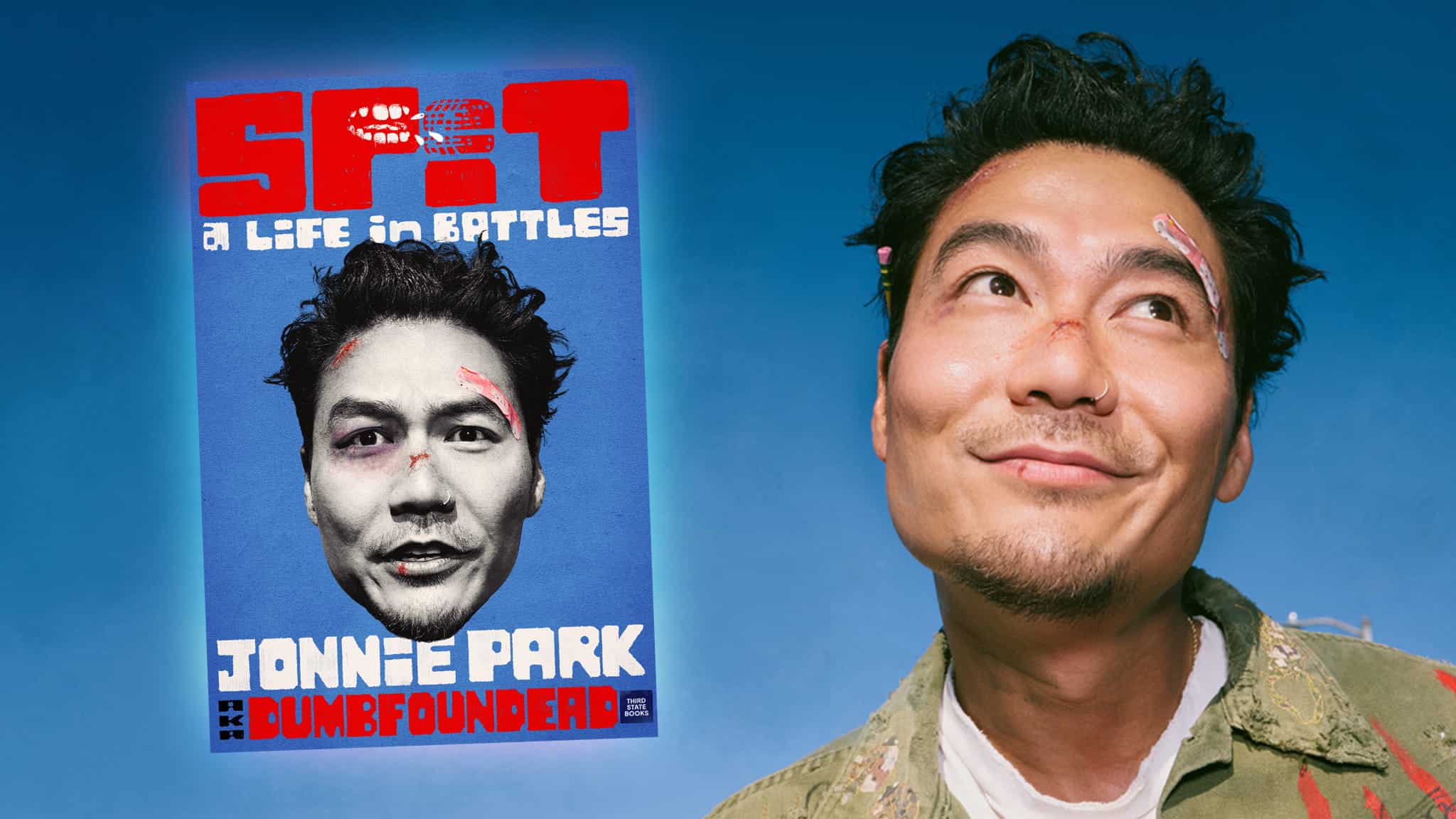
Jonnie Park’s obsession with hip-hop cemented his place in Asian American history
His memoir “SPIT: A Life in Battles” chronicles his life from growing up in LA's Koreatown, to battling in underground rap cyphers as Dumbfoundead
Jonnie Park, also known as Dumbfoundead, and his memoir, “SPIT: A Life in Battles.”
Photo by Lenne Chai
Words by Samantha Pak
There are many types of nerds out there. Star Wars nerds. Star Trek nerds. Sports nerds. Comic book nerds. Even regular book nerds—like me. But one area people probably wouldn’t associate with nerdom is rapping.
But trust me. Despite their reputation of being cool, rappers are their own flavor of nerdy. Emcees put as much practice, rehearsal, and research into their work as any other artist, performer, or academic.
When I tell Jonnie Park this, I’m happy to find he agrees. And relieved, seeing as how he’s also known as the rapper Dumbfoundead. He may have been part of a very cool subculture, but this was also a guy who grew up looking up at billboards and signs and stitching rhymes to go with whatever words he saw. And when he’d talk to people—whether they were girls he was dating or friends who were not part of the world—that was how they would frame it: “You’re actually a nerd.”
“When they mentioned that, it's just so funny because it's so true. It really is, you know?” Park says. “But it's just an obsession. I'm glad to have nerded over something. I think a lot of kids, when they don't nerd over something, they start falling into the wrong things and wasting a lot of time. It's nice to have an obsession, and I did at a young age.”
Park details his obsession with rap in his memoir SPIT: A Life in Battles. In the book, which was published Tuesday, the 40-year-old Korean American chronicles his life starting in Argentina, being smuggled across the U.S.-Mexico border at the age of 3, and settling in Los Angeles’ Koreatown. He eventually found his way into the underground battle rap scene, where he honed his freestyling skills and became one of the few successful Asian American battle rappers.
I recently spoke with Park about the influence Koreatown had on his battle rap career, touring colleges, the Korean hip-hop scene, a quintessential Asian American vehicle, and more.

Jonnie Park's memoir "SPIT: A Life in Battles" was released Tuesday.
Lenne Chai
This interview has been edited for clarity and length.
Samantha Pak: What made you want to write a memoir?
Jonnie Park: The memoir focuses on only up to my mid to late 20s, which I think was the most special time for me, as I discovered hip-hop and I was really in the culture. And it was the most pivotal moment for me.
I just feel like I'm into the subcultures and things that really built what things are now, as far as Asian and Asian American culture. I wanted to preserve a lot of that history, because I feel like we haven't heard much about that: the YouTube era, the college circuit, and how Asian entertainers actually made a living at that time, when there wasn't much support besides from our own community. That was important to me. Preserving some of my family legacy was important to me, and also sharing hip-hop history, battle rap history, LA history, and Asian American history.
SP: LA history and hip-hop history, they're pretty intertwined. Do you think if you had grown up somewhere else, you would have gotten into hip-hop and rap to the extent that you did?
JP: I think I would have gotten into hip-hop, but I wouldn't be the unapologetically Asian persona that I am as Dumbfoundead—and that's because I grew up in Koreatown, LA, where the signs are in Korean and people wear their culture on their sleeve. I wasn't a fish out of water, and I had the strong support of my community. Which instilled a lot of confidence in me in the arena of battle rap—which thick skin is needed. Because you're going to get attacked. People are going to hit you with Asian jokes. And everyone gets hit with something, no matter who you are. It could be a Latino guy, a Black dude, a fat guy, skinny dude, whatever. And if I don't have a true sense of identity with myself, I will get destroyed in that arena. So yeah, the circumstance played a huge part in who I am as an artist.

Jonnie Park grew up in LA's Koreatown and that shaped who he became as a rapper.
Lenne Chai
SP: What was it specifically about hip-hop that caught your interest when you first discovered it? What made you think, “I really want to get involved in the culture?”
JP: I think the audacity of the things they were saying caught my attention, and obviously the people's reactions to it. There was a natural reaction of oohs and ahs, when we would hear impressive rhyming songs, videos of these people performing on stage and seeing how the crowd was reacting. The same reaction that other elements of hip-hop get too—like a breakdancer doing a windmill, a DJ working a crowd.
SP: Hip-hop is obviously part of Black culture. What was it like for you as an Asian American to come up, get involved, and be part of that culture as an outsider?
JP: Honestly, I never looked at it as a crutch. I found it to be an advantage. When I was going to an open mic and there were like 200 young Black kids, I was the only Asian kid and I stood out like a sore thumb. In hip-hop, that's the whole point. I just knew that at least when I started rapping, people are going to be curious about what this Asian kid has to say. Is he going to be tight or just whack? I always loved having that advantage.
SP: What was the transition going from battles to a recording artist? Because those are very different parts of rap and emceeing.
JP: I feel very grateful in that sense, because a lot of battle rappers are pigeonholed. And the stereotype of a battle rapper is that they can't really make music, or they can't transition into a full rap career. And I was lucky enough to do both. I had a mentor at the peak of my battle rap career. His name was Brian Lee, a few years older than me, and he just really put into perspective that battle rap is really entertaining, but music is forever, and people are really impacted by music. Not that my battles weren't impactful. I have a lot of Asian kids still quoting my battle raps, but songs just really have a different type of reach. And so he really convinced me to start recording music. And I'm glad I did, because you can't really tour battle rap.
SP: Moving on to touring the kimchi circuit, as you call it. What was it like to go around and perform at schools and at colleges and meet all of these Asian, Asian American kids who knew about you, outside of the LA area?
JP: It was great. It was my insight into a lot of Asian kids from all around the country who were kind of yearning for a sense of identity and belonging in their own culture. I think a lot of Asian kids find or get closer to their roots in college. And I saw that immediately, when I started playing so many shows regularly. I'm very grateful because I think a lot of Asian entertainers in music, specifically, would have had a very hard time making money if it wasn't for those organizations back in the day—early 2000s, maybe 2005, to the early 2010s.
SP: Can you talk about when you went to Korea for the first time and the hip-hop scene there?
JP: It's changed a lot, obviously, and I talk about that evolution in the book. But when I first went, it was crazy. I was kind of a celebrity because there were only a handful of rappers actually doing it over there at the time—Drunken Tiger or Epik High or Dynamic Duo. People had seen me in the states battling, and I think that's probably what made me stand out. The fact that I was in these huge cyphers with hundreds of Black, Latino, white kids—and I happen to be Korean—I think that was very impressive to them.

The end pages of "SPIT: A Life in Battles."
Courtesy of Jonnie Park
SP: You get into some pretty deep things with your family and coming to the U.S., and then your home life. What were some of the challenges of writing that?
JP: Really getting all the details of family stuff right, because I have a language barrier with my mom and dad. I actually hired a friend to translate for me in the conversations with my mom. And obviously she's getting into heavy details about infidelity and domestic abuse in the household, to her journey across the Mexican border. So I learned a lot of new things that I would have never known unless I had that translator.
I already knew these are things I wanted to share, and they're not easy to share, but I did know I had to. I'm glad I got it right by really asking my mom and sitting down with her.
SP: On the flip side, what were some of your favorite things about this whole process?
JP: My favorite things were to honor these places that I found to be very special, like Project Blowed, the open mic I frequented. To honor some of these rappers that you wouldn't have heard about anywhere else except maybe my memoir—people who are truly some of my GOATs. It felt great that I could do that. I took my book around last week to some of these friends and OGs, and had them read their section. They felt it, and it was really nice to see that from them.
And also to honor Asian American history, which I don't think we talk about as much. We talk about Asian history. And obviously Asian American history is still getting written in the last 20 years and stuff. But I'm glad I can contribute.
SP: Yeah, because hip-hop definitely has its place in our community's history, for better or for worse when you talk about appropriation, but it's definitely a part of it. A lot of us grew up with it. I did think it was funny when you talked about the battle with that other Asian American rapper (Tantrum), and you mentioned the Acura Integra. I was like, “That is such a very specific Asian American reference.”
JP: That's why that battle was kind of important in a way. Obviously, we're just cracking jokes, but the fact that we talked about very nuanced Asian AZN culture—
SP: Oh, the AZN pride! [Laughs]
JP: Yeah, that was the first time that anyone had seen that. That's why it wasn't just a regular Asian rapper battle. It was two Asians who really dug into all these references in our community. So I did talk about why that was important. And it's funny because you're like, “Oh, this is an important battle,” while we're saying silly jokes. But those things matter to me.
Published on April 21, 2026
Words by Samantha Pak
Samantha Pak (she/her) is an award-winning Cambodian American journalist from the Seattle area and editor in chief for JoySauce. She spends more time than she’ll admit shopping for books than actually reading them, and has made it her mission to show others how amazing Southeast Asian people are. Follow her on Twitter at @iam_sammi and on Instagram at @sammi.pak.