
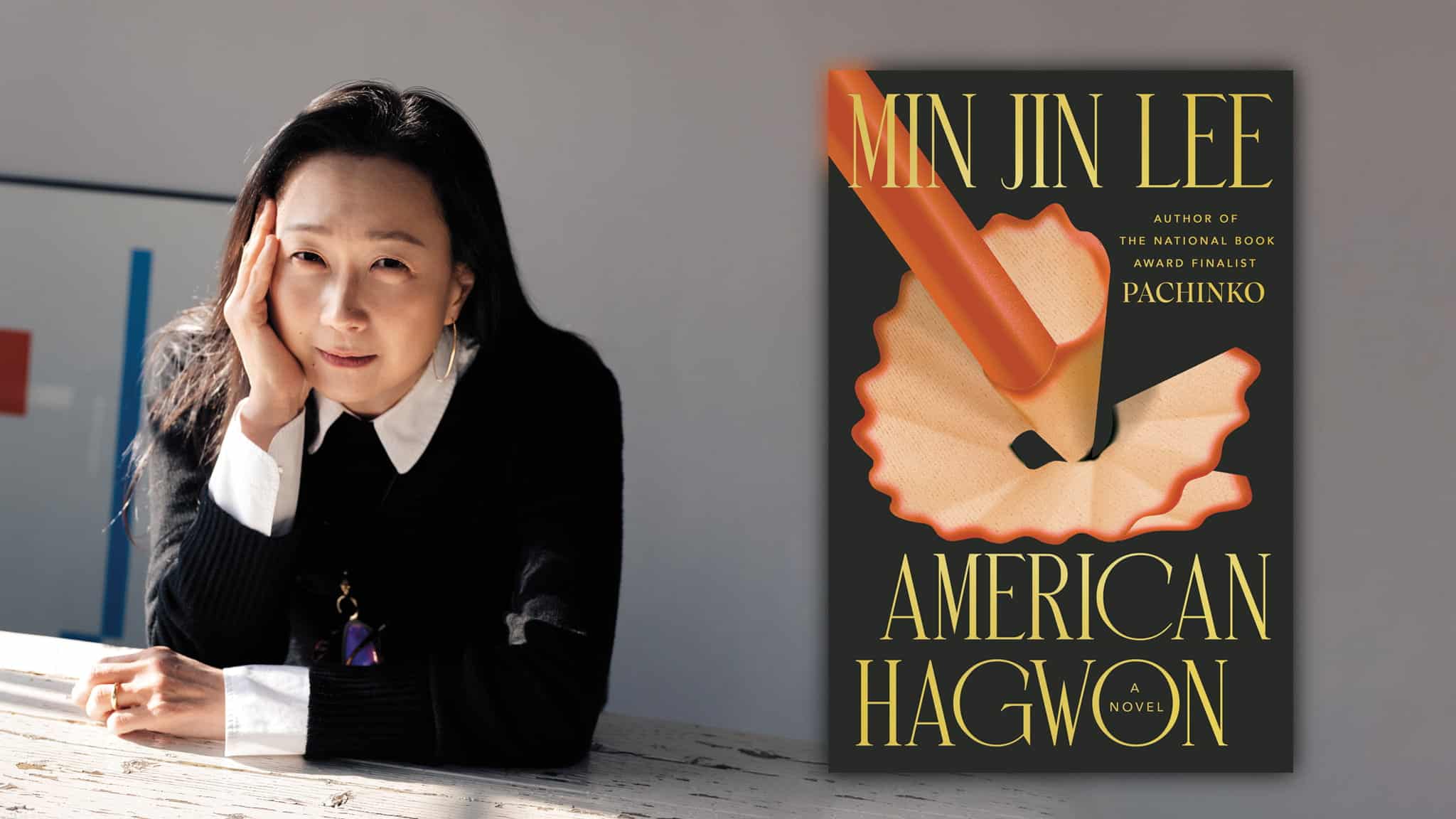
Min Jin Lee doesn’t think you should follow her career trajectory
Despite the success of "Pachinko," it took the author 12 years to get published, and now she's back with her third novel, "American Hagwon"
Min Jin Lee's latest book, "American Hagwon" comes out on Tuesday.
Author headshot by Hae Ran of Channel Yes

Words by Serena Puang
Min Jin Lee doesn’t believe anyone exists in a vacuum. They’re daughters, mothers, sisters, and friends.
“I’m always writing not just about one person,” she says. “I write about generations.”
And she does so in the third-person omniscient point of view, a style that is both difficult to execute, and advised against in fiction writing workshops. But Lee pulls it off. Her books, Free Food for Millionaires (2007) and Pachinko (2017) have brought her international acclaim. In addition, Pachinko was ranked 15th on the New York Times’ 2024 list of best books of the 21st Century.
On Tuesday, Lee is publishing her third novel, American Hagwon. On the surface, one might say it’s about a South Korean family with three children who find themselves between Australia, South Korea, and the United States, each finding their own path through the education system and societal expectations. But just as her books aren’t only about one individual, they’re not just about one story either. American Hagwon is a meditation on the burden to be exceptional, what it means to stray from the path you've laid out for yourself (or even the one that society chose for you) and doing things for the love of the game.
Ahead of the Tuesday release, I spoke to Lee about her writing process, following up her critically acclaimed second book and why she thinks people shouldn’t follow her career trajectory.
This interview has been edited for clarity and length.
Serena Puang: What gave you the idea for American Hagwon?
Min Jin Lee: In researching my other two books (and my other books that didn't work), I interviewed so many Koreans. In every single interview, they talked about the path of education. Everybody had really different and very intense emotions. I thought if I had to think about all the things that Koreans care about around the world—not just Koreans from Korea—it's this romantic attachment to education as a solution and a gateway for status mobility. Once I started really thinking about who I wanted to write about, the organizing metaphor became the hagwon.
SP: I’ve noticed that a lot of Asian American writers write a big novel about Asia first and then an Asian American novel later on. Did you intend to do your Asian American novel first and then an Asia novel and then come back to Asian Americans? Or is this just me reading too much into it?
MJL: Oh, that sounds interesting. When I was coming out in 2007, there weren't that many Asian American writers who were mainstream. So, in terms of pattern, no, I'm not clever like that. I'm not thinking about how to strategically create a career. I don't know how to do that.
I’m only going to say this because I've been asked by a lot of young writers who are starting out like, “How do you do this?”
I don't know if you want to do it the way I do it. Because most of it is poverty and exclusion. If you really look at my career, I didn't publish the first 12 years. I didn't experience any kind of mainstream success until the past seven or eight years. I couldn't get a teaching job because I was told I was too old. If you were a young Asian American, and you wanted to write novels, I don't know if you'd want to follow my career trajectory. You might want to find somebody who's young or who's more successful.
SP: Is the success weird for you? I can imagine it can feel intimidating to follow up Pachinko. How are you feeling?
MJL: I find it easier not to think about the reception but rather to spend my intellectual and emotional energy on creating the best possible book. Readers are very smart. Really good readers have read lots of books, and you're gonna get compared to the great books that have lasted 100-200 years. You can't lie to readers. If you're gonna send the book out, you're gonna have to send out something that's really gonna stand up to the intelligence of the reader. Respecting readers is what I really care about.
Being a novelist, first and foremost is to really respect the individual nature of human beings. The career stuff—ugh. There's so much bad advice and also incorrect advice and also the wish to reverse engineer. Art really doesn't work that way.
SP: How do you work on your books for a decade? I feel like I’m a different person now than I was three years ago. How do you keep your work so consistent and not hate the stuff you wrote towards the beginning of working on a book?
MJL: First of all, by the time you see the book, it has been through my hands in 16 or 17 drafts. A person might read the book in four or five days, so they're not gonna change from Monday to Friday very much. You must have the cleanness in style, that's the minimum readers expect. The reader and I are creating something together.
A book does not do anything unless the reader opens it and stays with it.
The question behind that question is, how do you stay with a project for as long as I do? And it's because the questions that I'm asking are really hard questions. I don't have the answer right away. The only way I can get that answer is if I stay with it.
SP: What do you feel like were the questions you were trying to answer with this book?
MJL: Oh, funny that you should ask, I have it right here. [Holds up a full sheet of A5 paper in a plastic sleeve.]
SP: Oh my gosh, it’s a whole page!
MJL: Every book, I have a list of questions, and I put them in this little plastic thing. What's the purpose of education?
How do you live a wise life? How does an immigrant survive in a new land? What is an immigrant's goal? Why does a person choose to immigrate? How does a person reclaim her status? What does it mean to lose one status? What does assimilation do to a person? What is an idol? Who needs idols? How does one not idolize? How does one person possess another?
These are hard questions. These are metaphysical questions. And you know what? You're actually asking them every day, anyway. Most people are trying to avoid them, but avoiding those questions causes so much suffering, and it always catches up with you.
Like, what should I do with my life? That's a metaphysical question, right? This is the reason why the 20s are really hard, and nobody gives anybody credit for suffering their 20s.
It's not war, it's not poverty. But self actualization is so hard that almost nobody reaches it. And that's the reason why I have that chapter on Maslow in American Hagwon, because the hierarchy of needs is the reason why you have generational conflict. Parents who grew up only thinking of survival do not understand that the young person is thinking, “Well, I don't have to worry about food and shelter, but I do have to worry about who I want to be.”
SP: Something I thought was really interesting about visiting Korea is that they actually shelve your books with Korean authors, not American. That’s rare!
MJL: I've been accepted in both ways, and I'm very grateful. But I also think it's because I really have listened to them. I work in some ways like a journalist but I don't have deadlines. I really listened to my subjects in Korea, and I really hate the mass categorization of any group. I argue against stereotyping. I have to, only because I’ve listened to so many people and (the generalization is) not true. I can give you three examples of why that’s not true.
SP: How many people did you interview for American Hagwon?
MJL: Hundreds. I went to Hagwons in Taiwan and Singapore that are not even in the book. I went to Hagwons obviously, in Australia, California, Massachusetts, and Washington, D.C.
It’s the reason why I feel very confident when I say something in fiction. I write social novels, which are a commentary on society. I can't write about things with confidence and authority unless I actually know what I'm talking about.
SP: What are you working on now?
MJL: I’m writing a novel called Marshall Plan. It's my fourth of the quartet about the diaspora. It’s about the Korean miners and nurses who went to Germany to work, and they sent money back to South Korea. They were there in the '60s and early '70s. And I'm also writing about the Koreans who went to Europe to learn how to become artists (and) military spouses. It's going to be my last book that’s a novel.
SP: You're not gonna write another novel?
MJL: Mm, I doubt it. This is a big topic. I'm 57. I work really a lot. I work harder than when I was a lawyer, and also I really want the quality to only get better.
SP: What are you doing for the love of the game?
MJL: I read.
I read outside of my genre, and I read to really respect people's ideas. I think that one can get very jaded, and it's something that you have to fight with all your heart and soul.
Published on September 29, 2026
Words by Serena Puang
Serena Puang is a Taiwanese American cultural critic and journalist who has made Baton Rouge home. You can follow her on Instagram at @dear.yall, or check out her personal blog at www.dearyall.net.