
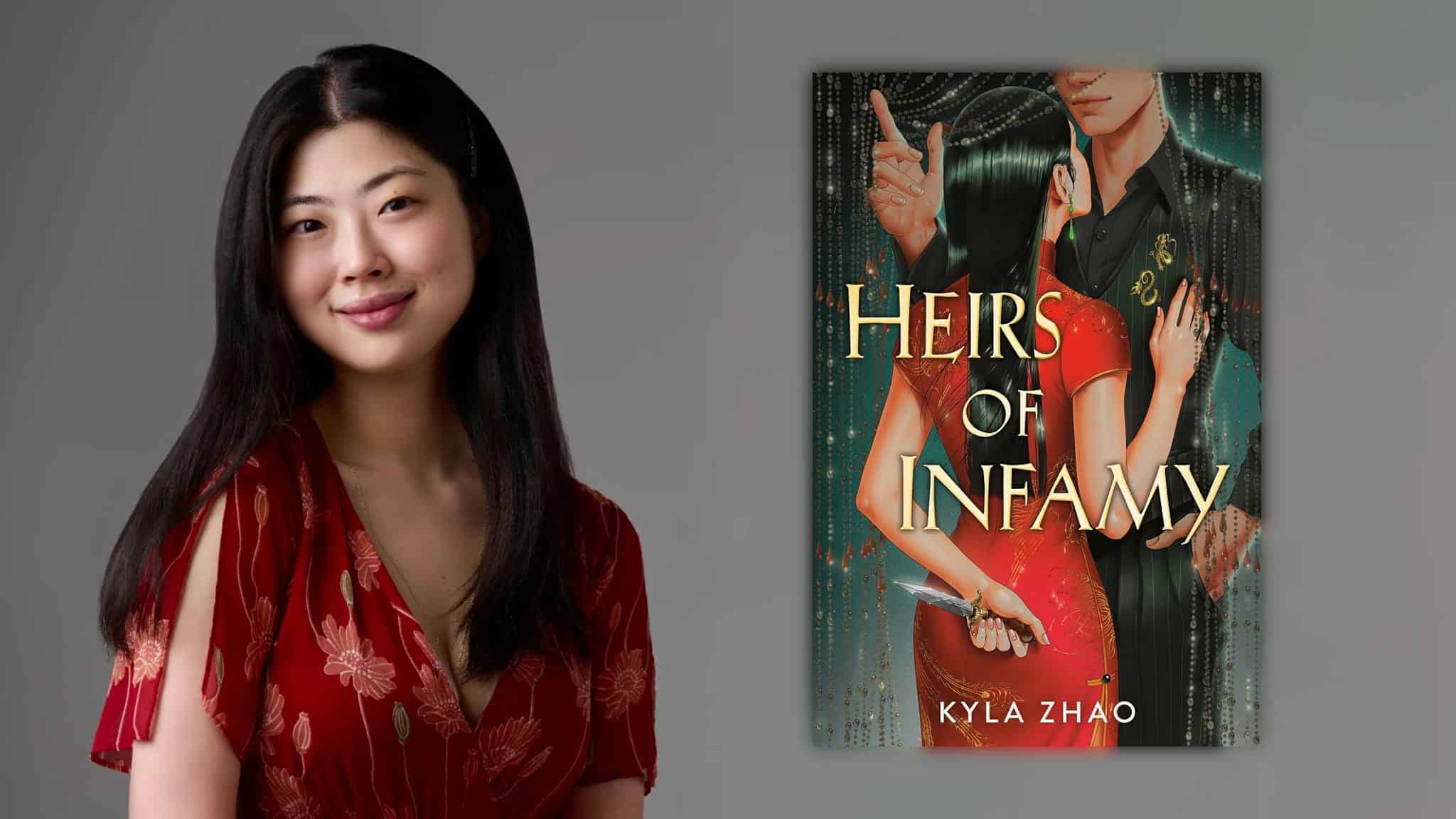
Kyla Zhao dives into organized crime and history in ‘Heirs of Infamy’
For her fourth novel, the Bay Area author tackles an enemies-to-lovers romance amidst the McCarthyism era
Kyla Zhao's fourth book, "Heirs of Infamy," released Oct. 13.
Courtesy of Kyla Zhao

Words by Samantha Pak
As a writer, Kyla Zhao will keep you guessing. She’s written about Singaporean high society, Silicon Valley, and chess. It can be hard to find a throughline.
So for her fourth and latest novel, Heirs of Infamy, a historical love story between the teenage daughter of a Chinese crime boss in San Francisco Chinatown and a boy from the rival gang—with a heist thrown in for good measure—is not that surprising because like her previous projects, it is so different from its predecessors. “I want to keep the process interesting for myself,” the 28-year-old Bay Area resident says. “And so I like challenging myself to experiment with new forms of writing or new types of stories.”
Taking place in 1949, Heirs of Infamy, which is Zhao’s first young adult novel, also shows a country during the rise of McCarthyism and the Red Scare, an anti-communist era in American history, and how it directly affected the Chinese American community at the time.
I recently caught up with Zhao ahead of the book’s Tuesday release. We spoke about how organized crime gangs could come from immigrants’ needs for community, the ways history repeats itself when it comes to discrimination against the Asian American community, the similarities between organized crime and K-pop (and my pitch to her for a crossover story for her next project), and more.
This interview has been edited for clarity and length.
Samantha Pak: This is your fourth book. You've done two adult books, one middle grade, and this is your first YA. What made you want to delve into the world of YA?
Kyla Zhao: I just think that the older I get, the more I think back to those teenage years with a lot of fondness. When I was going through those teenage years, all I saw were the bad parts: Life was so complicated. Why is everyone so hard to understand? But now that I've made it through to the other side, I'm able to look back on it and see both the good and the bad, and appreciate them more harmoniously.
I remember what it was like to be at that age, and feel such big emotions and like every emotion is the end all, be all. And there is something that is so raw and so beautiful about it that I haven't been able to capture it ever again as an adult. And so with that on my mind, it felt like the right moment for me to explore what it's like to be a young woman in her teenage years, coming of age, learning more about herself, learning more about her place in the world, and realizing that she doesn't have to accept the place that she has been put into by people older than her—that it is possible for her to forge her own path.
SP: What made you want to dive into historical fiction, and why specifically the 1940s?
KZ: A big love of my reading came from my dad, who would tell me about the great Chinese historical classics like Romance of the Three Kingdoms. I've always loved history stories, but I just never imagined I would want to write historical fiction because I thought that a lot of research has to be done, and it would feel too much like homework. And I didn't want writing to feel like a chore—
SP: [Laughs] That's fair.
KZ: It kind of happened in reverse. The whole idea for Heirs of Infamy came about back in 2023 on Memorial Day weekend when I was in Las Vegas. I saw this Reddit recommendation for The Mob Museum. When I walked into The Mob Museum, one of the first things that you see is this giant wall on which they hang like 40 different portraits of all the most famous mafia mobsters in American history. I think there was only one woman, and she was only famous for being the mistress of one of the men. And it got me thinking, “This is such a male-dominated patriarchal society. What would it be like to be a woman here and a young woman?”
I became very fascinated by what it's like to be growing up in a world of organized crime. How do you navigate all the social politics? How do you navigate the gender dynamics? So I naturally just started reading up a lot about it. So when my agent asked me, "Do you have a new book idea?” This just sprang into my mind.
Pretty early on, the late 1940s emerged as a really interesting time. It was just after World War II, and Chinese Americans have been quite celebrated in the aftermath because China and America were allies. But this was before the rise of communism in the early 1950s. So 1949, the year that my book takes place, is on the brink of when all the big anti-Asian racism would break out in the early 1950s.
SP: One thing I appreciate is it's a true enemies-to-lovers story. What was it like to write that dynamic?
KZ: Even though Alexis and Zachary have a shared history, she understands that it is her duty, especially as the daughter of a crime boss, to put her crime family above all else. And she knows this very, very well because this is the world and the life that she has been born into. It's all she has ever known. She didn't think it was even possible to break out of it, but then Zachary comes along, and slowly he shows her, because he wants to get out of this world. He begins to open her eyes to the possibility that hey, you don't have to be stuck in this lane. You can forge your own path.
SP: Here in the states, we hear a lot about white organized crime. Before you decided to write the book, were you able to find a lot of information on Asian organized crime here in the U.S. specifically?
KZ: I am lucky in that I can understand Mandarin Chinese. So I was able to read some sources in Mandarin Chinese. But actually back then during that time period, the main dialect was Cantonese, which I don't understand. But because my book is set in San Francisco Chinatown—and that's really close by to me—I was able to do a lot of primary research. I’d just go to the actual places named in my book, go talk to the people who are still living there, and who have been around for generations. And some of them were able to share really interesting stories. I think from the older generations, it sounds like everyone knows someone who was from a gang. That was really interesting primary research.
SP: The book takes place right before McCarthyism was starting to happen. And with McCarthyism and the Red Scare, it ended up being a lot of people reporting on people in their community. And unfortunately, it's come up again now with ICE. As you were doing your research, did you see those parallels?
KZ: I saw parallels in how the community has been discriminated against time and time again. And it's something I included in my novel. One of the characters says, “For a while, the white people loved us because we were on the same side, but then they turned against us.” And you see that repeated throughout history.
On the one hand, I don't condone organized crime by any means, but you kind of see how all these groups or gangs could start. They started because these are immigrants who came from a foreign country. They were looked down upon. They were discriminated against. They were treated as animals. And so they banded together out of pure survival instinct, out of desperation. And then from these very initial collections of people grew what became organized crime gangs. And it's just sad because people have been backed into that corner where they would rather resort to crime simply because they're not accepted by society. That was really sad—just to see the breakdown of society because of all of these racial and ethnic lines of division.
SP: As you were doing your research for this, what were one or two of the most interesting things that you learned as part of this whole process?
KZ: One thing that was really interesting to me was that all these gang members who came from rival gangs, they hated one another because they were all competing for a tiny slice of a shrinking pie. But then they would get locked up together. And then they would become really, really good friends in those places. Because at that point, all the Chinese criminals had to band together. So in a way, jail became a networking place for them.
I had to remind myself this is not a history textbook. I came across so many interesting facts, I was just dying to try to include as many of them as possible.
SP: What were some of the challenges that you came across in writing this book?
KZ: I had to remind myself this is not a history textbook. I came across so many interesting facts, I was just dying to try to include as many of them as possible. But I didn't want to bog down the story with all of the historical details, which might slow down the pace of the book. So I really had to prioritize what to include and what could be saved for a future book.
SP: Is there anything that you are looking forward to tackling in the future? Do you have anything in mind?
KZ: I had quite a lot of fun writing a slightly darker book compared to my first few books. So maybe I'll take it even further and write a thriller or something. Because in a way, this book has certain elements of a thriller with the heist, but I feel like I could push that even further in my next book.
SP: Are you still brainstorming, or is this something that you are actually working on?
KZ: I think I'm still in a brainstorming stage. I'm not even actively brainstorming. If an idea hits me, it will hit me. But in the meantime, I think I'm just doing what I always do, which is read up on things that fascinate me.
SP: Is there anything interesting that you've been looking into or reading up on lately?
KZ: I've become really interested in the world of K-pop because, in a way, it's also group psychology. It's kind of the same as organized crime. There are rituals to it. There's also a hierarchy. There are a lot of rules that are very opaque to people outside of the industry. Try to explain some of the nuances of K-pop to someone who is completely oblivious to it; it will sound so strange. These celebrities are not allowed to date. They are full-grown adults that are literally being treated like infants. How do you even begin to explain the concept of that? But it's also such a well-oiled machine. There's so many people who would kill to join, year after year. I think that's a very interesting dynamic.
SP: That'd be interesting. K-pop as a front for organized crime.
KZ: Yeah! You could totally see that!
SP: I'm just thinking of someone in organized crime, you want to join, but then you have to prove yourself. But in this case, you have to show that you can sing and dance.
KZ: Yeah, exactly. It's like the real Hannah Montana life. You get on stage and you're adored by millions of fans. And then you get off stage and you take off your wig, and suddenly you're this ice cold assassin.
Published on October 14, 2026
Words by Samantha Pak
Samantha Pak (she/her) is an award-winning Cambodian American journalist from the Seattle area and editor in chief for JoySauce. She spends more time than she’ll admit shopping for books than actually reading them, and has made it her mission to show others how amazing Southeast Asian people are. Follow her on Twitter at @iam_sammi and on Instagram at @sammi.pak.