
‘Mouse’ is a devastating coming-of-age drama steeped in grief
Despite its malformed approach to time, place, and race, the Berlin Film Festival premiere is a masterstroke of American indie filmmaking
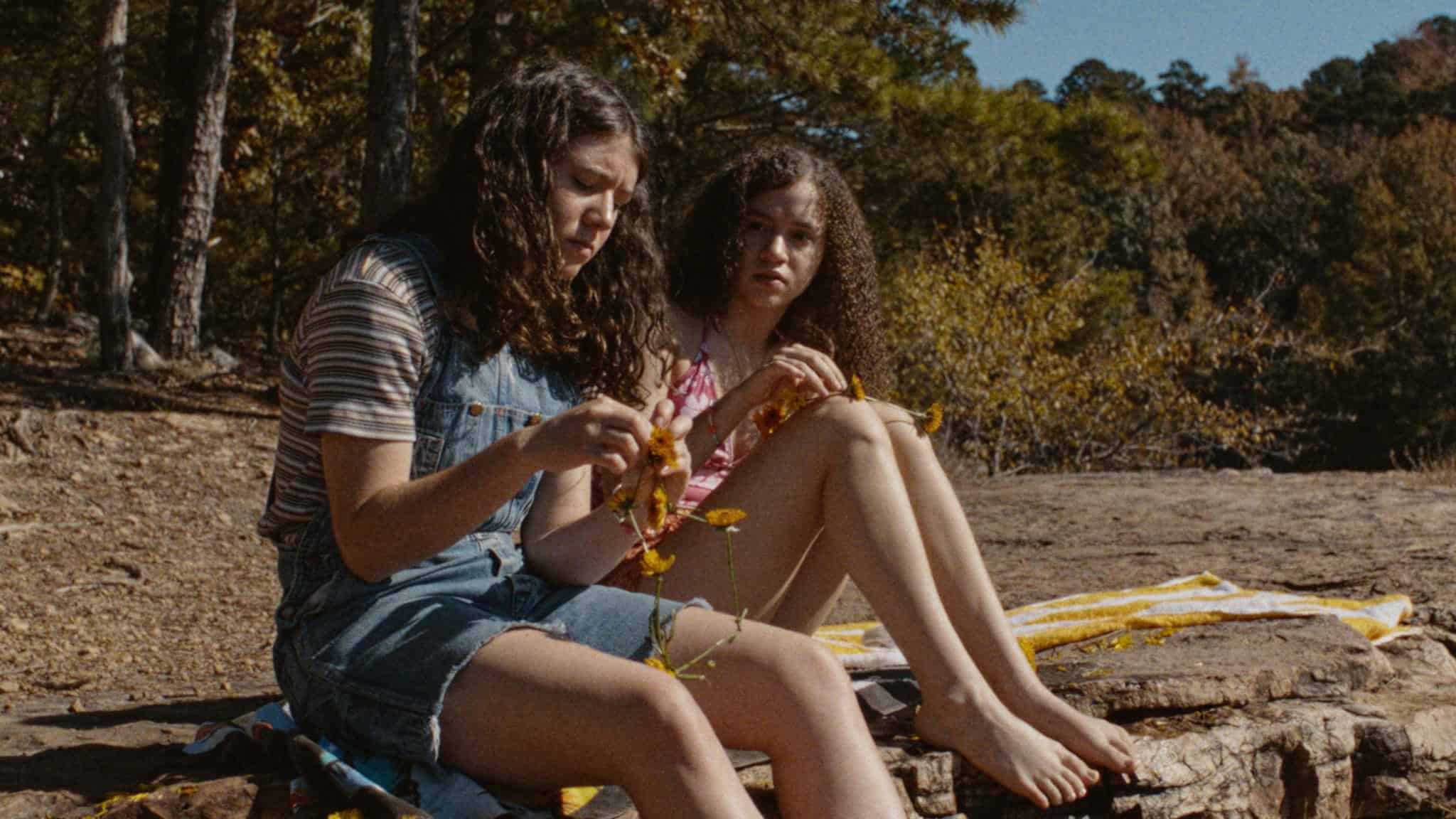
From left, Katherine Mallen Kupferer as Minnie Dunn and Chloe Coleman as Callie Bell in "Mouse."
Go Cats Go

Words by Siddhant Adlakha
There’s a photographic quality to Mouse—the unassuming coming-of-age indie by Kelly O’Sullivan and Alex Thompson—even though it was shot with digital cameras. Its warm, filmic texture imbues it with a sense of living memory, which is apt for its premise as a look back on teenage girlhood in the summer of 2002, at which it succeeds despite occasional blind spots as a capsule of time and place. A tale of friendship, parenthood, and devastating loss, it’s the kind of minor miracle for which the festival scene was made, and perhaps the most powerful film to come out of this year’s Berlinale.
On the night before their last day of junior year, high school besties Callie Bell (Chloe Coleman) and Minnie Dunn (Katherine Mallen Kupferer) stay up late in anticipation of having their respective houses pelted with toilet paper rolls by graduating seniors. Counter-intuitive though it may sound, it’s considered a sign of respect in North Little Rock, Arkansas, and makes for a pitch-perfect introduction to their perfect, mismatched friendship. That evening, Callie’s luxurious duplex is pranked by a whole group of enthusiastic 18 year olds, including her boyfriend Brad (Beck Nolan). Minnie’s ramshackle abode sees just the one visitor, though she’s pleased as punch; it’s way more than she expected.
The two are inseparable, and they even look alike in the low light of the movie’s introduction, even though Minnie is white, and Callie is of mixed Black parentage, and has much curlier hair. They have other friends too, like equally inseparable redheads Cara (Audrey Grace Marshall) and Brandi (Addisyn Cain), a more fearfully religious pair—like much of the town—who also seem jealous of the leads’ dynamic, and act out against them accordingly. As Callie and Minnie prepare for the long break before senior year, it feels like the two of them against the world, or rather, Callie in the limelight (she’s a stage actress with magnetic presence) and Minnie contently sitting in her shadow, supporting her from the wings. It’s not perfect, but it works. However, this paradigm is entirely upended mere hours into summer, when Callie meets a sudden demise in a car accident, leaving her family a wreck and Minnie adrift without her best friend.
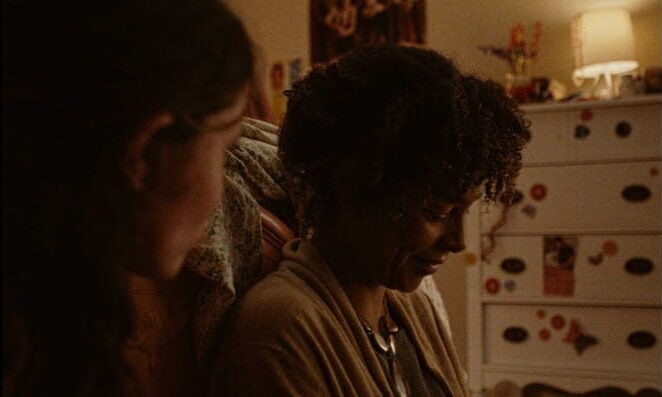
Sophie Okonedo as Helen in "Mouse."
Nate Hurtsellers and Luke Dyra
From there on out, what follows is a complicated jigsaw puzzle of familial dynamics, as Minnie falls out further with own mother Barbara (Tara Mallen)—a loudmouth veterinarian who takes in any animal she can, but has little time to tend to the house, or to her daughter—while befriending Callie’s mother, the British migrant Helen (Sophie Okonedo). The latter makes for a vital supporting centerpiece; Okonedo’s hollowed-out performance embodies the way grief can warp your posture and sense of being. On some level, she and Minnie try to fill the void with one another, hoping to augment the incomplete dynamics in their lives (for Helen, a daughter; for Minnie, some combination of mother and friend), but Callie’s senseless death is too recent, too raw. It certainly doesn’t help that the well-meaning townspeople, both kids and parents alike, pelt Helen with awkward platitudes before keeping their distance, as though her grief were radioactive. Death is one of those strange things that makes people walk on eggshells—but what happens when you are the eggshell, empty and fragile?
Where Helen feels too visible and exposed, Minnie is rendered invisible without her closest confidant. The difference between the two girls (other than Minnie being better at math) is highlighted by the way light envelops them. When we see Callie silhouetted by sunlight at dusk, it hits her like the spotlight of the stage, illuminating her like the bright star she believes she’s destined to be. Later, on one of Minnie’s many walks home near nighttime, the setting sun overwhelms her, hiding her from view. Maybe some part of her would rather be invisible. Either way, without Callie as her buffer, she may not have a choice.
Much of the plot concerns the buildup to an ill-considered senior talent showcase put on in Callie’s honor, for which neither the audience nor the teachers—like David Hyde Pierce’s kindly drama instructor Mr. Murdaugh—can pretend the kids are remotely prepared. However, a song sheet left behind by Callie prompts Helen to help Minnie prepare to sing on stage, a skill that isn’t remotely in her wheelhouse, setting the stage for mutual disappointment. Mouse is often a tough watch despite its simplicity, if only because Callie’s presence looms large despite her absence, in part because the feisty Coleman leaves such an indelible impact in her short screen time.
It’s also a queer coming-of-age story that sees Minnie exploring her interest in girls for the first time, which is also further complicated by Callie’s absence. The question of their closeness certainly introduces the possibility that Minnie may have been smitten with her straight best friend—a right of passage for most Millennial lesbians—but this only makes Callie’s absence more painful as the film goes on. When Minnie meets and befriends Kat (Iman Vellani)—a queer girl from another school, dealing with her own form of grief—she has no one to tell, and no way to process the absence of the life she and Callie could have lived together, as friends or otherwise.
But as much as Minnie has lost the person she may have been around Callie, Helen mourns Callie’s entire future, and her own motherhood as well. That she shows up to her regular parent-teacher meetings the following school year is an initially awkward occurrence, until you stop for a second to zoom out, and realize that while Callie was her own person, she was also fundamental to Helen’s entire identity. This is perhaps why Minnie is drawn to Helen, and the two try to help each other cope; they’ve lost the same person, and the same sense of grounding and self-reflection. They just don’t know who they are without her.
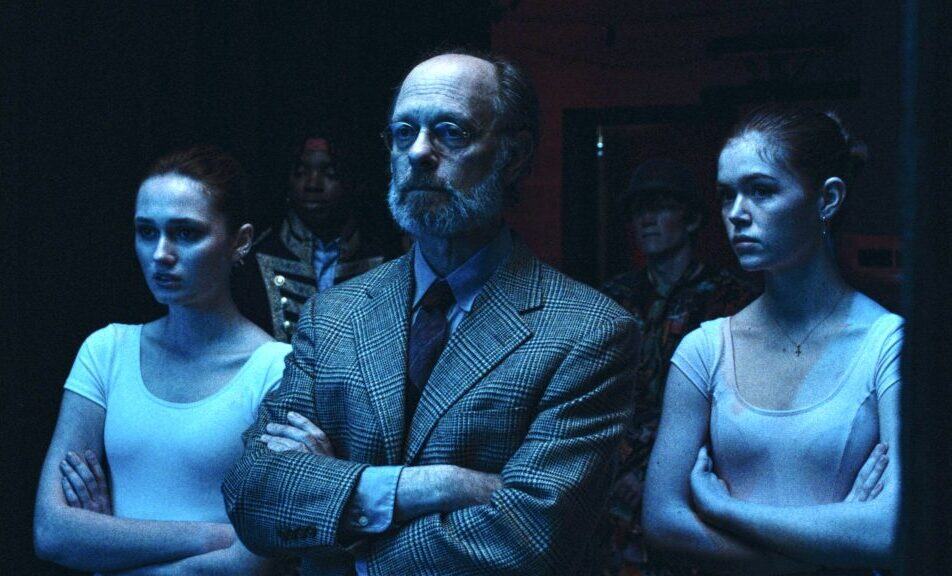
David Hyde Pierce as Mr. Murdaugh in "Mouse."
Nate Hurtsellers and Luke Dyra
The early 2000s setting is a blast from the past, with Good Will Hunting on VHS, Michelle Branch on the radio, and Nelly at the school dance. It’s born from O’Sullivan’s own experiences as a teenager in the neighboring town of Little Rock at the time, as well the loss of her own friend in a car accident in 2001. The film, therefore, bleeds emotional authenticity with every cut, though it does end up with a few awkward shortcomings when it comes to the presentation of its supporting cast. That characters like Helen and Kat were cast without their actors being limited by ethnicity is commendable, but their roles weren’t necessarily written with a racial or sexual mutability in mind, which works until it doesn’t.
No one in the film seems to even slightly bristle at the thought of any characters’ queerness, which is on one hand a relief, but also feels incongruous with the way the queer characters themselves might approach coming out. North Little Rock’s population is nearly half Black, so Helen doesn’t stand out racially, though her English accent does add to the sensation of her feeling like an outsider who now lacks all connection to the place Callie grew up. Kat, however, is played by a visibly South Asian actress, at a time in American history where being “brown” would have more than likely been a defining experience, less than a year after 9/11. We do not, however, see her interact with people other than Minnie enough for this to matter, even though it feels like it should.
Vellani, meanwhile, makes a meal out of her minor role, exhibiting—in just a handful of scenes—how pliable her Ms. Marvel charm can truly be. Kat is a delight, but her upbeat disposition is subtly restrained by the mourning hanging over her head, making her a perfect mirror to Minnie as she ploughs through the rankling unpredictability of grief. The film wouldn’t work nearly as well if Kupferer didn’t strike a delicate balance between hiding in plain sight and bursting out of her skin, as Minnie tries to trade one mother in for another (and in the process, climb the class ladder) while searching for herself in the total absence of the one person who gave her a sense of identity.
The film’s gentle look at duality is complimented by the filmmaking itself, between its writer-director partners, its two cinematographers (Nate Hurtsellers and Luke Dyra) running two concurrent cameras to capture spontaneity, and the dueling tones of a teenage comedy and a devastating domestic drama, which threatens to pull the young characters out of that former mode, and make them grow up too fast. Its loss is piercing and real, just as its eventual self-actualizations are incredibly difficult, forcing Minnie, Helen, and even Barbara to see better versions of themselves only once they’ve been confronted with the very worst of who they’ve been contorted into. However, Mouse is as emotionally affecting as it is enveloping and soothing, sitting comfortably alongside fellow Okonedo-starrer Janet Planet in its magnificently multifaceted look back at the life of young girls, and the vital connections that help them figure out who they are.
Published on February 27, 2026
Words by Siddhant Adlakha
Siddhant Adlakha is a critic and filmmaker from Mumbai, though he now lives in New York City. They're more similar than you'd think. Find him at @SiddhantAdlakha on Twitter