
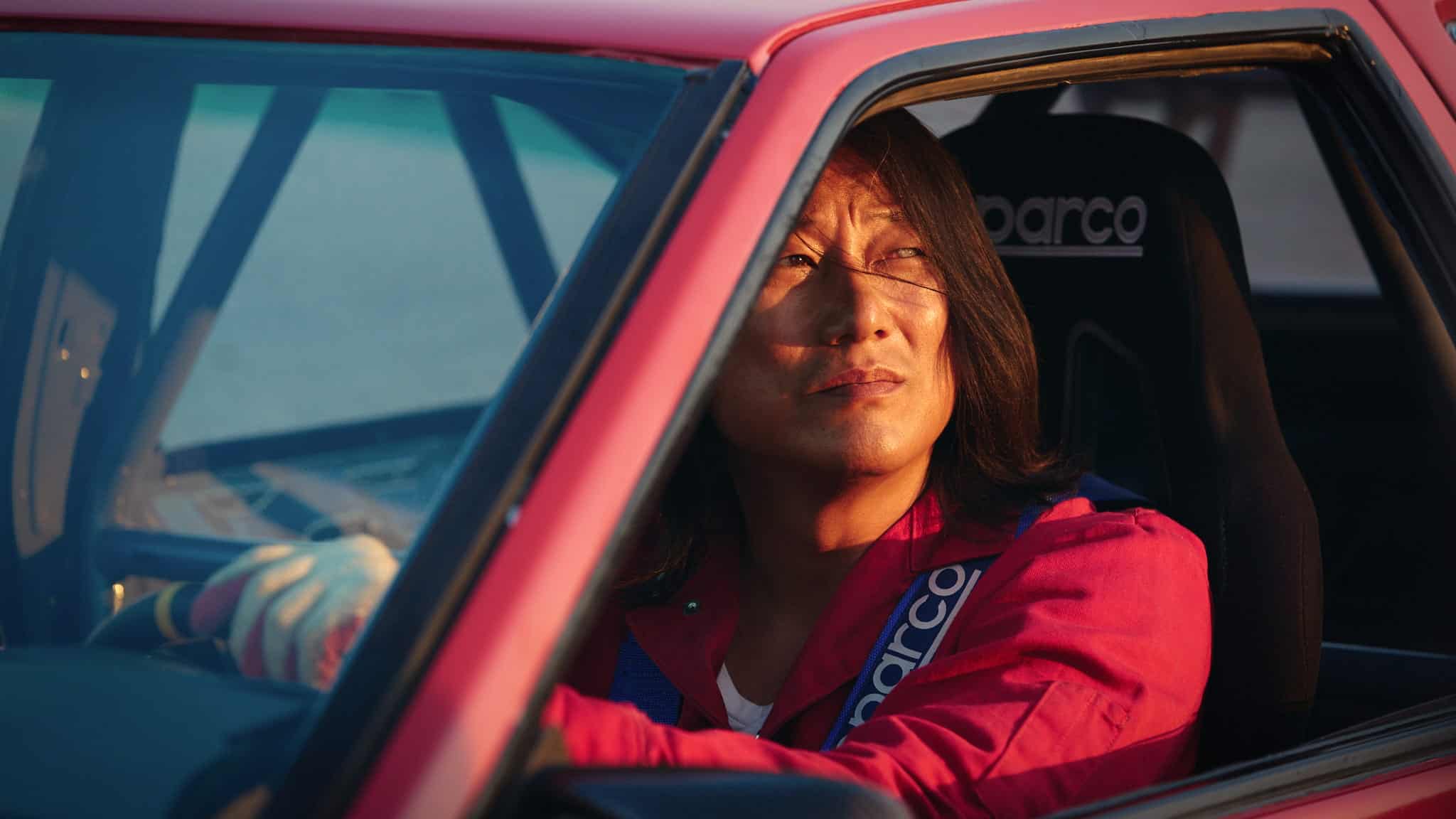
With ‘Drifter,’ Sung Kang wants you to know Sung
After more than three decades in Hollywood, the actor bares his soul in his directorial debut that premiered at TIFF
Sung Kang co-wrote, directed, and stars in "Drifter."
Courtesy of TIFF

Words by Nimarta Narang
Outside the final screening of Drifter at this year’s Toronto International Film Festival (TIFF), a large crowd waits to be let in. It’s 9 p.m., and the streets are just as lively as when the festival began 10 days prior. Then, Sung Kang drives past the crowd in a racecar with Drifter printed along its side. Fans scream his name. When he steps out in front of the theater, he looks around and pauses, as though taking it all in, before waving excitedly back.
Kang first appeared as the fan-favorite Han Lue in Justin Lin’s 2002 film, Better Luck Tomorrow, and as Han lived on in the Fast & Furious franchise, Kang became one of Hollywood's most recognizable Asian American actors. But recognition, as it turns out, isn't the same as being seen. For most of his career, Kang carried a private story about himself.
Drifter—which Kang directed, co-wrote, and stars in—is, in many ways, his rewriting of that story. The film follows Tree, a track custodian at Willow Springs Raceway in Rosamond, California, whose vintage Toyota AE86 Corolla nicknamed Lola gets him noticed when he fills in at a smaller event, earning him the chance of a lifetime to compete in pro drifting. It is a meditative and sensitive action film, which can sound like a contradiction, but in Kang’s hands, it is also soulful. The cast includes actors Kang met through his acting coach, Sal Romeo, some of whom he has known for more than 30 years, along with figures from the car world who fans may recognize, such as Adam LZ, Dai Yoshihara, Rutledge Wood, James Pumphrey, and Brian Scotto, co-founder of the motorsport lifestyle brand Hoonigan.
I spoke with Kang after the festival about the 10 days that changed how he sees himself, working with community, and why he believes you can't direct emotion—you can only share your story.
This interview has been edited for clarity and length.

Kang's character's Toyota AE86 Corolla, named Lola.
Courtesy of TIFF
Nimarta Narang: You were visibly emotional introducing the film at Friday's public screening, and you thanked Toronto and the crowd. It was so sincere and as an audience member, it felt special to take that in. What was going through your mind at that moment, after carrying this project for so long, and for TIFF to come to an end that night?
Sung Kang: [Deep breath.] It was such an overwhelming wave of emotions. You never predict it. Friday was our last screening and I really thought I was going in there just to say, “Hey, farewell. This was wonderful.”
My definition of support has completely been redefined. The narrative that I have been living with for the past 31 years as an actor, and I would say the majority of my life, is this narrative of, “I don't have a community. I don't belong. I don't have a seat at the table. I'm unseen.” In the course of those 10 days at TIFF and by the time I got to you on Friday, I would have this internal conversation and say to myself, “Sung, you can’t ever say that again. That version of you is no longer.”
TIFF proved it in terms of my film community. The car community that showed up in the city of Toronto, from business owners to just everyday pedestrians giving me hugs and telling me how much my career as an actor has meant in their lives. All these little micro moments that are not seen by the camera changed my perspective and my DNA.
At the beginning of the festival, you have all this noise and there are all these concerns about the business side of it. By the end, I understood what this movie meant personally in my life, and what it meant to so many people that came on this journey with me. It was just overwhelming. When I looked out and saw the people that were there or even waiting outside of the theater and waiting outside in the streets, it was a sensation of just gratitude. I've never cried with joy the way I have seen in films where people just tear up and are so happy. That is how I felt.
NN: There are scenes in the film that make me think of community. You have named the tire garden scene with Rosie as one of your favorites. Tree knows how to control a car sideways at speed, but not how to let another person see him. What was it like directing that kind of vulnerability, especially as someone who is also acting in the scene?
SK: The privilege I had with the cast is that we have known each other for three decades. We were taught by the same teacher, Sal Romeo, who laid this foundation of showing up for each other, of an ensemble supporting one another. I suffer from the same struggles (as Tree) to be vulnerable and put my heart on the table, in public and in everyday life.
You have an idea of what you are hoping for in a scene, and how you want it to look cinematically, but you can't predict how the true emotion is going to come out in the performance. Tamara Braun, who plays Rosie, is the real-life Rosie. She only sees the beauty in people. Her life's journey has given her the superpower to shut out all the noise and connect with every single person from here.
I would be full of myself and lying to you if I said it came out exactly the way I predicted or wrote it on paper. The film told us what it wanted, the scene told us what it wanted, our history told us what it wanted. Even me breaking down in that scene, it was this dance with the cinematographer, the crew, Rosie, the environment. It was truth. That's the only thing I could really control. Trust the truth, and something magical will happen.

Sung Kang as Tree and Tamara Braun as Rosie.
Courtesy of TIFF
NN: In the opening, young Tree witnesses his father getting beaten up. The camera then pans to his mother who tells him to keep looking at her and then she apologizes. It’s a wounding and specific image, especially showing it from the perspective of young Tree. Where did that backstory come from, and how did you approach directing it?
SK: I give credit to my writing partners Aaron Strongoni and Ted Chung. If you really stand back and look at the movie, it is a traditional sports drama. It is a Rocky, a hero’s journey. I knew that we were going to be guilty of that, but that structure was by design and by choice. However, there were moments I was so frustrated I wanted to scrap the script because it felt too familiar. Aaron called me one day and said, "Look, I don't think you need to be afraid of that, as long as you're speaking from your truth." The question became how to incorporate authentic, vulnerable, truthful moments within the film. He knows my mythology so well.
That scene is really just taken from my personal life. Those two characters, the mother and father, are like my real mother and father in life. I never really knew my father, but everything I heard about him was that he was selfish and not ready to be a father. My mother cleaned toilets her whole life to give me the opportunity, the American dream, if you will, to pursue anything in life.
I was like, “How do we ground this movie from the get go to also explain and show the audience that this film is not something that you're expecting, and how do we do that?” People walk in thinking they know the characters and the movie. Many people know me from the franchise and the character Han, but they don't know Sung. This was my opportunity to bare my soul to the audience, the crew, the cast.
When we got on set, it wasn't working. Even the costume and the hair and makeup designer dressed up my mother's character in a glamorous way and the actors weren't able to really tap into what I felt like I needed to share. I took them to the side and I started to just honestly share things I never told people about my parents, what they went through, and the trauma that my father caused in my mom's life and my life. I started to tear up, they started to tear up, the crew started to tear up.
Once I was able to be just completely vulnerable, it was so scary. But the actors trusted me, listened to me, felt me, and the whole crew worked together. I didn't need to say anything else. They went back into hair and makeup, and 10 minutes later, they came out basically transformed into my mother. I'm not in that scene, so I got to sit behind the monitor while the cinematographer and camera operators just let the actors go. Afterward, Jully Lee, an actress I have worked with before, told me, "You know, I never knew you, Sung. We worked together, but it was always on the surface level. Thank you for sharing this."
NN: What did this teach you as a director?
SK: First, you have to have the time, and then the courage to do it, because you're taking a chance. They could easily go, "What is he talking about?" But they got it. It’s something that I'll never forget as a director, to always show up completely and lead from here first. [Points to his heart.] It’s hard to articulate and describe something like, “I want it this way, with the master and the two shot, and I want emotion.” You can't direct that. You share your story in your heart. I feel like that is the most important and the most effective scene in the film. Without it, the rest of the movie won’t potentially work, in my opinion.
Published on September 25, 2026
Words by Nimarta Narang
Nimarta Narang is a writer and journalist from Bangkok, Thailand. Currently based in New York, she is a graduate of Tufts University, the University of Oxford, and has received her master's from New York University. She has lived in Bangkok, London, Oxford, Minneapolis, Los Angeles, and New York. She is part of the Autumn Incubator, the inaugural Gold House Journalism Accelerator, and a member of Gold House Book Club.