
Why ‘The Handmaiden’ is still an iconic sapphic film, 10 years later
Park Chan-wook's erotic psychological thriller paved the way for films featuring complex and complicated queer women
"The Handmaiden" was groundbreaking in its time for portraying a sapphic relationship that didn't end in death.
Amazon Studios/Magnolia Pictures

Words by Simone Margett
When The Handmaiden arrived in 2016, it felt almost radical to watch a film in which two women could desire each other so completely and, more importantly, survive because of it.
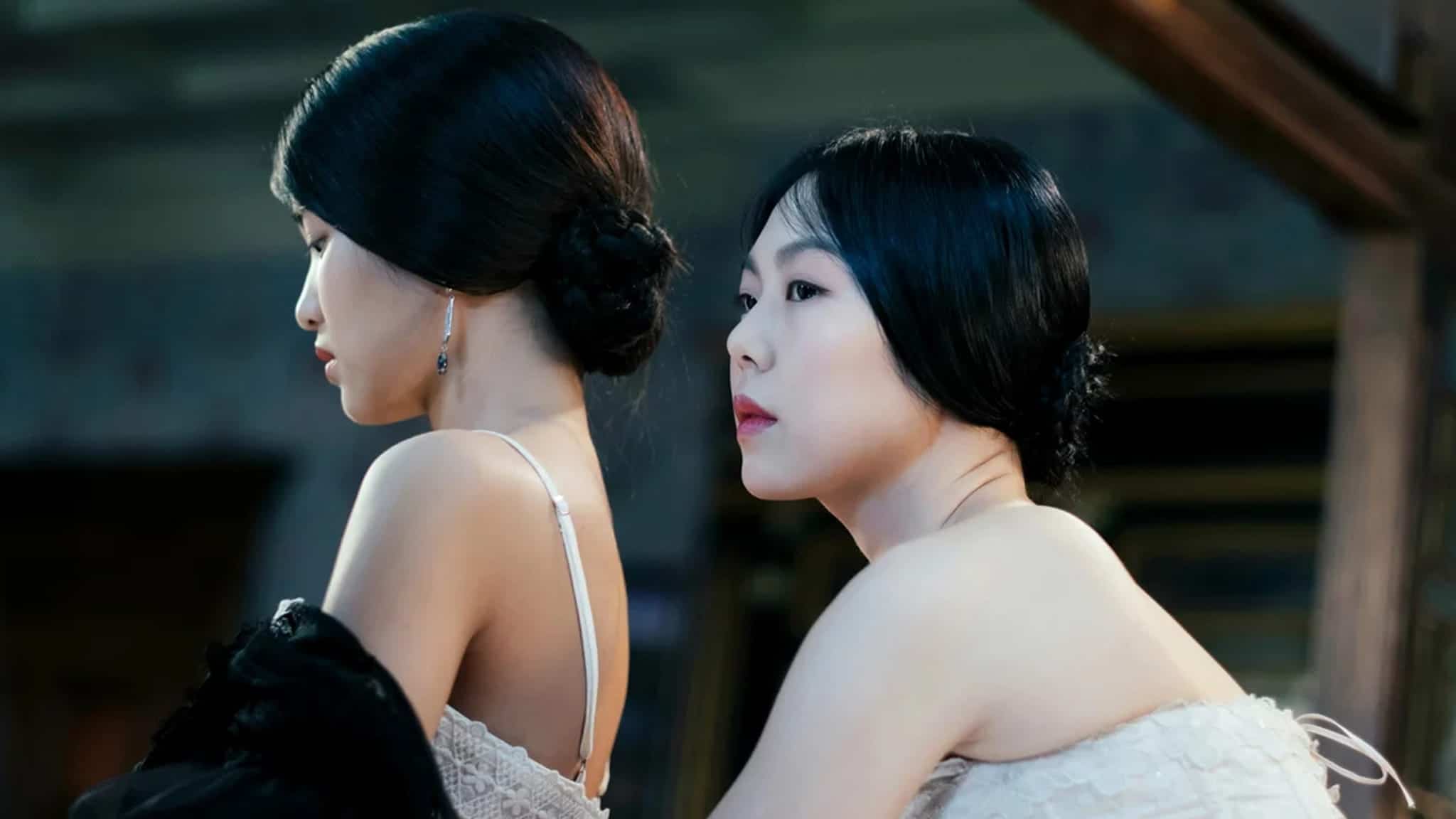
Set in Japanese-occupied Korea in the 1930s, the film follows Sook-hee (Kim Tae-ri), a Korean pickpocket who becomes maid to the wealthy Japanese heiress Lady Hideko (Kim Min-hee). Sook-hee has been recruited by Count Fujiwara (Ha Jung-woo) to seduce Hideko, marry her and steal her inheritance. But Hideko has her own plans. What begins as manipulation becomes intimacy; what appears to be a con becomes an alliance; and what initially positions the women against one another ultimately brings them together against the men attempting to control them.
Park Chan-wook's erotic psychological thriller is undeniably sensual. There is the bath sequence, the rope-tying, the whispered conversations and, eventually, the film's explicit final lovemaking scene. But reducing The Handmaiden to its eroticism misses what makes its depiction of lesbian desire so powerful. In an interview from 2016, Park described the film as a story about two women who form a relationship based on love and solidarity and escape from their “male oppressors.”
The film has also developed a life far beyond its initial release—which was 10 years ago on Sunday—becoming something of a sapphic touchstone. For queer women, The Handmaiden has endured as a film to recommend, rewatch, dissect and obsess over, its chemistry, eroticism and unapologetically queer ending giving it a cult-like status within sapphic film culture. Its continued presence in queer conversations a decade later says something about how hungry audiences remain for stories in which women can desire one another openly and are not ultimately punished for that desire.
Hideko has spent much of her life performing sensuality for men. Her uncle Kouzuki (Cho Jin-woong) forces her to read erotic literature aloud to male audiences, turning her voice and sexuality into entertainment. She is effectively trapped inside a performance written by someone else. Sook-hee initially enters that world to help another man exploit her.

From left, Kim Min-hee and Kim Tae-ri as Lady Hideko and Sook-hee in "The Handmaiden."
Amazon Studios/Magnolia Pictures
Hideko’s self-pleasure scene is particularly powerful as Kiki Marree, an Australian-based sexologist, tells JoySauce, “because her pleasure becomes something she can generate and witness for herself. Her sexual liberation doesn’t exist solely because another woman has arrived to give her pleasure; she is also beginning to claim her own erotic life.”
The women begin rewriting the script. Their intimacy gradually becomes something that belongs to them rather than the men watching them. The erotic scenes aren't simply interruptions to the plot. They are part of the rebellion. The women learn from each other, trust each other and eventually understand that the identities imposed upon them can be discarded. Hideko's readings are explicitly constructed for male spectatorship, while Sook-hee is initially instructed to observe and manipulate her. Park makes us aware of the voyeurism inherent in erotic cinema before gradually shifting the center of desire towards the women themselves. The difference isn't simply that the women are naked together rather than with men. It's that their pleasure is no longer being performed for men.
Queer female sexuality and taking control
Dr. JaeWook Ryu, associate lecturer in Korean studies at the University of Lancashire in England, highlights there are moments in the film when Sook-hee and Hideko hold hands, touch each other’s hair, or help one another get dressed. “These gestures may not necessarily be recognized as sexual within a heteronormative society, but queer audiences may still recognize desire within those spaces. Perhaps this is one of the differences between queer spectatorship and straight spectatorship.” he tells JoySauce.
Queer female sexuality has historically had an uncomfortable relationship with the screen. Lesbian desire has frequently been fetishized through heterosexual male fantasy, treated as a temporary experiment, or used as shorthand for transgression. Even when queer women are allowed to fall in love, their stories have often come with a price: violence, repression, separation, or death.
The Handmaiden refuses that ending. The love and desire between Sook-hee and Hideko become the conditions that make freedom possible.
So, has anything actually changed?

Ten years later, "The Handmaiden" remains an iconic sapphic film.
Amazon Studios/Magnolia Pictures
Ten years later, it would be easy to look at the explosion of sapphic stories and declare victory. Queer women are undoubtedly more visible on screen than they were in 2016. But the more interesting question isn't simply whether there are more lesbian and bisexual characters. The years following The Handmaiden brought a wave of films and television shows that made queer female desire increasingly central rather than incidental.
Portrait of a Lady on Fire (2019) offered a romance built around mutual looking and longing. The Bisexual (2018) complicated the idea that women have to fit neatly into lesbian or straight categories. Feel Good (2020) allowed queer women to be funny, sexually messy and deeply imperfect. Bottoms (2023) turned queer female desire into absurdist comedy rather than tragedy, while Love Lies Bleeding (2024) made female sexuality, physicality and obsession impossible to separate from its violence and fantasy.
These stories represent a meaningful shift from the expectation that queer female narratives should ultimately be about coming out, suffering or being punished for desire. But The Handmaiden remains an interesting benchmark because it asks a more difficult question than, “Are queer women represented?”
It asks, “Who is pleasure for?” A question that has become increasingly important over the past decade. Audiences are more willing to interrogate the difference between seeing queer women on screen and seeing queer women portrayed as fully autonomous sexual subjects. A woman can be naked on screen and still be presented through the male gaze. A sex scene can be explicit without actually communicating anything about the character's pleasure. And a queer relationship can exist in a story without challenging the conventions through which women's bodies have traditionally been presented.
Sapphic media now

"The Handmaiden" is a story about two women who form a relationship based on love, solidarity, and escape from their male oppressors.
Amazon Studios/Magnolia Pictures
The Handmaiden is complicated precisely because it doesn't escape those tensions entirely. Park is still a male director making an intensely erotic film about women. The camera is still capable of turning bodies into spectacle. Its sexuality is deliberately heightened and stylized.
Yet its narrative ultimately undermines the power of the gaze. The men who believe they understand and control these women are repeatedly outmaneuvered by them. The erotic performances designed to satisfy male spectators become part of Hideko's eventual escape. And the final sexual encounter belongs entirely to the women rather than the men who have spent the film attempting to possess them.
Since The Handmaiden, queer female characters increasingly get to be characters first: funny, horny, selfish, romantic, complicated and occasionally terrible. So the story isn't a simple march towards progress. Queer representation can expand and contract depending on what gets commissioned, canceled and considered commercially viable. There is also a difference between representation and erotic freedom.
It's easier for mainstream entertainment to say that queer women exist than it is to give them the same sexual agency routinely afforded to heterosexual characters. Queer female characters can still be desexualized, fetishized, killed off, or made palatable through conventional romantic narratives.
The legacy of The Handmaiden isn’t revolutionary because it showed two women having sex. It was revolutionary because sexuality was connected directly to autonomy. Women aren't simply desirable. They are desiring. They aren't passive objects of erotic fascination. They become active participants in determining what happens to their bodies, their identities and their futures.
The legacy of The Handmaiden isn’t revolutionary because it showed two women having sex. It was revolutionary because sexuality was connected directly to autonomy.
A decade later, queer women have more stories. They have more genres, more visibility and, increasingly, more opportunities to experience desire without being punished for it. But perhaps the biggest change is that queer audiences are no longer satisfied simply with being visible. They want to be desired, too. And they want to see themselves desire back.
That's why The Handmaiden still feels so powerful 10 years later. Its politics aren't found in speeches about liberation. They are embedded in two women taking control of their own bodies, narratives and sexuality. And, perhaps most radically of all, they get to enjoy their freedom. Ten years on, queer cinema has moved closer to that freedom but The Handmaiden still reminds us what it looks like when pleasure itself becomes an act of rebellion.
Published on October 1, 2026
Words by Simone Margett
UK-based freelance culture journalist with many hyper-fixations on the go. You can find her on Instagram: @simonelouise_xo