
‘Thirteen in Gaza’ is a harrowing, tender coming-of-age story
Palestinian director Hosam Abu Dan’s narrative debut about a father and daughter was shot entirely in the Gaza strip
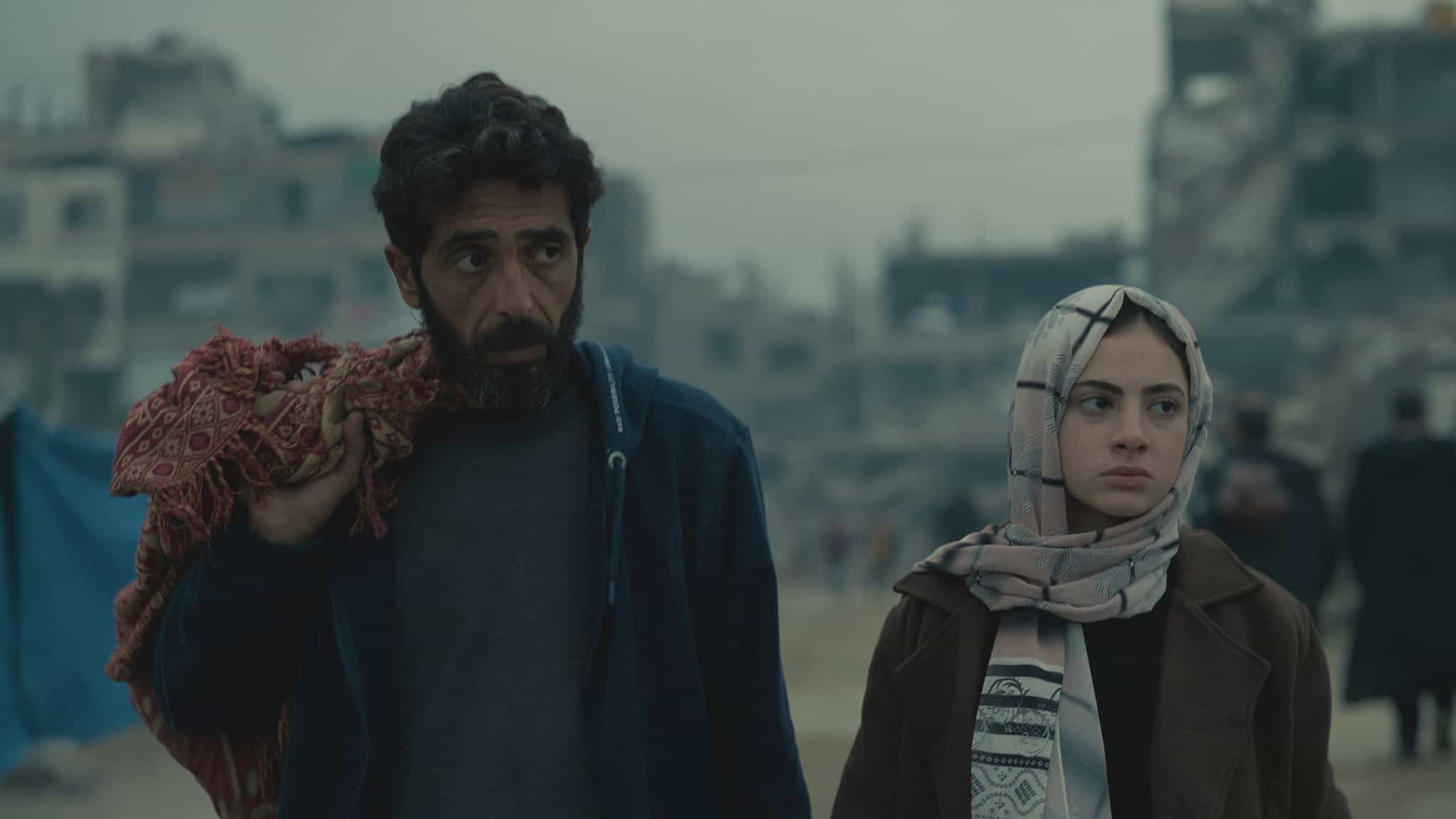
Firas Al-Masri stars as a father to Mary Ziyara's character Raghad
Courtesy of TIFF

Words by Siddhant Adlakha
The bodily ordinary becomes cinematically extraordinary in Thirteen in Gaza, a stripped-back film of billowing fabrics, crumbling spaces, and a teenager’s first period under harrowing circumstances. Part coming-of-age drama, part black market saga, and wholly naturalistic, the film from documentarian Hosam Abu Dan won the NETPAC Award at the Toronto International Film Festival, and is one of the rare movies to emanate from Gaza in recent years, alongside documentaries like Citizen Osama and anthologies like From Ground Zero—Palestine’s entry to the Oscars in 2025.
Shot entirely in Gaza with a local cast and crew, Abu Dan’s first fiction feature follows 13-year-old Raghad (Mary Ziyara) and her father Abu Raghad (Firas Al-Masri)—meaning “father of Raghad,” a common Arabic naming convention—a pair of refugees in a dilapidated tent city. Their camp plays host to both the intimate drama of teenage girlhood, and the more stylized subplot of a local fixer, Khalil (Ghassan Salem), running a predatory warehouse for aid, whose story becomes slowly entwined with both father and daughter.
Born from desperation, these Gaza black markets have made their way to the screen before (most recently, in Berlin prizewinner Chronicles From the Siege), challenging demands for perfect victimhood by portraying the complex situations that arise under occupation and genocide. No matter where the camera points in Thirteen in Gaza, it’s a reminder of the brink to which these characters have been pushed. Their surroundings are completely dilapidated, and during night scenes, you can even see bombs lighting up the horizon.
The story begins with Raghad’s father accompanying her to a doctor’s visit for her cramps, followed by a long, harrowing wait for a makeshift toilet, where she discovers blood in her underwear. The gendered shame of puberty is inescapable for Raghad, whose mother and siblings recently died when their building was bombed by the Israeli military. This leaves Abu Raghad to care for her solo, with his limited knowledge and emotional tools, allowing the gaunt Al-Masri to veer between a sympathetic weariness, and a sternness born from unwavering patriarchal tradition.

Mary Ziyara as Raghad.
Courtesy of TIFF
Raghad, not knowing how to deal with menstruation herself, sneaks around and uses strips of cloth, until a woman living nearby lends a helping hand. Meanwhile, to make ends meet, Abu Raghad ends up working for Khalil, skimming supplies from the aid trucks he drives through desperate hordes—intercut with real footage of people clamoring for help. On occasion, Abu Dan injects these documentarian reminders of the situation, like shots of fighter planes soaring overhead, but given the production of Thirteen in Gaza, the line between fiction and reality is blurry to begin with. Its mise-en-scène is born of a war-torn reality, harkening back to the Italian neorealism of post-World War II in its use of surfaces, textures, and extras plucked from ordinary life.
Raghad’s emotional reactions are captured not only through closeups of Ziyara’s face—a wonderfully thoughtful and self-assured actress—but of her dirty, slippered feet navigating the muck of the bathroom floor. It’s a thoroughly embodied performance of hiding in plain sight, born of the rank details and surroundings in which its characters are forced to exist.
Physically, it’s repulsive. Emotionally, it contextualizes thorny decisions with moral complexity, including Khalil’s predatory attempts to win Raghad’s hand in marriage. Her father—whose only means of dealing with his daughter’s coming of age is covering her up with conservative clothing—is left with little choice but to consider his offer, if it means rescuing Raghad from poverty. This uncomfortable catch-22 plays out like a crime saga between a desperate man and a parallel government, but it’s ultimately rooted in Raghad’s perspective, from which the drama emanates.

"Thirteen in Gaza" had its world premiere at the Toronto International Film Festival.
Courtesy of TIFF
Although Anu Dan employs lo-fi digital equipment by necessity, he wields it in meticulous ways. Visually, he reduces his shutter angle to decrease motion blur, imbuing even simple exchanges with a strobing effect typical of action scenes, as though violence could erupt from the frame at any moment. Aurally, he scores nearly every sequence with the white noise hum of drones hovering overhead, turning his teenage domestic drama into a film of oppressively morbid possibility. The only time characters are safe from the sound of death is within Khalil’s warehouse; swindling desperate people is their only means to survive.
With gentleness nestled between brutality, Thirteen in Gaza is a film of stark realities, produced and assembled against all odds. Few other films about teenage girlhood have so eloquently (and painfully) connected the maturing of body and soul to one’s environment, in a manner so powerful that it practically sharpens the rest of the genre, adding new dimensions to the ways we see the world, through a young girl’s eyes.
Published on October 2, 2026
Words by Siddhant Adlakha
Siddhant Adlakha is a critic and filmmaker from Mumbai, though he now lives in New York City. They're more similar than you'd think. Find him at @SiddhantAdlakha on Twitter