
‘The Unbidden’ turns women’s invisible labor into horror
Its ghost may drive the mystery, but this film's deepest horror lies in the silence, grief, and expectations passed from one generation to the next
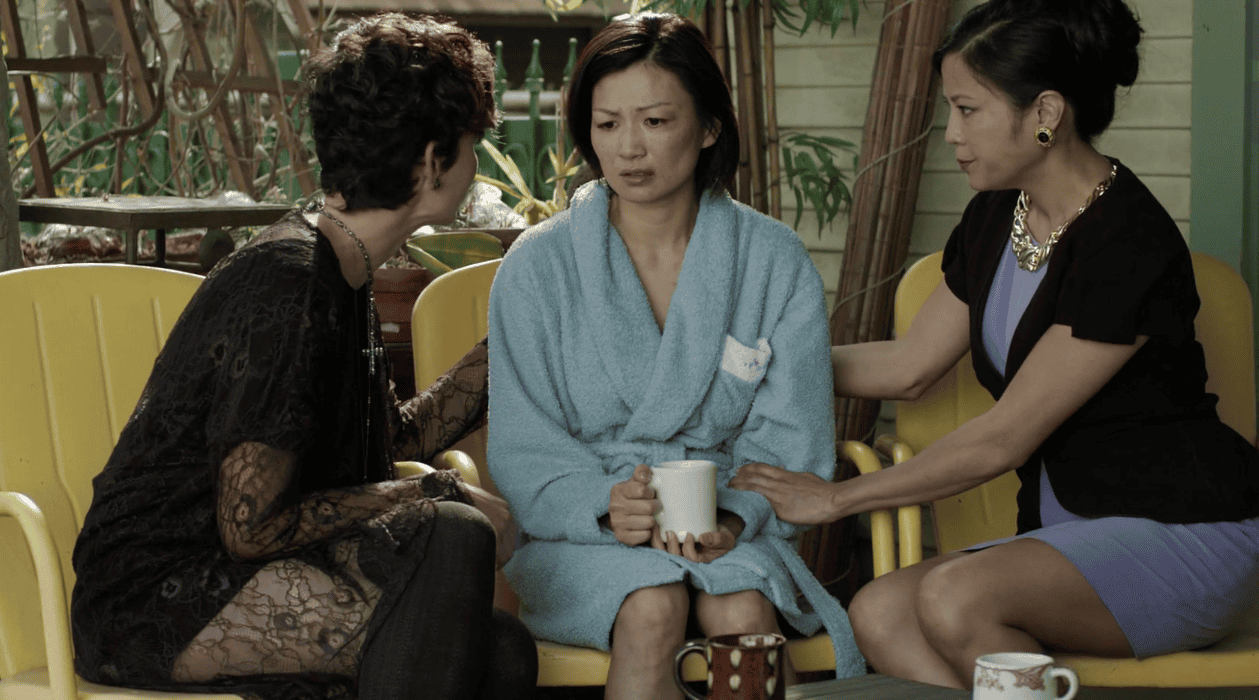
From left, Julia Nickson as Kat, Tamlyn Tomita as Lauren Lee, and Elizabeth Sung as Anna.
JoySauce TV

Words by Ayat'arrahman Mahmoudi
Horror has always found inventive ways to personify grief. Sometimes it's a ghost lurking in the shadows; other times, it's a family secret refusing to stay buried. In The Unbidden (2016), director Quentin Lee's supernatural mystery leans into both, delivering a quiet psychological thriller that understands the most unsettling hauntings aren't always paranormal. They can also be the emotional burdens families leave behind.
Nearly a decade after its release, The Unbidden, which is available to stream on JoySauce TV, feels surprisingly contemporary. Not because it predicted today's conversations, but because audiences have finally developed the language to articulate what the film has been exploring all along. As discussions around emotional labor, intergenerational trauma, and the so-called “eldest daughter syndrome” have become more visible within my genereation—particularly within immigrant communities—the film's central mystery takes on added resonance. What once played primarily as a ghost story now also reads as an examination of the invisible responsibilities women are expected to inherit.
At its base, The Unbidden follows Lauren Lee (played by Tamlyn Tomita), drawn into unwrapping unsettling family secrets after the mysterious death of her husband. The supernatural framework gives the story its tension, but its emotional engine lies elsewhere. The film repeatedly returns to questions of obligation: Who carries the weight of a family's past? Who is expected to hold everyone together when painful truths threaten to surface? More often than not, the answer is a woman.
This dynamic has long existed both on screen and off. Across many Asian households, daughters are often expected to become emotional caretakers, absorbing conflict, maintaining harmony, and quietly managing relationships that others would rather leave untouched. These expectations don’t announce themselves outright. Instead, they emerge through countless small acts of caregiving, mediation, and self-sacrifice that become so normalized they're invisible.
Lee taps into that reality without making it the direct subject of overt exposition. Rather than positioning Lauren as a conventional horror heroine, Lee presents someone navigating emotional responsibilities she never actively chose. Lauren's not only confronting unexplained phenomena; she's confronting an inheritance of silence, grief, and unresolved family history.
That's what makes the film's supernatural elements effective. The ghost isn't merely there to deliver scares. It amplifies emotions that have already been haunting the family long before anything paranormal enters the frame. The horror becomes inseparable from the emotional labor required to piece together her fractured relationships and reckon with truths others have spent years avoiding.
The parallel feels especially relevant today as conversations around emotional labor have expanded beyond romantic relationships to include family dynamics. The idea that women often become the default emotional managers within households has become increasingly familiar, particularly among younger Asian Americans reflecting on immigrant family structures. In that context, The Unbidden can be viewed as less of a traditional haunted house mystery and more of a story about what happens when one woman is expected to absorb the emotional consequences of everyone else's mistakes.

The sisters sit around Lauren's table to help her rid her house of bad spirits.
JoySauce TV
The recent popularity of eldest daughter syndrome has further sharpened that conversation. While shockingly not a clinical diagnosis, the phrase has become cultural shorthand for women who grow up feeling responsible for their family's emotional well-being, often placing others' needs ahead of their own. Whether or not Lee intentionally invokes that framework is beside the point. The emotional dynamic he depicts—the expectation that one woman will quietly shoulder responsibilities left unresolved by previous generations—feels strikingly familiar.
That burden extends beyond caregiving into memory itself. Throughout the film, Lauren becomes the family's archivist, assembling fragments of a history that has been obscured through omission and avoidance. In many immigrant families, daughters frequently become keepers of family stories, translators between generations, or the members expected to preserve traditions, while simultaneously adapting to a different cultural environment. The Unbidden captures a version of this responsibility through its mystery, asking one woman to reconstruct a past that others have allowed to disappear into silence.
The silence is perhaps the film's most persistent antagonist.
Many Asian families place understandable value on maintaining harmony and protecting loved ones from painful truths. Yet Lee raises another uncomfortable question: What happens when silence stops protecting people and instead begins hiding trauma? The film suggests that what lingers isn't only loss itself but the refusal to acknowledge it.
Rather than framing the pursuit of truth as an act of rebellion, Lee presents it as a form of care. Lauren’s willingness to confront painful realities becomes an attempt to interrupt cycles that have quietly persisted for years.
Importantly, the film doesn't reduce its female characters to symbols of suffering. Instead, it recognizes the complexity of carrying emotional responsibility. Caregiving can be an expression of love. Loyalty can coexist with resentment. Protecting family can sometimes require exposing the very truths everyone has agreed to leave untouched. The Unbidden has an emotional texture that elevates it beyond the bold supernatural premise in the simple synopsis you can find online.
Seen today, the film also occupies an interesting place within the evolution of Asian American genre cinema. Years before audiences enthusiastically embraced horror rooted in family history and cultural identity, Lee was already exploring how supernatural storytelling could intersect with immigrant experiences. It doesn't announce itself as a grand statement on representation, nor does it rely on cultural identity as its sole defining characteristic.
That may be one reason the film feels newly worth revisiting. Newer audiences have become increasingly interested in horror that privileges emotional authenticity alongside suspense, much like the recent film Obsession, recognizing that the strongest scares often emerge from relationships rather than monsters. Viewed through that lens, The Unbidden feels less like an overlooked curiosity from 2016 and more like an early entry in a growing body of Asian American genre storytelling willing to explore what families inherit beyond generations.
The film's greatest strength ultimately isn't its ghost but its understanding that some burdens are passed down without anyone ever intending to pass them on. Expectations, silence, guilt, obligation—these become the unseen inheritance women are often asked to carry, always without acknowledgment and almost never without consequence.
Ten years after its release, The Unbidden remains an understated supernatural thriller. But revisiting it today reveals something even more true: a story about the emotional costs of keeping families together, and the women who too often bear that responsibility alone. The most enduring hauntings aren't the spirits but the responsibilities that refuse to leave a daughter.
Published on September 16, 2026
Words by Ayat'arrahman Mahmoudi
Aya Mahmoudi is the managing editor of The Whitman College Wire newspaper. As a first-generation working-class daughter of Muslim Moroccan immigrants, Aya enjoys sharing her perspective and experiences with her college and the broader Walla Walla community. She spends her free time in the gym or lamenting and writing mid poetry or prose. https://whitmanwire.com/staff_name/aya-mahmoudi/