
‘Street Fighter’ knows how to stunt cast pro wrestlers
Among its star-studded ensemble, the Kitao Sakurai directed Capcom movie features a Japanese champion and a Samoan tribal chief
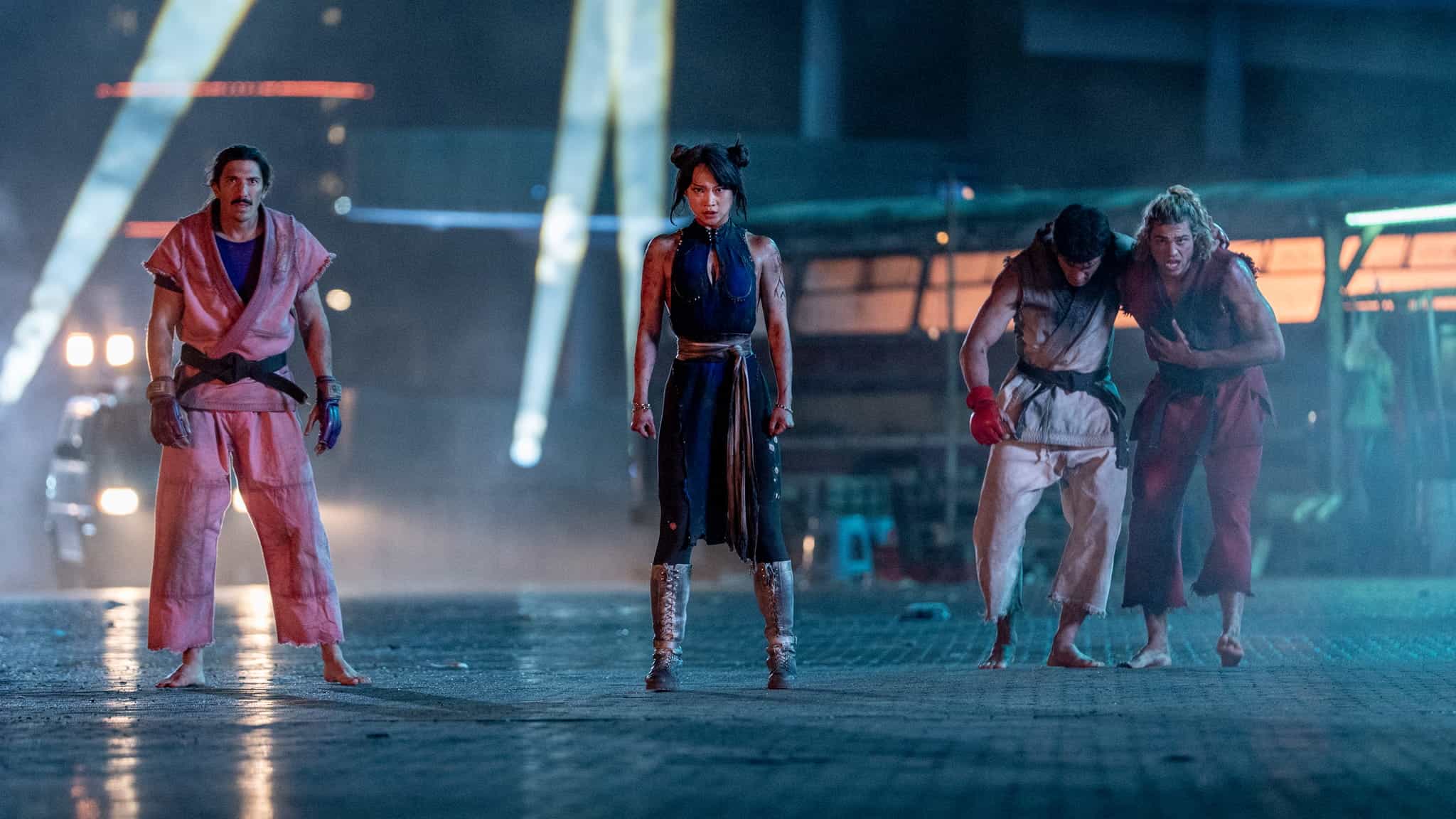
From left, Andrew Shulz, Callina Liang, Andrew Koji, and Noah Centineo in "Street Fighter."
Paramount Pictures

Words by Siddhant Adlakha
To put it plainly: Kitao Sakurai’s Street Fighter doesn’t work. It starts out on top, with some inspired anime flashbacks and formally fun fight scenes ripped right from the arcade game, but its second half is so scattered that its payoffs barely connect to their setups, and the movie comes to a screeching halt without an ending. However, if there’s one thing it gets right—that too, really right—it’s the stunt casting.
Where fellow fighter games like Mortal Kombat take an actor-first approach—for better or worse—Street Fighter opts for the seemingly counterintuitive route of ensuring that its roles are filled by entertainers and brawlers. This harkens back to when action star Jean-Claude Van Damme led the first live-action version in 1994. In the case of the 2026 film (starring Real Actors™ Noah Centineo, Andrew Koji and Callina Liang as co-leads Ken, Ryu and Chun-Li), the idea involves fleshing out the movie’s video game world with supporting actors who immediately snap into place, without having to do too much.
For instance, the swagger of rapper Curtis “50 Cent” Jackson is a perfect fit for the cocky boxer Balrog, while standup comic and podcast host Andrew Schultz brings an appropriately skeevy, car salesman energy to Ken’s opportunistic manager Dan Hibiki. But among the supporting ensemble, a trio of professional wrestlers from the United States and Japan find themselves perfectly cast, not just as individual performers, but in a movie that often operates on the logic of pro wrestling.
This is no more apparent than in the case of Japanese puroresu star Hirooki Goto portraying sumo wrestler E. Honda, first introduced in 1991 game Street Fighter II. Goto, a mainstay of New Japan Pro Wrestling (NJPW), is much leaner than the character and has to wear a fat suit (a gimmick with its own uncomfortable history), but his single-scene appearance helps flesh out the contours of the movie’s heightened, video game action and its emotional world. Co-lead Ryu approaches his old friend Honda in a sauna—a unique fight environment—and challenges him with Honda’s spot in the World Warrior tournament on the line.

Hirooki Goto as E. Honda in "Street Fighter."
Paramount Pictures
It’s an unofficial skirmish, but the very idea of friendly rivals negotiating through fisticuffs is at the heart of pro wrestling storytelling, making Goto a perfect fit. Honda, in his brief appearance, comes off as noble and trustworthy, which has long been Goto’s heroic (or “babyface”) character in NJPW, where he’s been a fan favorite and champion in the making for many years (he finally lifted the company’s coveted world championship in 2025, after more than two decades with the company). What’s also amusing about this Ryu-Honda bout is that Goto, who stands at a fairly normal 6-foot-0, is digitally enlarged—both vertically and horizontally—to make him seem especially exaggerated, as though the two allies were action figures belonging to different playsets, further establishing the movie’s nostalgic visual logic.
However, while NJPW’s Goto has only a minor role, a pair of WWE mainstays have more significant screentime: former enemies Cody Rhodes and Joe “Roman Reigns” Anoa’i. Their long-standing rivalry isn’t necessarily the reason they were cast—they don’t ever share the screen here—but as individuals, they fit their respective roles quite perfectly.
Rhodes plays Street Fighter II’s cartoonish American G.I. Guile, who—like John Cena’s DC anti-hero Peacemaker—functionally parodies the wrestler’s “all-American” image. Rhodes made a name for himself in NJPW as “The American Nightmare” (a play on his father Dusty’s wrestling nickname, “The American Dream”) before founding U.S. company All Elite Wrestling (AEW) and eventually returning to WWE as a bonafide star. In WWE, he’s long been an underdog draped in stars and stripes, harkening back to the classic (if arguably outdated) mode of American pro wrestling in which the American flag scores you automatic sympathy with the crowd.

Cody Rhodes as Guile in "Street Fighter."
Paramount Pictures
As the flag tattoo-sporting Guile—a man of camo tank tops and wild, blond flat-top hair—Rhodes plays a smarmy version of his wrestling persona. He gets up close and personal with characters like Hibiki, throwing aggressive quips in their face, all as a tongue-in-cheek (albeit slightly retrograde) gay undertone takes hold. The film may not be thoughtful enough to actively deconstruct this militaristic image or Rhodes’ embodiment of it, but it leans into an element of Rhodes as a performer which he has seldom accessed since rejoining WWE: his comedic timing.
As one of the company’s biggest stars, he’s practically a corporate mascot, and therefore must adhere to a polite and clean-cut image. However, prior to his return, he frequently featured on the AEW-adjacent vlog series Being The Elite, on which he played a similarly exaggerated version of himself, eager and foul mouthed. This incarnation of Rhodes returns in Street Fighter by way of childish jabs like “suck on this!” (in reference to a beer bottle), and a boastful saunter, as he attempts to draw every eye in the room while desperately staving off any obvious embarrassment he might suffer in the tournament.
However, the movie’s biggest threat actually exists outside the tournament itself, in the form of the red-eyed Akuma (Anoa’i), a demonic fighter shrouded in smoke, and the brother to Ken and Ryu’s slain master Gouken (Don Lee). Although mostly seen in the movie’s animated flashbacks, Anoa’i’s shadowy presence, as he taunts Ryu in haunting voiceover, draws on the Roman Reigns character to a tee. After being presented for years as the WWE’s next golden retriever, Reigns turned “heel” (or villain) during the pandemic, and took advantage of the crowd-less shows by engaging in dialogue-heavy matches where the camera mics could actually pick up what he was saying, in lieu of any cheering.
It was here that his Shakespearean “tribal chief” character was born, a master manipulator who indoctrinated his real life cousins, fellow wrestlers and twin brothers Jimmy and Jey Uso, into a cult of violence he called The Bloodline, fashioned after the regal dynamics of his Samoan culture (his other cousin, Dwayne “The Rock” Johnson, would get involved in this saga as well). The Bloodline story—in which the Usos tried desperately to get out from under his abusive grasp—began in 2020 and is still going six years later, making for a fitting echo to Anoa’i’s role in Street Fighter.

Joe “Roman Reigns” Anoa’i as Akuma.
The similar six-year gap between the movie’s animated flashbacks and its current events, while a coincidence, also lends credence to Akuma’s reach as a spiritual presence, whose dark, rageful powers have dug their claws so deeply into Ryu that he’s shut himself off from martial arts. This internal battle, in which he risks becoming a violent, vengeful version of himself, is at the center of his dynamic with long-time best friend Ken, making Akuma’s booming provocations a key dramatic fixture of the film.
Granted, when it comes time for Akuma to actually appear, late into Street Fighter’s runtime, the film has long gone off the rails and failed to properly align its conflicts by way of setup and payoff. It even ends without a real conclusion. However, Akuma is no less terrifying in his brief appearance, thanks to how fully Anoa’i embodies his Machiavellian vibe. Like the Tribal Chief Roman Reigns, he commands the stage as soon as he steps foot on it, drawing out the worst emotional impulses in anyone who dares step up to him.
Although Street Fighter falters in its second half, its power plays pave the path for some delightful dramatic and comedic beats, all of which pivot around the idea of violence as an expression of character. In a better movie, each one of these moments would’ve solidified its story and enhanced its fight scenes, but regardless of where things end up, the broad strokes of this video game world feel entirely in tune with pro wrestling storytelling, thanks in large part to its use of pro wrestlers who fit the bill.
Published on October 16, 2026
Words by Siddhant Adlakha
Siddhant Adlakha is a critic and filmmaker from Mumbai, though he now lives in New York City. They're more similar than you'd think. Find him at @SiddhantAdlakha on Twitter