
Stir Fried: How Marc Heu brought French patisserie to the Twin Cities
A look at the Hmong French pastry chef's journey, from his childhood in French Guiana to living the American dream in Minnesota
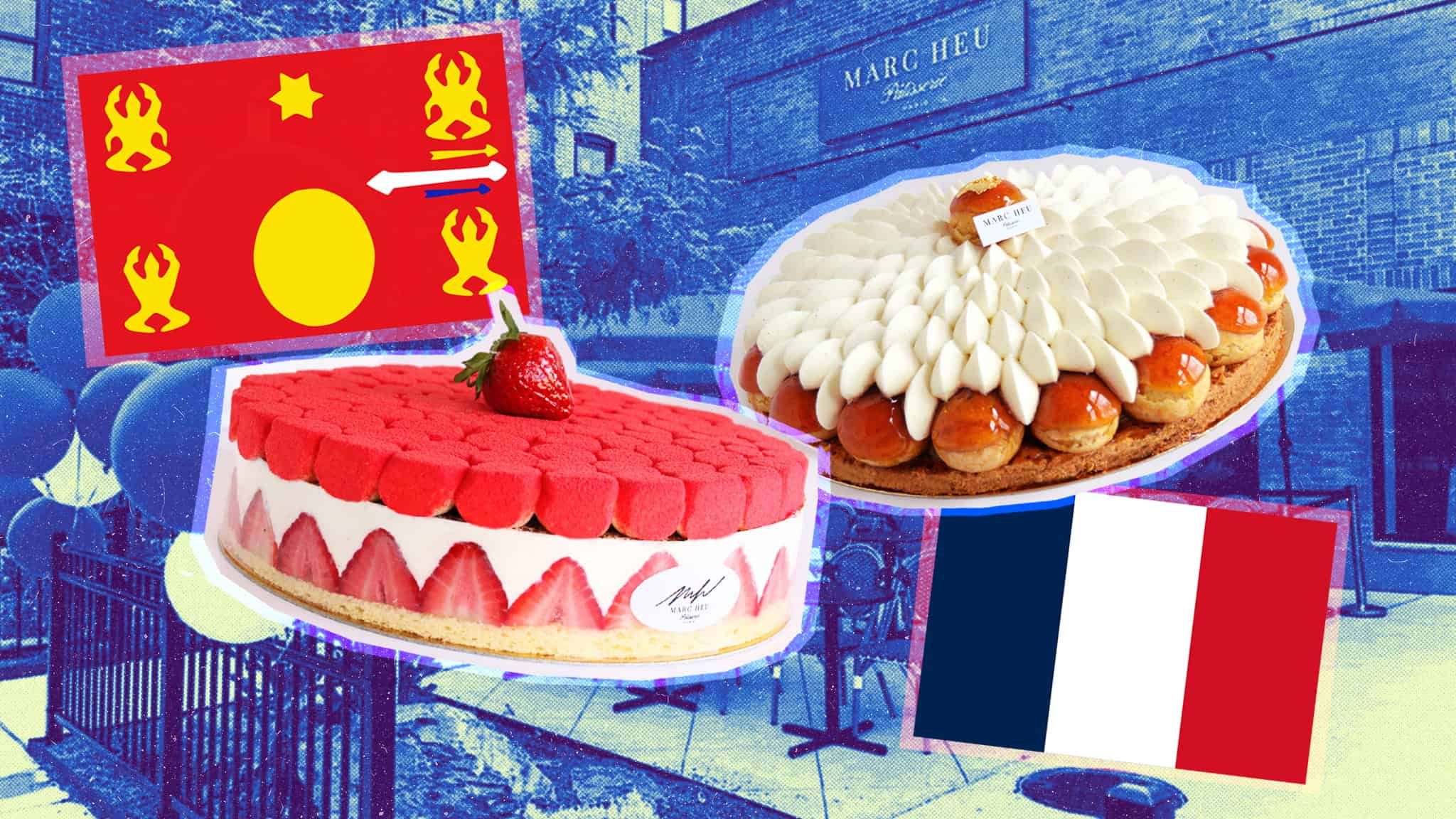
From left, pastry chef Marc Heu's fraisier and vanilla Saint-Honoré cakes.
Photos courtesy of Marc Heu; graphic by Ryan Quan

Words by Clara Wang
Stir Fried: The story of any immigrant diaspora is the story of how outsiders became insiders, and nothing tells this story better than food. Names may get scrambled, languages forgotten, neighborhoods gentrified—but no matter how muddled histories become, the truth is served on a plate. Stir Fried breaks down the weird, messy, bastardized fusion cuisines that tell the story of Asian diaspora communities around the world.
It’s summer, and the Minnesota sun is shining through Marc Heu Patisserie Paris’ expansive windows in St. Paul, making the glossy croissants and delicate hand-piped tarts, nestled in a minimalist white display—with sleek, clean lines inspired by Parisian couture houses—sparkle like jewels.
“I wanna offer people an experience, an escape, to treat themselves,” says namesake Hmong French pastry chef Marc Heu.
Since opening the first Marc Heu Patisserie in 2019, Heu has established himself as one of the finest French pastry makers in the Twin Cities. A graduate of the Lenôtre Culinary Arts School in Paris, his prestigious resume includes internships at Stohrer (the oldest patisserie in France), three-Michelin-starred Le Pré Catalan restaurant in Paris, and Dominique Ansel’s namesake bakery in New York. Heu and his wife and COO Gaosong recently opened their third location in the Twin Cities, and Heu was nominated for a James Beard award in 2025.
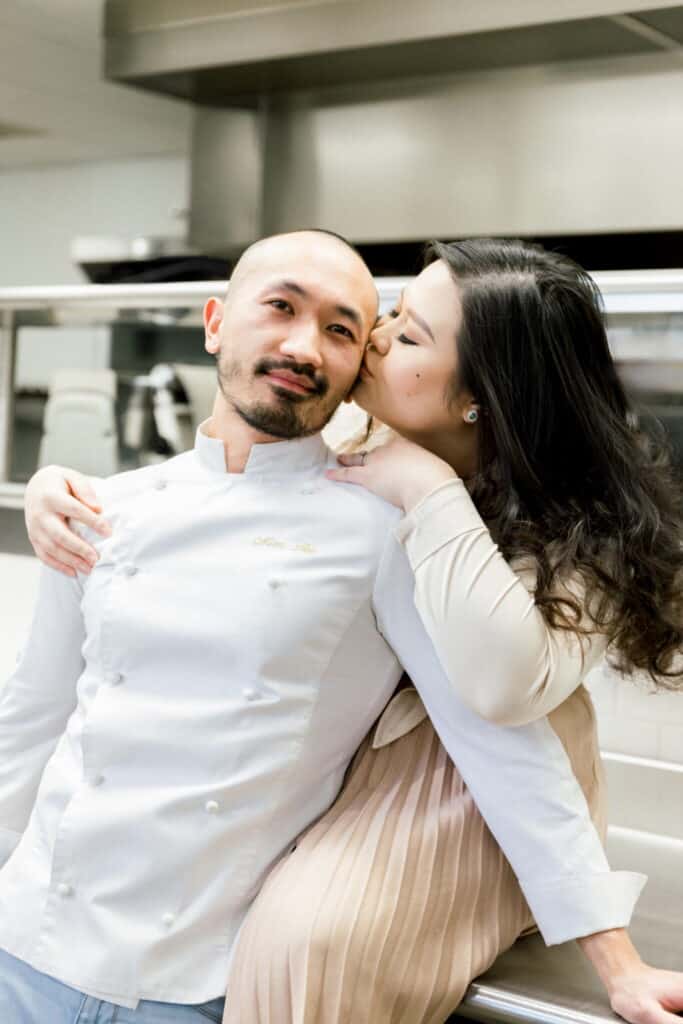
Chef Marc Heu and his wife Gaosong.
Mee Yang
From a pistachio ring cake with piped buttercream filling, to their signature passionfruit raspberry tart, each pastry is a unique work of art. While sometimes they do limited runs of trendier items, like a baked croissant version of the state fair corn dog, Heu eschews silicone molds and is adamant about sticking to classic French patisserie; it took years to overcome his very French resistance to serving sandwiches and coffee because “in France, you don’t have that in a patisserie.”
“I don’t want to do fusion. I may not be white French, I’m Hmong. But I was born and raised in France. I grew up with both cultures—Hmong and French. But what I want to do is to represent the French gastronomy. I’m not rejecting my home culture,” says Heu.
Despite initial dubiousness, his favorite item to make is the belle croissant (croissants are technically a boulangerie item). The intricate chemistry involved in a perfect belle croissant—something that he says people often take for granted as simple bread—appeals to his scientific nature. “You can find the belle croissant at the gas station, Aldi, Cub Foods, anywhere you go. It’s something people are familiar with…I think that when you see it everywhere, you think it’s easy to make, but actually it’s really technical,” says Heu. “It’s just so many things that come into place when you make a croissant. The temperature, the hydrometry, the cooking time. It’s actually harder to make than a pastry with piping.”
The breathtaking work of creating something elegant, purely meant to be enjoyed—beauty as defined by writer Annie Dillard as “a grace wholly gratuitous”—is a throughline running through the 38-year-old’s life. It’s a theme made more poignant for the child of Hmong refugees who grew up farming in the tropics of French Guiana and foresook the safety of a medical career to pursue pastry.
French Guiana
The story of Heu’s family is a familiar one in the Twin Cities, home to more than 90,000 of the 100,000 Hmong refugees displaced from Southeast Asia after the Vietnam War in 1975. His parents were Hmong farmers from around Luang Prabang, Laos, who fled to a refugee camp in Thailand. Despite having little formal education, Heu’s father was a self-taught man who produced several children with doctorates. “Even after a long day of farming under the sun, he would come home, and he would always be reading,” Heu says about his father.
Having learned a little French from the missionaries, they immigrated to France, where Heu—the youngest of six—was born. Facing discrimination and a lack of job opportunities, the family moved to the sparsely populated tropics of French Guiana when Heu was 3, where the French government was allotting land for farming.
When Heu talks about his childhood, the vivid recollections of suddenly going from a cool brick house outside of Lyon to the rural tropics are magnified by a toddler’s shock and confusion. Lean and tattooed, Heu looks more like an artist or rock star with his perfectly trimmed beard and white T-shirt as he muses to me about his first memory of an Air France birthday cake on the flight to Guiana. “I still remember that the steward came with a little treat, a little French Air France plane, and yeah, I was standing on the seat, and I even have the sense of the plastic of the bag…I don't know if it's selective memory or just trauma memories,” he chuckles.
Farming can suck
It was a rough transition. For the first few years, they lived in an abandoned cow barn with no electricity or running water. “I'm not trying to portray myself as that poor little jungle boy, but the truth is we didn't have much,” Heu says.
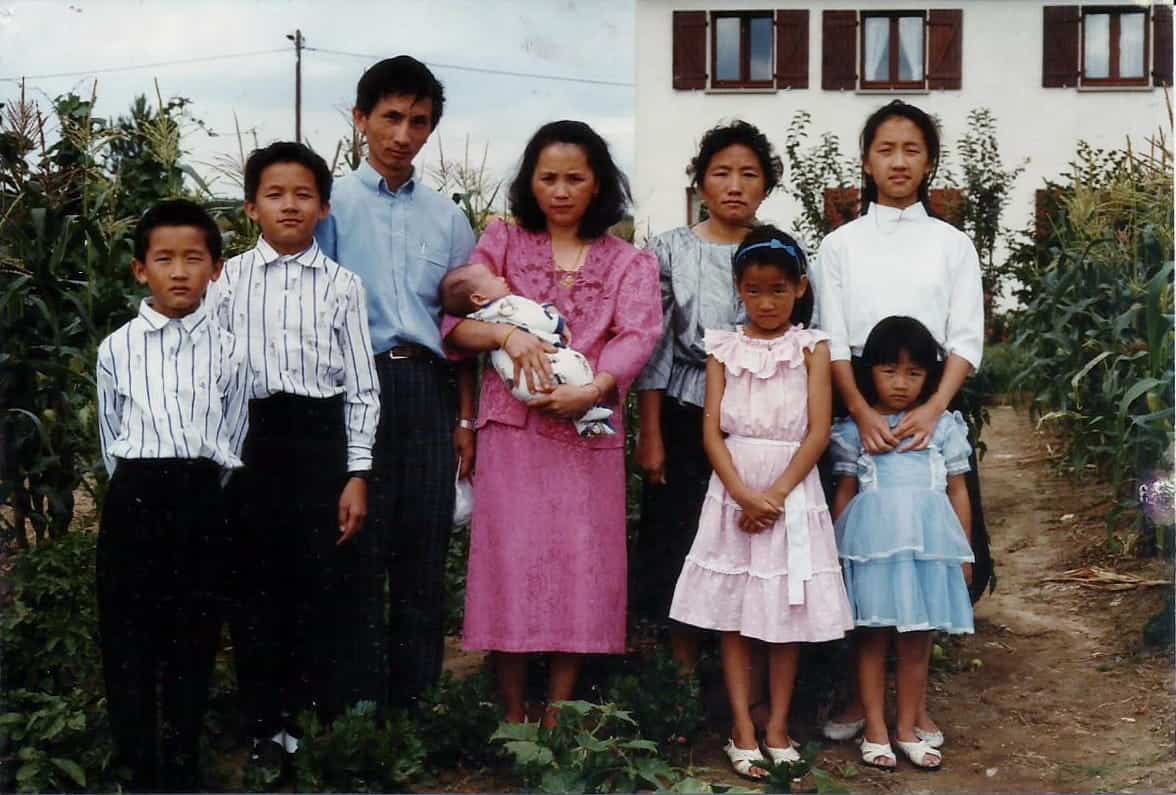
Marc Heu and his family.
Courtesy of Marc Heu
Young Heu slept in a cow trough, then a military cot. They grew and sold vegetables, herbs, and tropical fruit. All the children labored on the farm before and after school, leaving little time for extracurricular pleasures like playing soccer. Heu hated it. “When you looked around you, I mean it was just like trees, animal noises, insects, and nothing else,” Heu says. “I just did not understand how we ended up there.”
Since his older siblings attended middle school in the city an hour away, Heu was left to fend for himself as one of the only Hmong kids in elementary school. The bullying helped him grow a tough skin and learn how to make friends with people from all walks of life. “You know, everybody brings something different, and that helped me be more open to the world, to people, I think, to be surrounded by different cultures. It was tough. But slowly they learn not to be scared of you, to accept you,” Heu says.
After long days on the farm, Heu’s family always had time for dessert. The family converted to Catholicism when they moved to France, and among the church donations were French recipe books, as well as regular supplies of eggs, milks and flour, from which his sisters learned to make a dry sponge cake. The process fascinated Heu, who fought to have the honors of whipping egg whites into snowy peaks with their small electric beater. Baking tied him to a French idyll, which Heu felt he’d lost in the jungle.
“They would let me whip the egg white and I just got so fascinated. You start with a clear translucent liquid, and by whipping it, it transforms into something foamy,” Heu says. “I would call it snow, because I still had memories of snow, you know. But obviously in French Guiana it doesn't snow. So it was my way of bringing or making snow, I guess.”
In their family, dessert was also a way to prove that life was about more than just surviving—that time and effort can be put into a sweet treat, just because it’s fun, and it feels good. Heu’s parents would buy “charlotte,” or ladyfingers, because they were cheap, soak the dry cookies in water (“not even cream,” he says) and make a layer cake with cream and the fruit they grew, which they kept in the fridge. “So right after a long day of farming, you know when you come home, you have a very cold dessert,” Heu says.


To reach the stars
Heu dreamed first of being an astronaut, channeling his early scientific aptitude and razor-sharp memory to win a national school rocket-drawing contest run by the Guiana Space Centre, the European Space Agency’s primary launch site. With no high schools in the area, his parents sent him to boarding school in Limoges, France. The transition to a Western city from Guiana, where they had no Internet and their only connection to the outside world were early 2000s music videos from a faulty cable channel, was eye opening. Heu experienced McDonalds for the first time, and was mesmerized by the abundant pastry shops with their beautiful displays and French toques.
“I felt like my whole life was a lie,” Heu says. “No one tells you about opportunities that you can do. That the world is not just that little bubble, like the jungle. You can actually take a plane and go, and there's actually more. You can actually do more.”
While Heu had been obsessed with the delicate formulations of pastry making from a young age, his parents didn’t consider chefhood a serious profession. (Wishing to impress upon a post-Anthony Bourdain era American the lack of respect accorded chefs in France, he shares an anecdote about how a cherished mentor felt judged for wearing a chef coat on the Paris subway as late as 2018.)
Though he wasn’t passionate about being a doctor, his parents had sacrificed too much for him to ignore their wishes. “It doesn’t matter if you’re Hmong in France or in the U.S., you still want your kid to be a doctor,” Heu says. “Obviously it’s the wrong reason to go into the medical field, but I was like, ‘I’ll do it for them.’”
Heu aced the difficult written exam and snagged one of the 120-130 spots to test into medical school, scoring in the top 10 out of 1,200 students. As a reward, his parents sent him to visit his uncle in Minnesota. He barely spoke enough English to order scrambled eggs, but when his cousins set him up with a pretty theater major, sparks flew. “I’m single, I’m on vacation. I was like, ‘Hell yeah.’ And it happened to be my wife,” Heu says.
They got married just two weeks later. From then on, Gaosong became an integral partner in every step of his life and business. Sensing his lack of excitement about transferring into American medical programs, and impressed by a batch of croissants he’d turned out with ingredients from Trader Joe’s, she sat him down and helped him take concrete steps towards becoming a pastry chef.
“I had the pastry inside of me, but I wasn’t American enough to dare to do things. It’s something very American—the mindset to dream bigger, not be afraid. French people, we’ll just stick to job security,” Heu says.


An expensive lesson
Gaosong was the one who not only encouraged Heu to pursue his passion, but made it possible. Wanting to fast-track his career, they made a plan: Do a 12-week course at the most expensive and prestigious private pastry school in Paris. His father helped him with the down payment, and Heu went back to work on his parents’ farm for eight months to come up with the rest.
Unfortunately, Gaston Le Notre turned out to be an expensive brand name geared towards wealthy Chinese hobbyists. Students learned how to make pastry cream and croissants with the best ingredients from a Pierre Hermé chef, but there was no instruction on scaling production or how to actually run a kitchen. “I’m not saying I wasted my money, but it’s not necessary to pay that much money to learn how to make pastries,” says Heu.
Two weeks before graduation, an impromptu visit to Stohrer landed him an unpaid internship with the handsome head pastry chef Jeffrey Cagnes. At Stohrer, Heu finally learned the ins and outs of patisserie—how to work quickly, churn out large batches of exacting recipes, and make everything from scratch. Always the first one there and the last to leave, Heu absorbed knowledge like a sponge. “In one day, I learned more than I did in four months,” says Heu.
Teamwork makes the dream work
Heu went on to fine-tune his skills at Dominic Ansel’s in New York while Gaosong earned her master’s degree in arts administration at Columbia University. Then the Heus returned to Minnesota to build their corner of the American dream, starting with Marc making king cakes in a basement.
Business boomed when Gaosong put herself on the front lines of her husband’s dream. She created the Marc Heu branding, from snagging a domain name and running the social media, to finding a bakery space and handling rollout strategy. When they opened their first location, people queued up for hours in freezing Minnesota temperatures.
“I’m lucky enough to only do what I’m passionate about, the pastry,” says Heu. “All the time my chef friends, they’re like, ‘Dude, you’re so f*cking lucky,’ and I’m like, ‘I know.’ I don’t take it for granted.”
Published on September 9, 2026
Words by Clara Wang
Clara Wang is a freelance writer based in Austin, TX but often found wandering abroad exploring culture through the lens of food and drink. Her work has been featured in publications such as Conde Nast Traveler, Food & Wine, Eater Austin, BuzzFeed, Refinery29, the Austin American Statesman, and the Daily Dot. Her monthly column Stir Fried explores Asian diasporic cuisines around the world.

Art by Ryan Quan
Ryan Quan is JoySauce's social media manager, associate editor, and all-around visual eye. This queer, half-Chinese, half-Filipino writer and graphic designer loves everything related to music, creative nonfiction, and art. Based in Brooklyn, he spends most of his time dancing to hyperpop and accidentally falling asleep on the subway. Follow him on Instagram at @ryanquans, and check out his work on his website.