
Spook up your Halloween with a JoySauce TV horror movie marathon
We're bringing the scares to you with some classic Asian horror films, available to watch on Roku, Amazon, and JoySauce TV
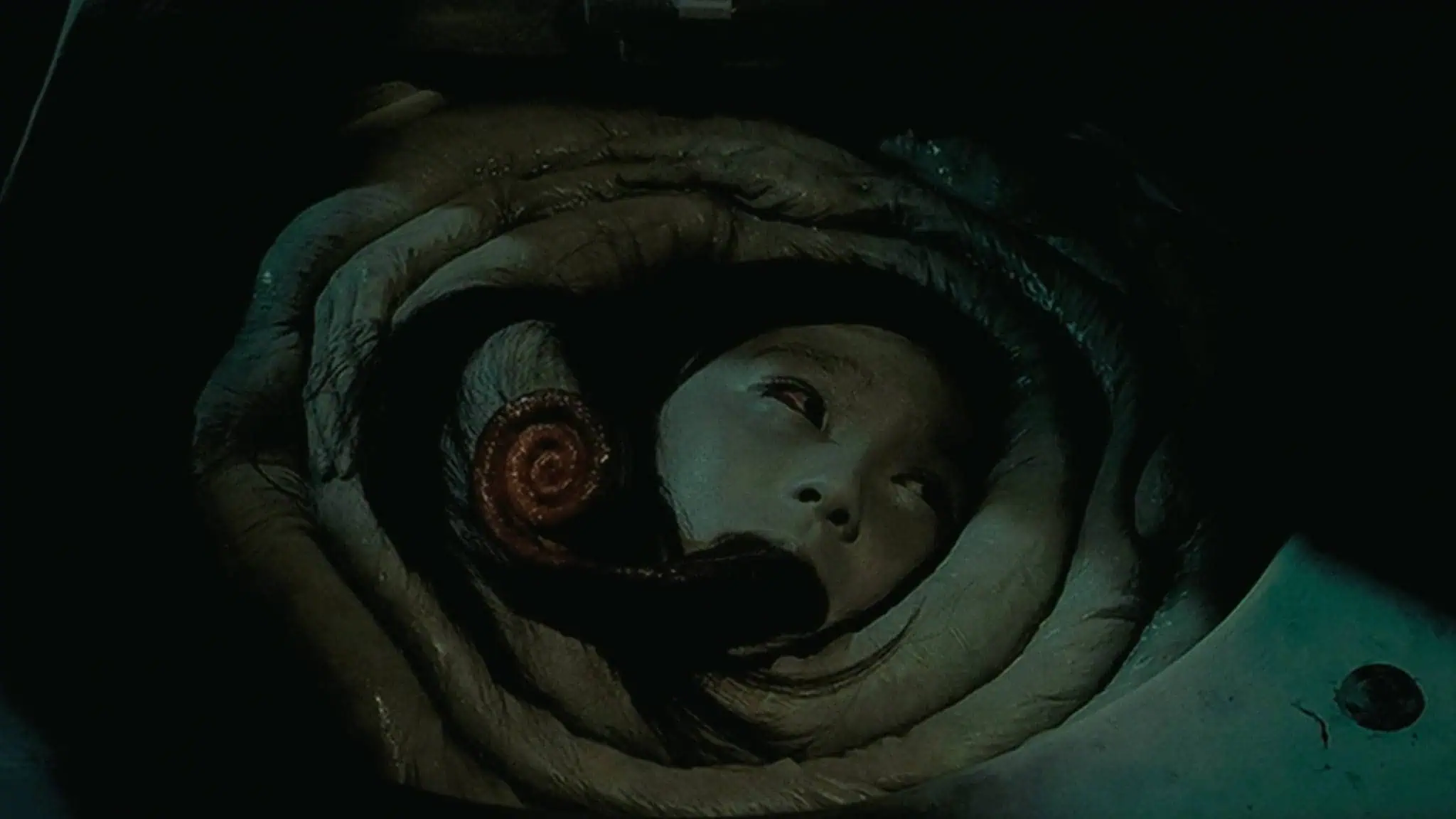
Higuchinsky's 2000 film, "Uzumaki," is an adaptation of prolific horror manga artist Junji Ito’s same-named series.
JoySauce TV

Words by Andy Crump
Every Halloween party needs a few key elements: costumes, candy, a themed playlist, a selection of adult beverages (also themed, if you can manage), and a good horror movie. But every great Halloween party will rock more than just one good horror movie—because if we can have variety in what we wear, what we eat, what drink, and what we listen to, we should also have variety in what we watch. We’re past the point where Halloween is the time of year when everyone is a horror fan, after all; everyone is a horror fan all year long in our golden age of contemporary horror. Halloween is just the calendar-mandated time of year when we celebrate the genre.
Now you’re scrambling to put together a movie slate for your Oct. 31, aren’t you? Don’t worry! JoySauce has done all that hard work for you by programming a Halloween horror movie marathon to stream on our Roku and Amazon channels and on JoySauce TV. The scares start at 5 p.m. (PT) on Saturday and will run till 1:30 a.m. on Sunday.
Looking for a place to start? Here’s a selection of five films from the list to make your Halloween just a little bit scarier.
Death Kappa (2010)
A tribute of sorts to Toho Co., and Godzilla, specifically his 1960s incarnation, known for goofy, colorful camp in sharp contrast to the sober foundational political allegories of the prior decade. That’s to say Tomoo Haraguchi’s riff on Shōwa’s cheesiest stretch of Godzilla movies won’t be to everyone’s taste, but if you dig them—1967’s Son of Godzilla especially—then Death Kappa ought to be right up your alley. Kanako (Misato Hirata), a failed idol singer, befriends a kappa; she entertains the little guy with her music, and the little guy returns her kindness by rescuing her when she’s kidnapped by nationalist mad scientists and their pack of fish-man samurai. Death Kappa isn’t as silly as it sounds. In fact, it’s sillier in the best of ways, like an at times uncomfortably kinky Power Rangers episode made as a nod to Japan’s pop cultural and political histories. In other words: it’s a hoot. Loving horror movies necessitates loving highbrow artsy ones equally as much as B-movies like this one, and what’s not to love? For a mucky turtle-gremlin, that kappa is downright adorable.
Black Rat (2010)
Horror charts social fears period by period, decade by decade, culture by culture, and the horror of Japan is no exception. Through the 2000s, as adult suicides began a slow decline, student and youth suicides refused to dip, and occasionally even rose; that’s an alarming reality to face, which explains why Japanese horror films from the aughts, like 2001’s Suicide Club, centralized the country’s public health crisis as thematic material. Kenta Fukusaku’s Black Rat filters the anxiety, grief, and frustration feeding into as well as leeching out of these contemporaneous circumstances, then lets them crystallize into a standard slasher. Oddly enough, it’s refreshing to see that niche explored in Japanese genre cinema, given that the image typical to J-horror is the onryo: vengeful ghosts, like Sadako of Ringu (1998) and Kayako of Ju-On (2002). In Black Rat, there are no ghosts per se, but instead the figurative spirit of a girl betrayed by her friends—a sad tale awash with blood.
Seoul Station (2016)
Yeon Sang-ho is one of South Korea’s most non-stop filmmakers, evinced if not by the two movies he has out this year–Colony in August and Paradise Lost in November–then by the one-two punch he delivered with Train to Busan and Seoul Station, the former’s prequel, within a month of one another in 2016. The obvious difference between them is that where Train to Busan is live action, Seoul Station is animated. The difference one may not appreciate on first viewing is that Train to Busan encompasses a range of social strata through its cast of characters where Seoul Station focuses exclusively on marginalized people, from Hye-sun (voiced by Shim Eun-kyung), a young woman escaping from her life in a brothel, to Seoul’s homeless population. Yeon has a knack for tugging heartstrings while orchestrating zombie chaos; Seoul Station is no exception to this rule, and hits emotional notes as brutal as its violence.
Uzumaki (2000)
A spiral, depending on how it is formed, can visually pull observers into its center, which fits nicely alongside what mononymous filmmaker Higuchinsky attempts with Uzumaki, an adaptation of prolific horror manga artist Junji Ito’s same-named series. High school student Kirie (Eriko Hatsune) notices something’s awry with her boyfriend’s father, who out of the blue becomes increasingly obsessed by spiral patterns, whether in the swirl of his miso soup’s broth or the shells of snails; because Uzumaki is a horror movie, one can easily guess where his fixation leads him. Soon after, Kirie’s small town becomes ground zero for a plague of eldritch spiral patterns, driving people to self-harm, madness, and in most cases, both. Higuchinsky appears to wish madness on his audience, too, judging by the number of techniques he uses—dissolves, smash cuts, flash cuts—and by his choice to meet in the middle between Ito’s black and white drawings and live-action filmmaking, resulting in a contrasty, ethereal nightmare.
Hansel & Gretel (2007)
Aughts-era reviews of Yim Pil-sung’s horror fairy tale made the easy comparison to Pan’s Labyrinth, on the basis that both are dark fantasy and feature child protagonists. The sharper, and frankly more logical, comparison would be Kim Jee-woon’s A Tale of Two Sisters (2003), likewise orbiting around tragic children with a severely traumatic backstory, bolstered by a serious case of the creeps. Hansel & Gretel isn’t a retelling of the classic Grimm yarn, which functions as a motif rather than as the narrative. The choice is refreshing for being unexpected, because the obvious path here would be to adapt the Grimms’ text. Instead, Yim introduces us to Eun-soo (Chun Jung-myung), who crashes his car on a highway, wakes up in a wood, and meets three siblings: Young-hee (Shim Eun-kyung again), Man-bok (Eun Won-jae), and Jung-soon (Jin Ji-hee), who dwell in a disused orphanage and harbor Secrets™. They might also be murderers. Hansel & Gretel is a lesser-recognized entry in 2000s South Korean horror; for its rich production design, well-executed frights, and sustained atmospheric unease, it deserves far more mention than it gets.
Other films in JoySauce’s horror marathon include Hakaider, Dark Tales of Japan, Doomed Megalopolis, Death Trance, and Shopping For Fangs.
Published on October 28, 2026
Words by Andy Crump
Bostonian culture journalist Andy Crump covers movies, beer, music, fatherhood, and way too many other subjects for way too many outlets, perhaps even yours: Paste Magazine, Inverse, The New York Times, Hop Culture, Polygon, and Men's Health, plus more. You can follow him on Bluesky and find his collected work at his personal blog. He’s composed of roughly 65 percent craft beer.