
Renee Zhan brings killer puppets to life in ‘V/H/S/Mixtape’
The director discusses her gory short film, "Dance, Dance, Dance, Dance," and working with Jim Henson's Creature Shop
Christopher Romero Sosa as Sam.
Waranetta Kai

Words by Andy Crump
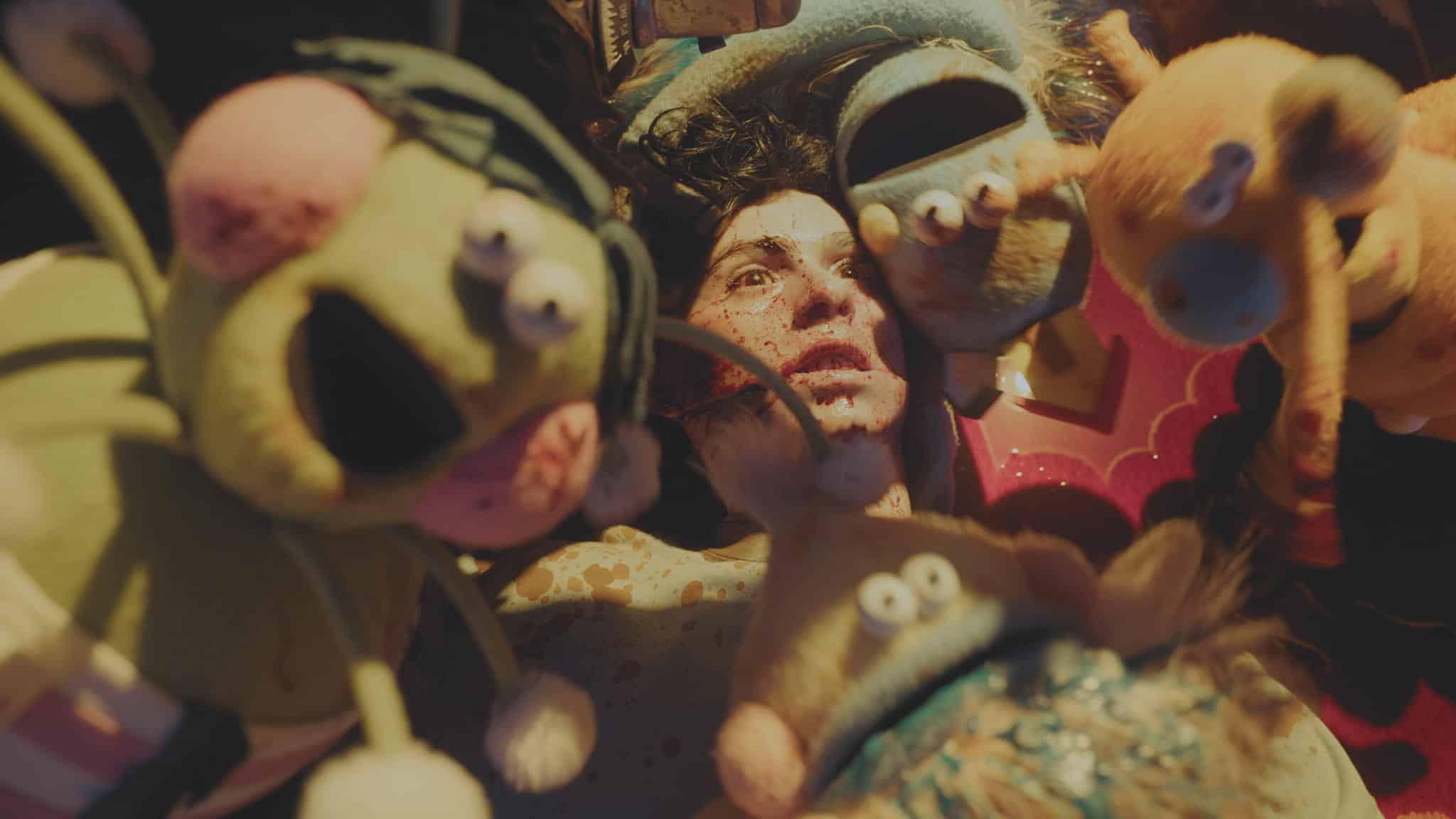
Almost everyone loves muppets, but few entertain the possibility that muppets might not love them back, despite years of public broadcasting propaganda telling us otherwise. Fewer still consider that muppets might actually love running radial saws into people’s faces for kicks. That’s the bite-sized logline for “Dance, Dance, Dance, Dance,” Renee Zhan’s commencing segment for V/H/S/Mixtape, the newest edition of Shudder’s anthology horror series, premised on the idea that each film consists of multiple videotapes that contain tales to shock, chill, and disturb viewers. It’s a loose concept, and by now largely an excuse to round up a handful of horror directors to make shorts related by theme.
Thank goodness for that. The first V/H/S film premiered in the midnight section of the 2012 Sundance Film Festival, featuring then-unknown directors like Adam Wingard, Tyler Gillett and Matt Bettinelli-Olpin; since then, Wingard has gone on to steer the Godzilla x Kong films as well as the recent action horror joint Onslaught, while Gillett and Bettinelli-Olpin directed the first two of the three 2020s Scream reboots in between working on 2019’s Ready or Not and its sequel, out earlier this year. In the intervening years, filmmakers like Gareth Evans, Timo Tjahjanto, Flying Lotus, Virat Pal, and others have participated in the series, too, and either expanded upon or kicked off their careers in the outcome.
Established directors like Scott Derrickson and living legend Ernest Dickerson contribute to the brand, too, but for the most part, V/H/S films provide space for up-and-coming horror directors to get weird and put their names out in the world for viewers to discover. Zhan’s work to date comprises short films, animation, and music as a recurring motif, so she seems a suitable candidate for V/H/S/Mixtape on paper; in practice, she’s ideal. “Dance, Dance, Dance, Dance” is gonzo splattery fun, striking a truly demented high note for all the segments that follow it up to hold. Taking a “behind the scenes” mini-doc approach, a studio exec (played by genre icon Barbara Crampton) barges into a puppet workshop with her crew, intent on scanning images of the puppet characters from The Curious Chorus—a long-defunct kids show, a’la Sesame Street and Fraggle Rock—for a modern digital reboot.
Suffice to say that the puppets don’t take kindly to the incursion, and that Zhan has a ball spilling blood and guts all over the set as the gaily laughing fleece menaces mutilate and dismember the crew members one by one. It’s disgusting. It’s delightful. It’s also profound. I dug into the material of “Dance, Dance, Dance, Dance” with Zhan—how the short’s basic conceit speaks to a cultural backlash against artificial intelligence, and the joy of working with names like Crampton and Henson.
This interview has been edited for clarity and length.
Andy Crump: Since the beginning, but especially since it came back, (the V/H/S series) has become a way for people to dip their toes into horror’s waters. I'm curious if that's how you perceive the series, and what that experience was like for you. (These films) are some of the best places where people can get their start in horror today.
Renee Zhan: I’ve noticed the same trend, where people who start out in V/H/S go on to make these amazing feature-length films. I hope that happens for me! I've been working in the horror space for a little while. I made another short called Shé (Snake), which also incorporated a lot of musical elements. So when this kind of idea came around and I started to work on it, it felt like the perfect meeting of all my interests, which is horror and music; also, I come from an animation background, so the puppets were a very exciting part of it. Working with Jim Henson’s Creature Shop as well was an amazing experience.
This shoot is the most blood I've ever seen on set, I'll say that. I stupidly turned up for the blood day in a white blouse. I didn't think about it. I'll know for next time. So yeah, it was definitely a great experience. I learned so much just from making it, and hope it does lead to more work in the space.

Barbara Crampton in "V/H/S/Mixtape."
Waranetta Kai
AC: So many things about “Dance, Dance, Dance, Dance” feel like huge gets. Making a V/H/S segment is a big deal, but you also have the Creature Shop, and you have Barbara Crampton too. Did the combination of those two elements make the experience of shooting a little bit more comfortable and relaxed? Or did that put more pressure on you?
RZ: That's a good question. In their own ways, Barbara Crampton and the Jim Henson studio both made it more relaxed. With the Creature Shop, like I said, the puppet element I felt really comfortable with. I've done some puppetry work in the past, but with them, I gave them initial designs and ideas for the puppets, and they just made them. They were perfect. I had no notes. They obviously know what they're doing. Of course, there was the pressure of, “Whoa, I'm working with these amazing people,” but they made it easy. Same with Barbara! She was so generous, playful, and willing to try different stuff out. She was collaborative and lovely to work with.
AC: It takes a certain kind of person to make a movie, and a certain kind of person to make a horror movie. The energy, I think, is very different in horror spaces. You've spoken to that a little bit, but I wonder if you see that same distinction between working in movies versus working specifically in horror?
RZ: Oh, interesting. I totally agree with you. There is a certain kind of person who makes horror movies, and I guess I didn't know that many of that kind of person. I was always the one making the gross film or the weird film. Then, making V/H/S/Mixtape, I was in a space where I was being pushed to make it grosser and more disgusting, and also funnier. So yeah, I like these horror people! I felt really comfortable. I think horror people are people with a sense of humor, and I really appreciate that.

Christopher Romero Sosa as Sam.
Waranetta Kai
AC: You have to have a certain sense of humor to find the, "Hey, I'm working here," joke funny, or the shot of two puppets picking up (tools) and waving. It could be a day in the life of a puppet on set, but we also know that they're murder puppets. As somebody who grew up on Sesame Street, there's something about this niche of horror that speaks to my inner child; it’s a popular motif recently, between this, Buddy (2026), and Five Nights at Freddy's (2023?). Where do you see “Dance, Dance, Dance, Dance” fitting into that space?
RZ: Just to speak also to those moments that you pointed out, like the “I’m working here” line—so many of those lines were ad-libbed by the puppeteers. I think puppeteers’ inner children are very present, so the stuff that they come up with in between each take, we just kept the camera rolling just to see what they would do next. That's what I love about puppetry. It's improv. Anything can happen.
To speak to what you're saying about this blend of puppets and horror recently, it does feel like it's coming back right now, but it’s been present for a long time—Meet the Feebles (1989), that kind of thing. A lot of puppet stuff is for kids, and I think puppeteers get excited to make something freaky. I think they are freaky. People think animators are weird, but I think puppeteers are really—
AC: I think you're 100 percent right.
RZ: Yeah. So I think it's something that we're all excited to try. There's something creepy about puppets because they feel alive and they look alive, but they're not. So I think they just live in that uncanny valley. It's a natural pairing.

The segment featured works from Jim Henson's Creature Shop.
Waranetta Kai
AC: I wonder if there's subtextual resistance to what we're seeing in the proliferation of AI image generation. (“Dance, Dance, Dance, Dance”) feels like unintended protest art. You know folks did a lot of work to bring those puppets to life. It takes hours to make them, and there's the amount of time it takes to do your setups and have them act on screen. Is that a theme in the back of your head that occupies your psyche?
RZ: For me, it was definitely not the most front of mind, but AI is something we're all thinking about, even as we're trying not to. I think it's really encouraging at the moment that there's a reaction against it, which we're seeing a lot more. People want to see the behind the scenes. They want to see the hands that made the puppets, that are moving the puppets. With puppets in particular, you can really feel that handmade quality. You can recognize the person behind them, and I love that. That's what gives (the puppets) life. That's what people respond to. So it was definitely there, in the plot point of the studio coming in to reboot the show in CG. They want to find a cheap, easier way with fewer people involved.
AC: I like that detail because then it goes from a gore movie, where the fun of it is the thrill park element of watching people get absolutely destroyed by puppets, to almost a revenge film. Was craftsmanship fighting back against the assimilation of craftsmanship at the core of the idea, too?
RZ: Yeah. It felt important to the writer, Zoe Cooper, and me, that the puppets had a reason for the killing. Obviously, the killing is really fun, and that in and of itself is a great short film. But it felt satisfying to us that there's a through line. It makes you root for them a little bit—and that's fun, too.
Published on October 9, 2026
Words by Andy Crump
Bostonian culture journalist Andy Crump covers movies, beer, music, fatherhood, and way too many other subjects for way too many outlets, perhaps even yours: Paste Magazine, Inverse, The New York Times, Hop Culture, Polygon, and Men's Health, plus more. You can follow him on Bluesky and find his collected work at his personal blog. He’s composed of roughly 65 percent craft beer.