
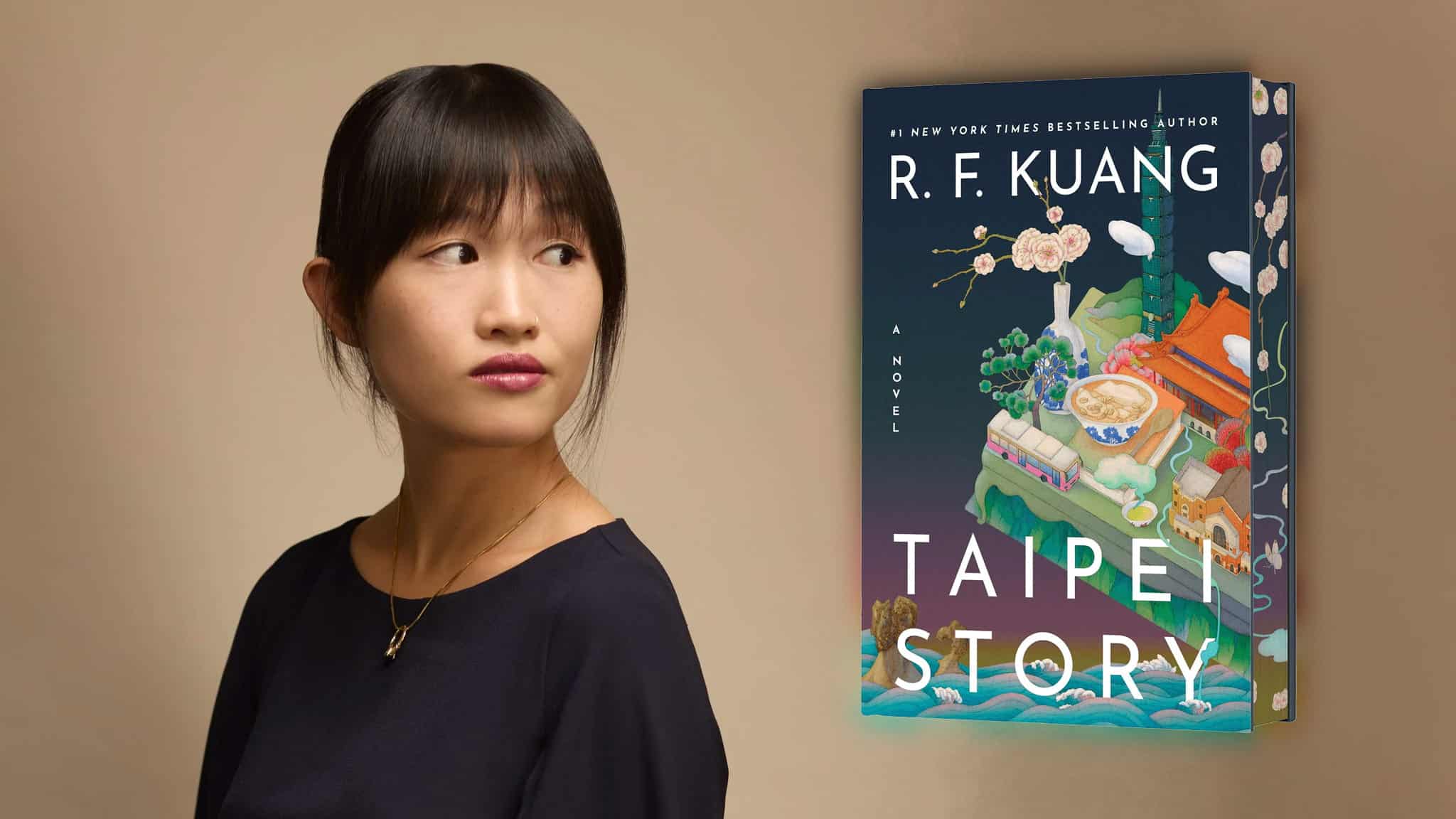
R.F. Kuang deflates the diaspora fantasy in ‘Taipei Story’
The author examines the Asian American trope of returning home and shows the beauty that can be found in going back
R. F. Kuang's novel "Taipei Story" releases on Sept. 8.
John Packman 2025

Words by Sara Conway
There are many words to describe R.F. Kuang: New York Times bestselling author. Teacher. Learner. But “invisible” might not come to mind.
Yet when Kuang was younger, that’s what she wanted to be—until her high school debate coach gave her the confidence to believe that she had something valuable to say. This coach taught her how to project, despite a speech impediment making her hesitant to speak out loud, and helped draw the now-lauded author out from her own shadow.
Kuang’s newest protagonist—Lily Chen in Taipei Story—is the opposite. Lily prides herself in knowing the answers, in making that knowledge known to others, in being an “excellent student,” Kuang tells JoySauce. The author challenges this personality trait often in Taipei Story, in which the Chinese American Lily goes to Taiwan to study Mandarin. Lily aims to use her magically improved language skills to reconnect with her grandparents in mainland China. But life, her teachers, and cultural shock have a different plan.
Ahead of Taipei Story’s Tuesday release date, I spoke with Kuang about puncturing the Asian American diaspora fantasy and the importance of learning to laugh at yourself.
This interview has been edited for clarity and length.
Sara Conway: Your author’s note starts with, “Taipei Story is a novel about getting things wrong.” Why did you want to write a story centered on mistakes and stumbles, especially those related to language and culture?
R.F. Kuang: When it comes to a diaspora identity and, in particular, language, there is such an attachment—almost a fetishization—of language skill as proof of being enough. It becomes almost a matter of proving your superiority to other people, the fact that you have the credentials that you belong more to this in-group.
On the flip side of this is that there's so much shame attached to people and diaspora communities who didn't grow up speaking the languages that their parents speak, who feel disconnected, who feel like they have been severed from a cultural lineage that they feel entitled to. The worst consequence of this is when people never speak at all.
Taipei Story is trying to push against this really rigid attachment to a total cultural authority and suggests maybe the important thing isn't proving that you're perfect at something. Maybe the more interesting way to live is being willing to make mistakes and (putting) yourself out there and just (being) extremely vulnerable in bilingual encounters. Unless you are doing that, unless you're opening yourself up to being corrected, then you can never learn and you can never form a genuine relationship to a new place that you would like to call a home.
SC: How did Lily and her voice first appear to you? How did you approach fleshing out her voice—which balances between a bit arrogant but also self aware—her personality, and her character arc?
RK: I was trying to figure out how a 19 year old moves through the world. This was a really fun technical exercise for me because I’m 30. So I couldn't write it just as a straight-up diary entry. There are experiences I've had that Lily hasn't. I deliberately chose a much younger protagonist for this novel because it's a novel about confusion and alienation, and those are really classic tropes for a coming-of-age text.
There are ways in which Lily is so competent and so clever. The main part of her identity that she's very attached to is that she is an excellent student. She is very diligent; she has a good work ethic; and she sort of treats life like a class. If you just dutifully prepare your material, and you show up and ace your quizzes, everything's going to be fine.
On the other hand, she is colossally clueless about so many things. She's just a really classic combination of a smart dumb that we all are. She is really observant; she overthinks everything; she is really perceptive. And for all of that perceptive ability, she keeps coming to the wrong conclusions anyways.

SC: Sometimes Lily pokes fun at herself and you, as the author, also poke fun at her relatable stumbles. Why did you want to take this approach to what could be a sensitive topic for some within the diaspora?
RK: I think it’s really important to make fun of yourself, and I think it's important to laugh. I wrote a much longer essay about the importance of laughing at yourself over at my Substack, but I take a lot of inspiration from a scholar named Doris Sommers’ monograph Bilingual Aesthetics. She does an extended analysis on the role of humor, on the value of being the butt of a joke. I think when you get comfortable with laughing at yourself—and being laughed at—it helps you move away from this default assumption that you'll only ever be met with hostility or judgment if you get things wrong.
Sometimes you f*cked up and it's hilarious. You say the wrong thing and you should be laughed at. But being laughed at is not the same thing as being ostracized, so if you can turn humor into a learning moment, into a compassionate encounter, that's really beautiful.
I think that's a good way to describe almost all of the awkward encounters in Taipei Story. They're hilarious moments that are deeply humiliating, but ultimately move everybody towards a place of deeper intimacy and connection.
SC: Why did you want to explore and deconstruct the diaspora fantasy?
RK: I think it's such a strong trope in Asian American fiction. It’s something that a lot of us still cling to deep down, this idea of “The Return” and reassimilation. Because we feel that as a loss, there is also this dream that if you just were magically able to acquire fluency—if you worked hard enough by getting it back, and went and spent time with your extended family—it would be like that breach had never occurred.
I think the urtext of this fantasy is in Amy Tan's novel, The Joy Luck Club, which is a novel that I love. It's not a criticism of it. It's just an instance of this fantasy coming true. It's just a fantasy about reconnection linguistically, about repairing mysteries in your family history. Of course it's natural that we're all hoping for that circle to close, to think if you could just get back home, everything would be okay. But sometimes that movement is permanent and sometimes your extended family doesn't want you. Sometimes you can't acquire that language fast enough, sometimes you do. Even when a language is no longer a barrier, all the other barriers are still in the place.
I wanted to puncture and deflate the diaspora fantasy and ask, “Well, if you can't have the fantasy, what can you have?” Even if that fantasy doesn't come true or that reunion doesn't look like how you expected, there is still something beautiful to be found in going back. It just takes a really different shape than what you'd always hoped for.
Even if that fantasy doesn't come true or that reunion doesn't look like how you expected, there is still something beautiful to be found in going back.
SC: Why did you also want your characters to begin understanding Taiwan’s complex history?
RK: Lily never gets a full sense of the history that she is operating within, or even as it pertains to the language program she is studying at. I wanted to portray, with a really light touch, how naive we can be about assumptions we make about homecoming, linguistic return, and diaspora fantasies.
Lily thinks that going back to Taiwan to study Mandarin is this act of uncorrupted return to a cultural heritage that was always there. This is a flat assumption for lots of reasons: first of all, her family is not from Taiwan. She's never stepped foot in Taiwan. Her parents have never stepped foot in Taiwan.
And then she's learning Mandarin. Because Mandarin language learning is a soft power push by both mainland China and Taiwan, there is this narrative being pushed that studying Mandarin in these places is a connection to a very long cultural heritage.
But Mandarin didn't become the lingua franca in Taiwan until the middle of the 20th Century. Before the Nationalists arrived and instituted martial law and began a period of extremely repressive language education, there were all these Indigenous languages that were spoken by the majority of the population, and that was also complicated by the fact that there were decades of Japanese colonial rule before that. Never was it organically the case that everybody just spoke.
Mandarin. Lily, at no point, questions this attachment between Mandarin and cultural connection and heritage the whole time that she is (in Taiwan). I couldn't spell all of this out throughout the novel because it's really important that everything is filtered through Lily's gaze and what she doesn't understand.
SC: Why did you want to include personal photos—both ones you took of Taipei and those of your family members?
RK: I have such a split mind about this. On the one hand, the book has been described as autobiographical—but that is very inaccurate. It's inspired by personal events, just like all of my novels are, but I didn't have Lily's life. I think a lot of authors, when they're writing loosely autobiographical things, they turn to fiction so they can explore the reactions they didn't have or the thoughts they didn't have.
At the same time, we had always wanted some sort of image to mark out the different sections of the book and their seven parts. I told my production team I have some great photos that I took while I was over there, and they would look like the same photos that Lily took as she was walking around exploring the city, so let's use those.
The only personal (image) is that portrait of my grandfather and that's used as the portrait for Lily's fictional grandfather. In that case, I wanted to indicate something about how any version of my own grandfather's past that I could write, any biography that I could do is also now fictional. I would have to fill in the gaps. I would have to project. I would have to interpret it because he's gone. I can't ask him those questions anymore. I can only ask my questions to silence.
SC: What does Lily learn about grief as she tries to express her grandfather’s death in Mandarin?
RK: I think this goes back to what we were saying at the beginning of our chat when we are talking about how it's important to be able to laugh, especially at yourself. I think one of the worst things that I experienced when I was grieving was silence from other people.
When I was grieving my grandfather—and we've had some losses in our family over the last a few years—I just wanted people to laugh with me. Laughter is the opposite of that suffocating silence. That silence weighs you down. The laughter lets you breathe again and buoys you up. Lily finally learns to start laughing about it and just saying something, even if it's the wrong thing.
She is wrestling with the impulse to be scared into silence out of fear of making the situation worse. But she finally learns, just as with her Mandarin, she just has to go through the wrong ways of dealing with it before she can deal with it at all.
Published on September 7, 2026
Words by Sara Conway
Sara Conway is a Chinese American writer based in New York and Taiwan. A lover of a good story and a good song, Sara is the creator behind the bookstagram Lyrical Reads and the digital editor at EnVi Media. She also has published her writing in places like Timid Magazine, GRAMMY.com, and Clash Music. Although books are her number one love, you can always find her learning Mandarin, listening to K-pop, heading to another concert, or petting all the cats she sees.