
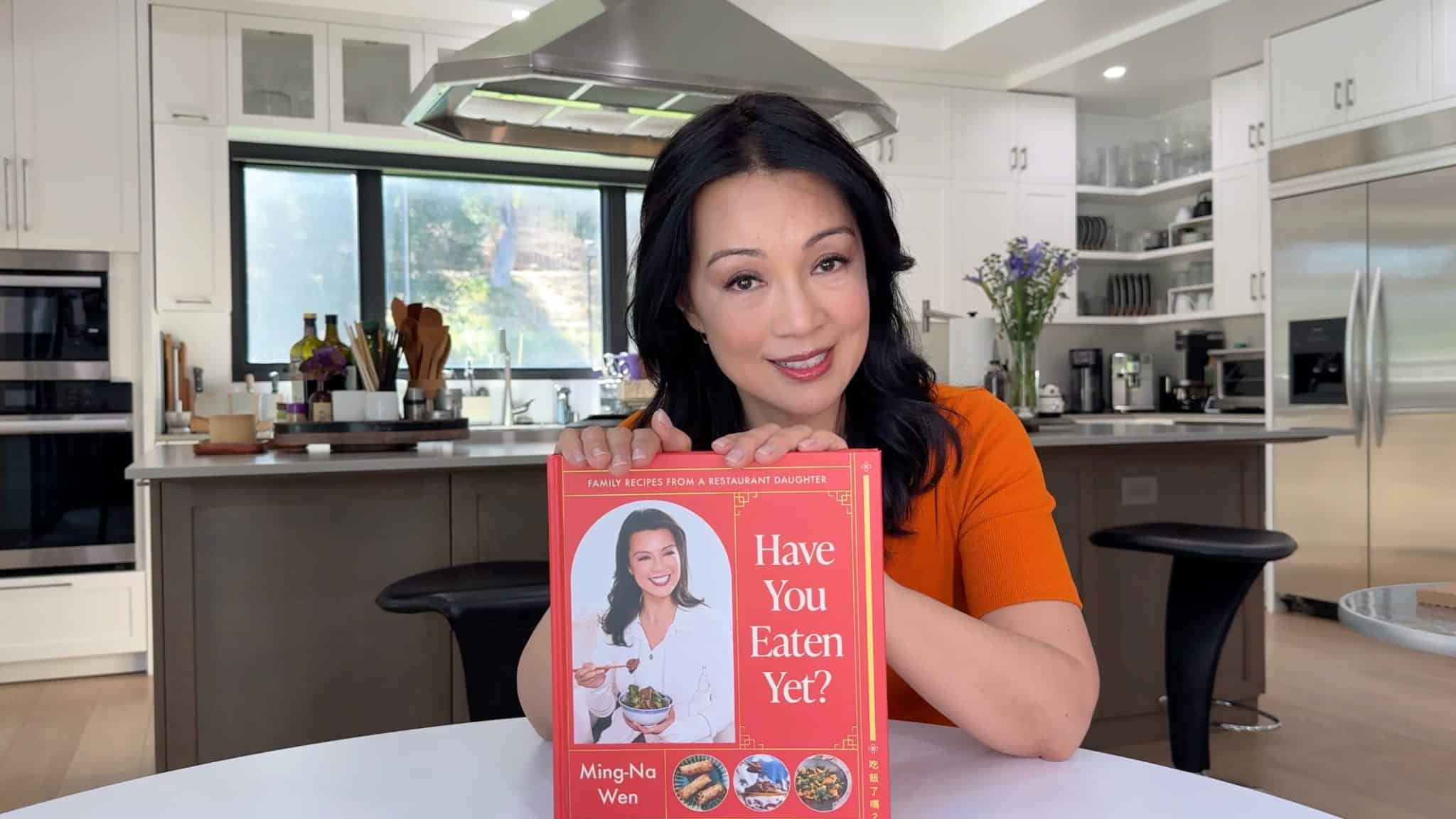
Ming-Na Wen’s debut cookbook asks fans, ‘Have You Eaten Yet?’
The screen icon discusses her cookbook, preserving her family's Pittsburgh Chinatown legacy, and bringing recipes to social media
Ming-Na Wen and her cookbook "Have You Eaten Yet?"
Wen in the Kitchen With Ming-Na Wen

Words by Daniel Anderson
For generations of audiences, Ming-Na Wen is a screen icon—the hero who saved China as the voice of Mulan, the formidable “Cavalry” agent Melinda May in Marvel’s Agents of S.H.I.E.L.D., the lethal mercenary Fennec Shand across the Star Wars universe, and a central heart of the groundbreaking classic The Joy Luck Club. But beyond her storied acting pedigree, there is another deeply personal side to Wen that fans are just beginning to discover.
With her debut cookbook, Have You Eaten Yet?, releasing on Tuesday, and a companion YouTube cooking channel, Wen invites readers out of the galaxy far, far away and straight into her home kitchen. Raised in her family’s legendary Chinatown Inn—the last surviving founding establishment in Pittsburgh’s historic Chinatown—Wen grew up steeped in the bustle of restaurant life, learning that food is the ultimate love language. Part recipe collection and part tender family archive, Have You Eaten Yet? captures the recipes, secret sauces, and memories that shaped her upbringing, transforming decades of unwritten family tradition into an approachable guide for home cooks.
In this conversation, the restaurant-daughter-turned-formidable-home-cook with a big-*ss wok spoke to JoySauce ahead of the book's release about deciphering top-secret family recipes, preserving Asian American history, and bringing the warmth and joy of the kitchen back to the screen.
This interview has been edited for clarity and length.
Daniel Anderson: I’d love to start with the timeline for the cookbook. This seems like something that was brewing for a while. What made now the right time to make it happen?
Ming-Na Wen: It really started with my fans wanting recipes because I love cooking so much and would post pictures of my food online. My manager eventually came over and said, "Listen, your food is great. Maybe you should write a cookbook." I said, "Are you crazy? I’m not a chef!" But then I learned that a lot of people who aren't professional chefs have cookbooks out, which validated me a lot.
I worked with a wonderful literary agent, Katherine Latshaw, and spent about two years figuring out what kind of cookbook it should be. I didn’t want it to be just Chinese food; I wanted it to reflect an Asian American experience. That meant including international dishes—like prime rib—that my father cooked for us growing up. Katherine suggested making the cookbook a journey through my life. It became somewhat autobiographical, which is something traditional Asian families don't usually do—we don't air our laundry! But it was a lovely way to reminisce and share my life with my fans.
DA: The storytelling is my favorite part of the book. Asian families aren't always known for sharing personal histories openly. Did you already have family photos ready, or did you have to dig through archives?
MW: It was definitely a process. There are a few very special ones. My mom didn't have many photos with my grandparents, but we have one prize photo: it’s of my grandmother, my grandfather, and my mom’s two older brothers. My mom is in the picture too because my grandmother was pregnant with her at the time! It’s sepia toned and held together with tape. Going through those photos grounded me. It made me look back at our family history and realize how important food was to the love we shared, especially since we didn't always share personal stories verbally. Passing these recipes down to my children is my way of passing on that legacy and tradition.
DA: In the book, you mention the challenge of recipe testing and pinpointing precise measurements—especially since so many Asian home cooks don't measure anything. Did you have established measurements for the restaurant recipes from Chinatown Inn, or did you have to figure those out from scratch?
MW: All from scratch! Especially the restaurant recipes. I’d ask my brother or my mom, and they’d list ingredients and say, "Yeah, I think there might be some of this in there too." I literally had to figure out the exact ratios by memory, going off how I remembered things tasting.
Everything down to our special duck sauce—to this day, I’ve never been to another Chinese restaurant that has duck sauce quite like ours. It’s very specific and really good. I feel like I’m giving away top-secret recipes, which is a bit of a no-no, but I wanted to share them because they bring back such happiness. Our restaurant is the last surviving establishment in Pittsburgh’s Chinatown, serving that community since around 1943. It felt like the right time for people to have these recipes to make at home.
DA: What was the hardest dish to decipher without measured recipes?
MW: The egg rolls! The Chinatown Inn egg rolls are famous not just for their size, but for their specific flavor. Recreating that recipe—and our duck sauce and General Tso's chicken—was a real challenge. Even with the written recipe, if you don't get the right oil temperature, the right amount of oil, or the right ratio of breading, it’s hard to get it 100 percent identical to the restaurant.

The secret egg roll recipe from Chinatown Inn is included in Ming-Na Wen's new cookbook.
Jennifer Chong
DA: How has the transition been to launching your YouTube channel and cooking on camera?
MW: It’s like trying to pat your head and rub your tummy at the same time! I felt a slight need to show that I could actually cook—to validate to myself that it’s not just my parents who are the chefs, but that I’m a real cook too. More than that, I wanted to bring the joy of cooking back to screen.
Starting the channel is a lot of work, but it’s so much fun once we get going. It’s also a great way to bring on my acting friends. I can't wait to do an episode with my Joy Luck Club sisters—though I don't think anyone will be able to hear what we're saying because we’ll all just be talking over each other the entire time!
DA: I read The Joy Luck Club in my senior English class in high school and watched the movie right after. Coming from a predominantly white background before moving to a school with a large Asian American population, that book was huge for my identity.
MW: Amy Tan is an incredible storyteller. She bridged both the cultural differences between East and West, as well as the generational gap between the older generation from China and the Asian Americans raised in the States. Her book helped me realize I wasn't alone. I had the opposite experience as you—I lived in Hong Kong and New York surrounded by Asians as a young child, and then moved to a suburb in high school where there were virtually none.
DA: But there’s a sequel in the works, right? If I remember correctly, there was something in development?
MW: There was, but all of us feel like unless Amy’s involved, it makes sense, and the script is good, we don’t want to sort of ruin the beautiful movie that came from the book.

Wonton soup from Ming-Na Wen's cookbook.
Jennifer Chong
Published on October 5, 2026
Words by Daniel Anderson
Daniel Anderson is a disabled Chinese American adoptee based in Seattle. His freelance writing specialties include K-pop, entertainment, and food. He believes that any restaurant can be a buffet, and the key to success is to take a nap each day. Follow his adventures on Instagram @danzstan.