
Mike Chen’s YA debut asks, ‘What happens after you save the world?’
In “Of Sorcery and Science,” the sci-fi author delves into fantasy for the first time and follows a teenage boy after his grand adventure
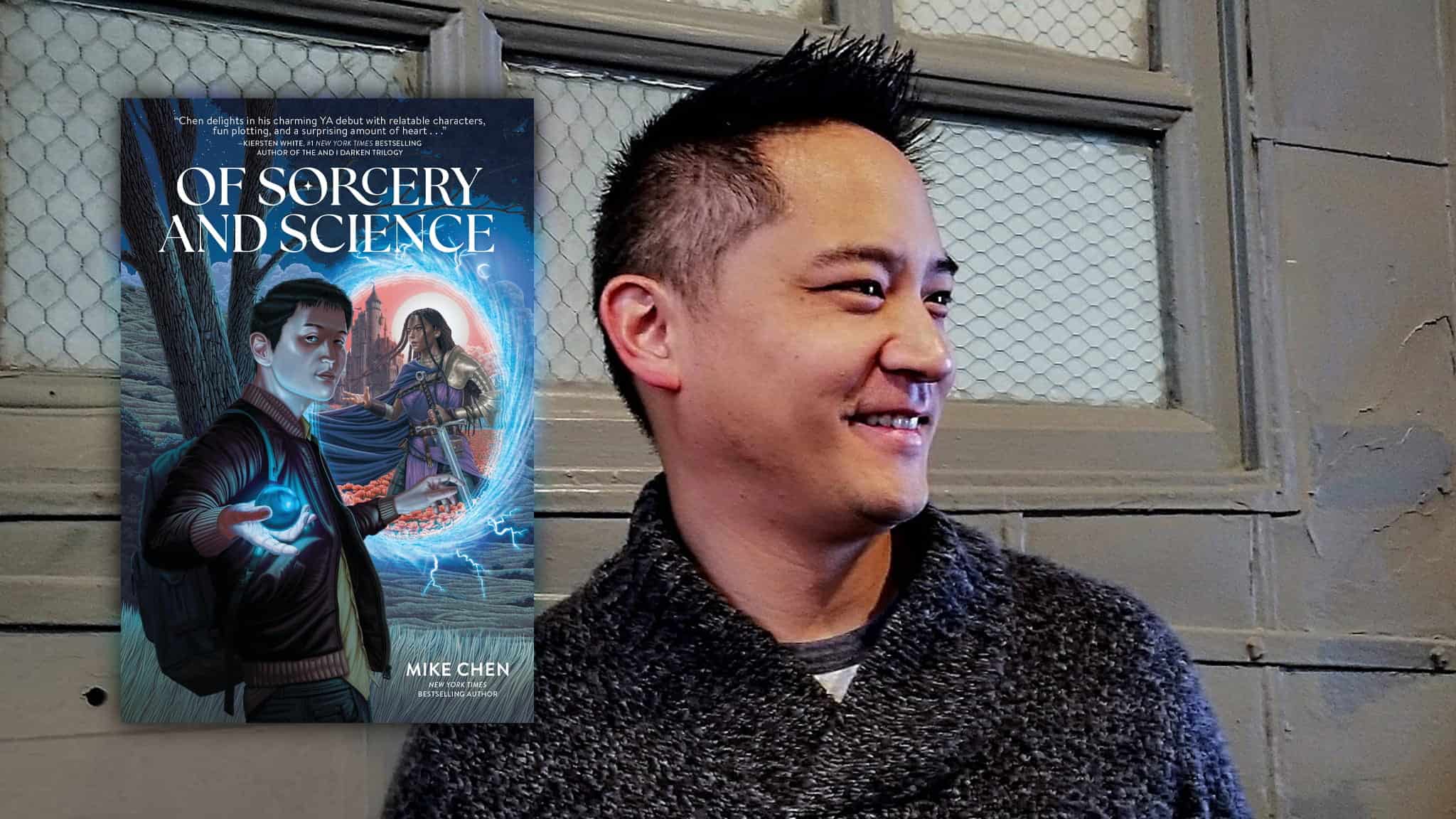
Mike Chen and the cover of his latest book, "Of Sorcery and Science."
Photo by Amanda Chen
Words by Samantha Pak
In literature, there are building blocks that make up every genre.
In a romance, the two main characters are going to fall in love and end up together. In a mystery, the killer will be unveiled. And in a fantasy adventure, the protagonist goes on a quest to save the world.
I’ve read enough of each genre that I can tell you many of the beats these stories will hit. For a fantasy adventure, our hero will likely go through some training—especially if they are new to the world, of a lower class in society, or female (because, the patriarchy)—defeat or befriend some sort of mythical creature, before taking on a final boss type of magic user. And in the end, they will be celebrated for saving everybody from a terrible fate.
But what happens after the hero’s journey has come to an end?
For Andy Lao, post-adventure life means coming home to the Bay Area and suffering through high school. As the protagonist in Mike Chen’s latest book, Of Sorcery and Science, we follow the teen after he returns from the Realm of Garriod—having become a powerful mage and, you guessed it, saved an entire realm. Needless to say, life in the real world is a bit of a letdown.
I recently spoke to Chen, who has previously written mostly for adult audiences, though he did contribute to the middle-grade anthology, You Are Here: Connecting Flights. Of Sorcery and Science came out Tuesday and is his young adult debut. The Bay Area-based author and I discussed writing for a younger audience and how it has helped him as a parent, the experience of existing between identities, and how a computer game from the 1980s inspired his story.
This interview has been edited for clarity and length.
Samantha Pak: What was the difference in writing for an adult audience and then writing for young adults?
Mike Chen: The voice is different. The You Are Here anthology really helped. It taught me how to shrink the level of overthinking that adults tend to do, which is often presented in prose. So the level of awareness and complexity of thought, to shrink it down and bring the emotions up. Because for people in their teens, they don't have the lived-in experience that adults can use to contextualize information. Because for them, the newness of emotions is so raw and so real—whereas when you're in your 30s or 40s, you've lived enough that you know how to tone it down a little bit. The stakes for your emotions when you're an adult are the same as they are as a teenager, but you know how to process them better and weigh them against real-world responsibilities.
SP: You're mostly science fiction, and this is a mix of fantasy and science fiction. Where did that idea come from to mix them both?
MC: My output shows that I am primarily a sci-fi person, and I've been a sci-fi person my entire life. But the one fantasy thing that I really enjoyed growing up was this RPG series for computers called Ultima.
Ultimas four, five, and six were really interesting because the series creator wanted to explore these themes of, what does it actually mean to be a hero? How do you uphold the virtues of being a hero? So that was the fourth game. And the fifth game was inverting that, where the government takes those virtues to extremes, and so as the hero, you have to destroy the system that you helped create. In the sixth game, you find out there's this secondary world to that fantasy world where your choices—the system that you have rebuilt—is creating harm to that other world. And so it's these huge themes that are very relevant today.
But in the fifth game, after you defeat the big bad, you actually go back to your real-world home and you find that you left the front door unlocked and so your house has been robbed. It was such a storytelling moment for me because it's this idea that the real world keeps going on while you're having this fantastical adventure. And that has stuck with me for years.

SP: In any traditional fantasy the story would be Andy going into the world, finding out he's the Chosen One, becoming a mage, fighting the chaos demon. This reminds me of Rosencrantz & Guildenstern Are Dead. They're the side characters in Hamlet, and here, they're the story. It is similar, in that vein.
MC: If readers want an epic adventure, there are so many epic adventures. But this is very particular about the emotional and relationship fallout after someone goes through something like that.
I go to a lot of conventions, and there's always the joke about how you feel depressed after a convention. When you go to a convention, you are entering a portal into this world where everyone just loves Star Wars, or DC, or Doctor Who, or whatever. And then you have to come back to the real world, where you're dealing with work and answering emails, and can't talk about Doctor Who with anyone. So, it's very much that same thing.
SP: Andy has saved the world, and now he's come home and it's such a letdown. He's like, “I just fought this chaos demon and all these different creatures and all this stuff, and now I'm stuck in chemistry and trigonometry.” And I love that he's not the best at those. I appreciated that he struggled academically.
MC: He’s a B student, yes. Just not good enough for Asian parents—but in particular, the hyper-focus you get in the Bay Area is, I think, off the charts. It's not healthy. I have seen it firsthand with the parents around here as we try to give our daughter a more balanced real-life education, as opposed to purely academics.
And part of it is cultural identity, too. I talk a lot about the child of immigrants thing. But there are so many different forms of existing between identities: If you're a teen and you're struggling with your sexuality or your gender identity, or your religion, whatever. I hope those readers can find a home in this too—the lateral parallel, to the need to exist in multiple ways. Because I think there's probably only a very small segment of teenagers who don't deal with that.
SP: When Julia makes her appearance, she comes to the Bay Area with Andy, and then they quickly realize that she's from the '90s. What made you want to make her from a different time?
MC: This book has themes of how systems and governments manipulate their messaging and presentation. And so the idea of having her draw in from a different era was the first hint that something's not exactly up and up with the government over in Garriod.
But also, I wanted to play with the idea of the time that we're living in now. I grew up in the 80s and 90s, and I'm seeing what was good and what was bad about that. We often joke, if you told someone in the 90s that you could have this little square in your pocket that has all the knowledge and all the media in history, and most people use it to sh*t talk to other people, they'd be like, "Really, what?” I really like that “aha” moment of if you could actually bring someone from that time period and put them face to face with now, what would their reaction be? It was a neat way for me to explore that dichotomy between the onset of technology, versus the overabundance of technology and how people would react to that.
SP: What were some of the challenges you faced with this?
MC: I think the biggest one was adjusting my instincts to the YA audience. The pace is different. Where you put the emotions in relation to the character's surface, that's much different. The amount of interiority and inner processing, the YA pace is much more immediate. I tried to really step through that with care to make sure that it was fitting this new age demographic that I was exploring.
SP: And on the flip side, what was your favorite part of this whole process?
MC: I was giddy that this idea that I've been carrying for a long, long time—like decades, even before I started properly writing as a professional—it was just really cool to actually be able to be like, “I'm going to get to explore this across a full story, and someone's going to pay me for it.” That was probably the most gratifying part.
It's interesting because I feel like individually in the real world, we really appreciate friendships, but our pop culture does not celebrate it. Our pop culture does not acknowledge the importance and the depth of friendships, and the diversity of friendships.
SP: One of the tropes in YA is there's always a love interest, and they always end up together. And another trope is the love triangle. I appreciate that you avoided all of that.
MC: This is (about) a friendship. It's interesting because I feel like individually in the real world, we really appreciate friendships, but our pop culture does not celebrate it. Our pop culture does not acknowledge the importance and the depth of friendships, and the diversity of friendships. My entire life, I've probably been friends with more girls slash women than boys slash men. And I think that's because I have a few stereotypical male interests, but in general I'm more arts and fandom inclined. I want to normalize that, especially now seeing my daughter entering her tween years. I want her to understand that it's totally cool, you know? Not everything has to be built like this.
SP: Do you have plans to write more for younger audiences?
MC: I definitely have ideas. I don't think I'm ever going to shift my primary output away from adults. But I had a really good time with this, and I liked feeling like a teen again, if that makes sense.
Understanding those emotions and writing kid lit helped me understand my daughter a little. It really allowed me to frame her emotions that I see when they puzzle me. If I take a step back and reframe it as, “Okay if I was breaking down a character for this age range, what would it look like?” I'm like, “Oh! I get it. The feelings are here. They can't process. The cognitive part is here, but the emotions are here.” And so that was a very surprising aspect of this. But in general, I don't fear writing kid lit like I used to. I used to think there's no way I could understand it or pull it off, and now I feel much more comfortable about it. So, if they will have me, I will pitch more stories.
Published on September 14, 2026
Words by Samantha Pak
Samantha Pak (she/her) is an award-winning Cambodian American journalist from the Seattle area and editor in chief for JoySauce. She spends more time than she’ll admit shopping for books than actually reading them, and has made it her mission to show others how amazing Southeast Asian people are. Follow her on Twitter at @iam_sammi and on Instagram at @sammi.pak.