
Like a high school overachiever, ‘Best of the Best’ peaks early
Directed by Lena Khan, Netflix's latest film is a scattered comedy-drama about a South Asian college dance troupe
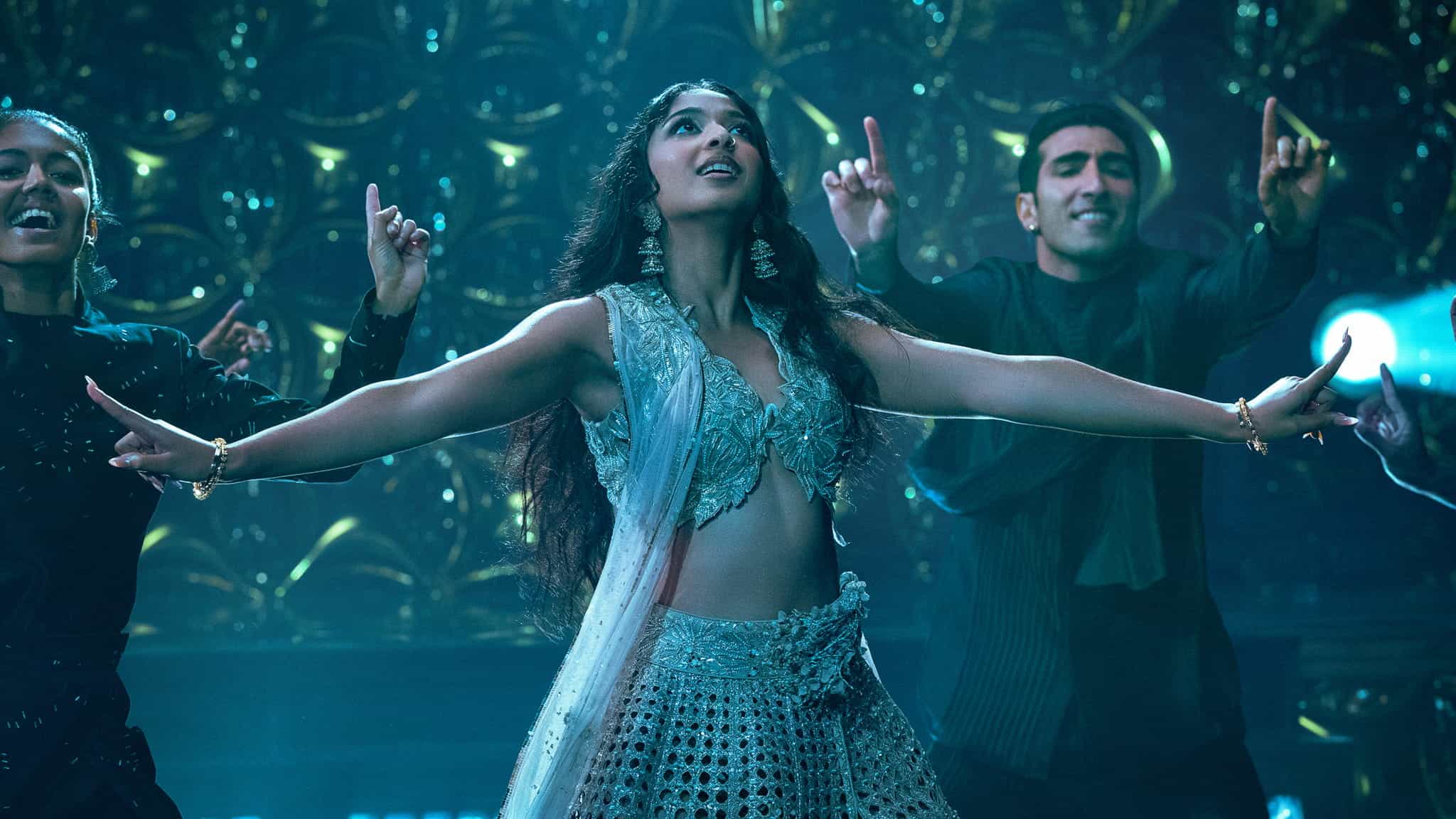
Maitreyi Ramakrishnan as Maya in "Best of the Best."
Emily V. Aragones/Netflix

Words by Siddhant Adlakha
The dancing is the best part of Lena Khan’s Best of the Best, but it’s also strangely vestigial for a film about a Bollywood fusion troupe. The coming-of-age movie centers on lifelong best friends Maya (Maitreyi Ramakrishnan) and Anjal, aka Anj (Priyanka Kedia), whose freshman year is built around this artistic staple of South Asian American college life. However, while the artistry therein announces itself with gusto from minute one, it ends up strangely divorced from the ensuing comedy and drama, which feel both haphazard and outdated.
For one thing, its Gen Z characters are second-generation Americans (their parents appear to have been born, or at least, raised in the United States), marking an intriguing shift from the first-gen focus of most South Asian American stories; South Asians are, after all, a relatively new immigrant demographic. However, the movie’s Millennial scribes—comedian Hasan Minhaj and his Patriot Act head writer Prashanth Venkataramanujam—have concerns that don’t quite gel with this premise, and slot into it in awkward ways.
For another, the film is often so ramshackle that it pulls back the curtain, perhaps accidentally, on how these films and shows often harbor outward animus towards South Asians hailing from the subcontinent. Is this a product of some internalized racism? Who’s to say, but in the absence of new immigrant parent characters, upon whom this angst is often projected, it instead manifests as stray verbal shots taken at “FOBs,” “Green Card mothers,” Indian accents, and a minor Indian-born character defined by his brash narrow-mindedness. None of these are overarching themes, but their totality is as irksome as it is revealing about why this mode of identity-politics storytelling feels so stuck in place.
To watch Best of the Best—named for the collegiate dance competition of its final act—is to be open to its display of athleticism and rhythm, at which it most certainly excels. However, the problem is that these scenes might just be too polished. Maybe that’s a good problem to have, but it has its drawbacks. Right from the opening, a high school talent show during which Maya and Anj mix classical Indian dance with modern jazz and hip-hop, the choreographed sequences adopt a climactic visual energy, and the kind of aesthetic finesse that screams dramatic harmony—even though so much goes wrong behind the scenes. These hurdles never manifest through movement, even in the form of a sweaty brow. No one seems to struggle to perform, even in rehearsal. A dance movie is effectively a sports movie, but that its athletes are consistently adept (to the point of flawlessness) makes the whole thing a lot less interesting, leaving little for the characters to actually overcome on stage.

From left, Maitreyi Ramakrishnan as Maya and Ankur Rathee as Ronak in "Best of the Best."
Emily V. Aragones/Netflix
There’s certainly drama to be found, much of it stemming from Maya and Anj’s divergent campus lives, their varying levels of academic prowess, and the way this complicates their co-dependence. However, this ends up building to last-minute reveals and realizations about how they see the world (and how the world sees them) that feel plucked from thin air. Best of the Best is the kind of movie in which both jokes and dramatic beats feel entirely self-contained, existing only in the moments they’re brought up and become relevant to the plot. Sadly, what needs to be paid off is seldom established beforehand, while the numerous setups are either immediately resolved, or forgotten altogether.
For instance, an embarrassing viral moment follows Maya from high school to UCLA, and becomes her impetus for joining Agni (the college’s sprawling South Asian dance team) so she can eventually move past this defining embarrassment. But once she’s accepted to the group, it doesn’t really come up again, rather than her having to work to shed this baggage (in other people’s eyes, or her own). Similarly, an imaginative scene where Anj imagines herself as the dance partner of Agni’s charismatic leader, Ronak (Ankur Rathee), paves the path for a romantic tale that doesn’t really exist—until it needs to generate some wheel-spinning conflict between the friends, late into the runtime.

From left, Becky Alex, Nihar Duvvuri, Shreya Navile, Maitreyi Ramakrishnan, Ankur Rathee, and Nico Greetham.
Emily V. Aragones/Netflix
Between these random spurts of manufactured drama are comedic beats that whiz past the screen at lightspeed. It’s a film strung together with attention deficits in mind, snappily adding joke upon joke via off-screen ADR—all delivered in the cadence of Minhaj’s own stand up—until half the dialogue seems to stem from minor characters out of frame. It’s comedy by way of culturally identified punchlines, in service of gesturing towards an in-group, rather than comedy rooted in the characters we’re actually following.
There are flailing gestures toward intra-South Asian divisions (like Maya having to establish that her family is Sri Lankan Tamil, not Indian, and an extremely minor gag about Hindu-Muslim animus), but these resemble the kind of Tumblr 101, baby’s-first-diaspora-discourse chatter from more than a decade ago; it’s a couple of rewrites away from a subplot about stinky lunch complaints. Fine, these are the established mechanics of this broad community—but what of it? The film doesn’t seem to want to do anything with this flimsy backdrop, beyond pointing towards it and saying, “See? We get it! Now pat us on the back…”

From left, Becky Alex as Dimple, Priyanka Kedia as Anjali, and Shreya Navile as Deepica.
Emily V. Aragones/Netflix
The cast bears little responsibility for this, mind you. They’re all adequately energetic, even if they sometimes struggle to conjure the appearance of depth from the material. Ramakrishnan is left especially astray, as a character whose selfish decision making sabotages her team, but whose self-centeredness is never contoured in meaningful ways, tied to her own past or her established worldview. It’s all a bit random at times, and although Maya has a romantic subplot of her own—with chipper family friend Arjun (an amusingly flirtatious Chaneil Kular; the movie’s standout)—this doesn’t tie much into the central dance drama either. Granted, it can be mildly refreshing that leaving romance on the peripheries allows for a stronger focus on the friendship of a female duo. But this also means their personal lives don’t often intersect with the central dance drama, whose high-concept staging and music video gusto emanate from a different movie altogether.
There has probably never been a mainstream American movie with this many South Asian actors, or this much Hindi and Tamil music laying the foundation for its verve (including, at one point, an improvised routine inspired by Kuthu, or Tamil street dance). But its dance scenes are entirely isolated from everything else, both visually and dramatically, rendering its more down-to-Earth concerns the product of the very same broad stereotyping Best of the Best no doubt hopes to combat. But this is perhaps its biggest problem: it plays more like a response to deep-seated grudges for past slights, than it does a tangible reflection of vivid, complicated human beings finding themselves during a pivotal college crossroads. Like the name of its protagonist, Maya, it’s a mere illusion of reality.
Published on September 18, 2026
Words by Siddhant Adlakha
Siddhant Adlakha is a critic and filmmaker from Mumbai, though he now lives in New York City. They're more similar than you'd think. Find him at @SiddhantAdlakha on Twitter