
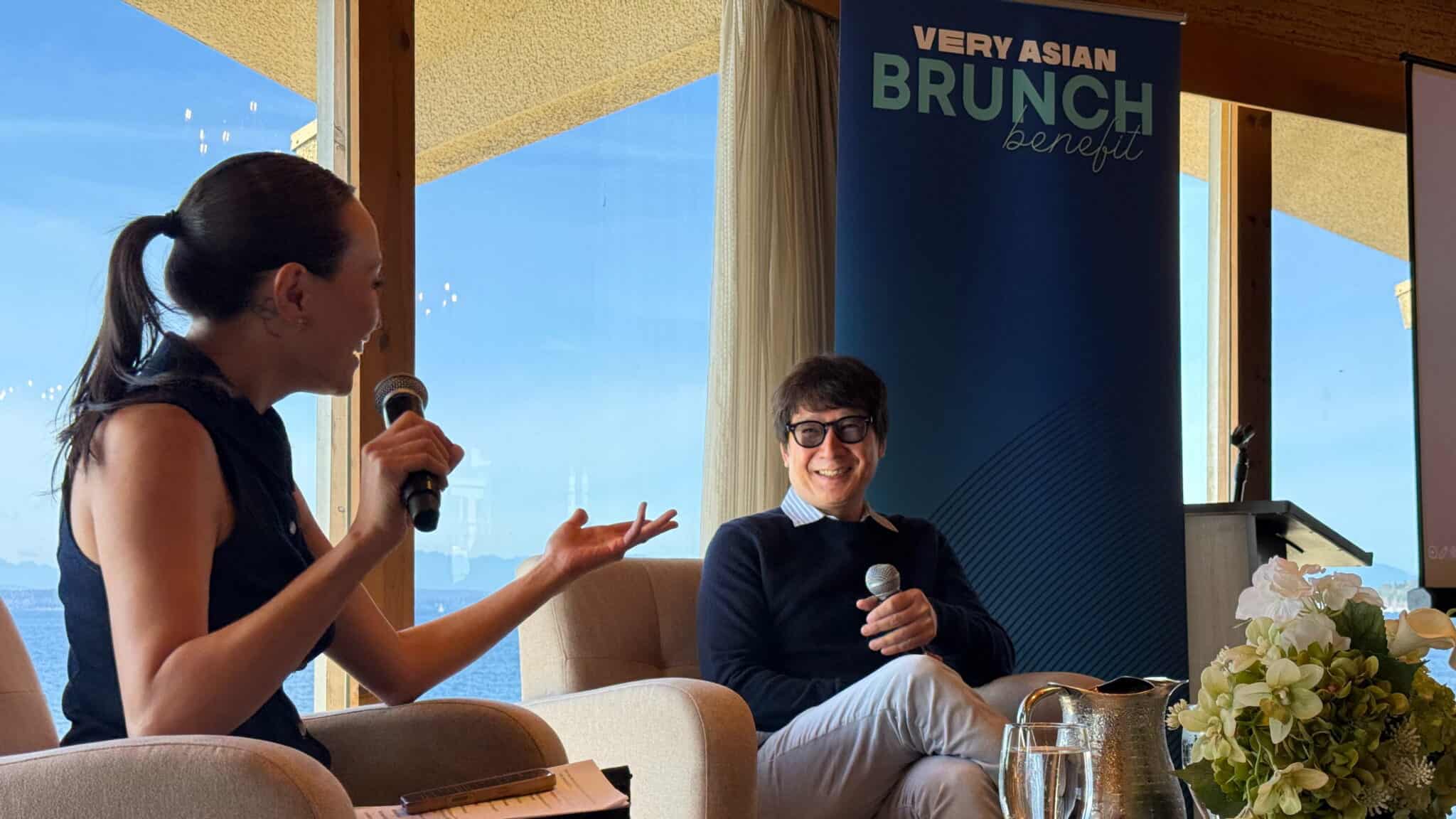
Ke Huy Quan joins Very Asian Foundation at annual Sunday Funday brunch
The event raised money for the foundation’s various programs, including bringing more Asian stories to bookshelves in libraries and schools
Journalist and Very Asian Foundation co-founder Gia Vang interviews Academy Award-winning actor Ke Huy Quan at the Very Asian Brunch in Seattle.
Samantha Pak
Words by Samantha Pak
At this point, most people with even a passing interest in film know Ke Huy Quan got his start in Hollywood as a child actor in the mid 1980s.
After starring as Short Round in Indiana Jones and the Temple of Doom (1984) opposite Harrison Ford, and as Data in The Goonies (1985), Quan acted in a few TV series and films through the late 1990s, but stepped away from the profession as opportunities dried up. He attended the University of Southern California to study film and began working behind the camera as a stunt coordinator and assistant director.
It wasn’t until the 2020s that he decided to get back in front of the camera—and he did it in a big way. Starring as Waymond Wang in Everything Everywhere All at Once (2022), Quan was on the receiving end of praise from critics and fans alike, with it all accumulating to numerous awards, including a Golden Globe and Oscar for best supporting actor. And since then, he has worked steadily in projects including Loki (2023), Love Hurts (2025), and Zootopia 2 (2025).
“I think when people think of me, they often think of the highlight reel: a kid who spent a year in a refugee camp and then got discovered by Spielberg, then got to go on this incredible adventure with Harrison Ford. And then all of a sudden, decades later, out of nowhere, he came back and won an Oscar,” Quan told journalist Gia Vang and Very Asian Foundation (VAF) co-founder at the their annual Very Asian Brunch in Seattle.
A life beyond the highlights

From left, Gia Vang and Ke Huy Quan discuss Asian representation in Hollywood.
Samantha Pak
During their fireside chat, Quan and Vang touched on other aspects of his life, the parts that aren’t on his highlight reel, including his childhood in Saigon, and his family’s three attempts to flee Vietnam after the Vietnam War ended, as the ethnic Chinese, like Quan and his family, were targeted because of the “geopolitics between China and Vietnam,” as he described it. The first two escape attempts were unsuccessful, and landed them in jail—all by the time Quan, who didn’t know why they were fleeing, was 8. Once his family was finally able to get out, they spent a year in a refugee camp in Hong Kong before immigrating to the United States.
Quan also discussed the stigma that comes with the label of “refugee,” telling Vang, the daughter of Hmong refugees, that he struggled with that identity for a long time. It took attending an event with the UNHCR, the UN Refugee Agency, and being confronted with his family’s story—including seeing the passenger log from the boat they escaped Vietnam on, with their names—that he came to appreciate his parents’ sacrifice. Now Quan wears the refugee label proudly.
These are the parts of Quan’s story that most people don’t know, as well as what his life was like during the 30 or so years he spent away from acting, which he called “the quiet years.” He details that story in his memoir, Never Say Die, which was published on Sept. 15 and made the New York Times bestseller list within a week and a half.
Very Asian representation
VAF was co-founded by Vang and fellow journalist Michelle Li, who received a racist voicemail in 2022 after doing a broadcast segment about the types of food people eat to ring in the New Year. Li, who is based in St. Louis, mentioned that as a Korean American, dumpling soup is part of her New Year meal. A viewer later called in stating she was being “very Asian” for the ad-libbed line and should keep her Korean to herself. Li posted the voicemail on social media. It went viral and garnered a huge amount of support as other Asian Americans shared their New Year meals and what made them “very Asian.”
This led to Li and Vang starting VAF, which focuses on shining a light on Asian experiences through advocacy and celebration.

Very Asian Foundation co-founder Michelle Li acts as auctioneer during the live auction at the Very Asian Brunch in Seattle.
Samantha Pak
One of the ways the foundation does this is through The May Book Project (MBP). In partnership with the nonprofit We Need Diverse Books, MBP helps schools and libraries “build and maintain robust Asian American youth literature collections for all readers,” according to the VAF website.
During Sunday’s brunch, VAF Executive Director Soogi Hong discussed the importance of kids seeing themselves reflected in literature, noting how many Asian Americans adults have grown up so accustomed to not seeing ourselves represented in any sort of media that we just didn’t expect it. And as a result, our stories are “treated as exceptions.”
Quan echoed this during his conversation with Vang. Speaking on Asian representation in his industry, he said questions on proper representation are important to ask because for so long, the community has been so underrepresented. And while Hollywood has made a lot of progress, being mindful of everything that’s going on, he does feel that we have taken a step or two back—which is why it’s important to keep doing the work and being vocal.
“We must keep asking that question for as long as we have to, until it's no longer relevant,” he said. “We can't be complacent just because we've had a few movies that made a difference, that won some Oscars, and were able to have some box office success. That's not enough because it's not the norm yet. So we have to keep working hard until it's no longer necessary to ask these questions.”
According to Hong, over the past four and a half years, more than 200,000 kids across 20 states, the Philippines and Canada have been impacted by MBP.
In addition to highlighting MBP, the brunch also included its first-ever live auction, a raise-the-paddle, and dessert dash—all to benefit VAF’s various programs.
Published on October 22, 2026
Words by Samantha Pak
Samantha Pak (she/her) is an award-winning Cambodian American journalist from the Seattle area and editor in chief for JoySauce. She spends more time than she’ll admit shopping for books than actually reading them, and has made it her mission to show others how amazing Southeast Asian people are. Follow her on Twitter at @iam_sammi and on Instagram at @sammi.pak.