
Inside the fight choreography of ‘Avatar Aang: The Last Airbender’
Actor and martial artist Alfred Hsing breaks down the fight choreography and creative decisions behind the new animated film
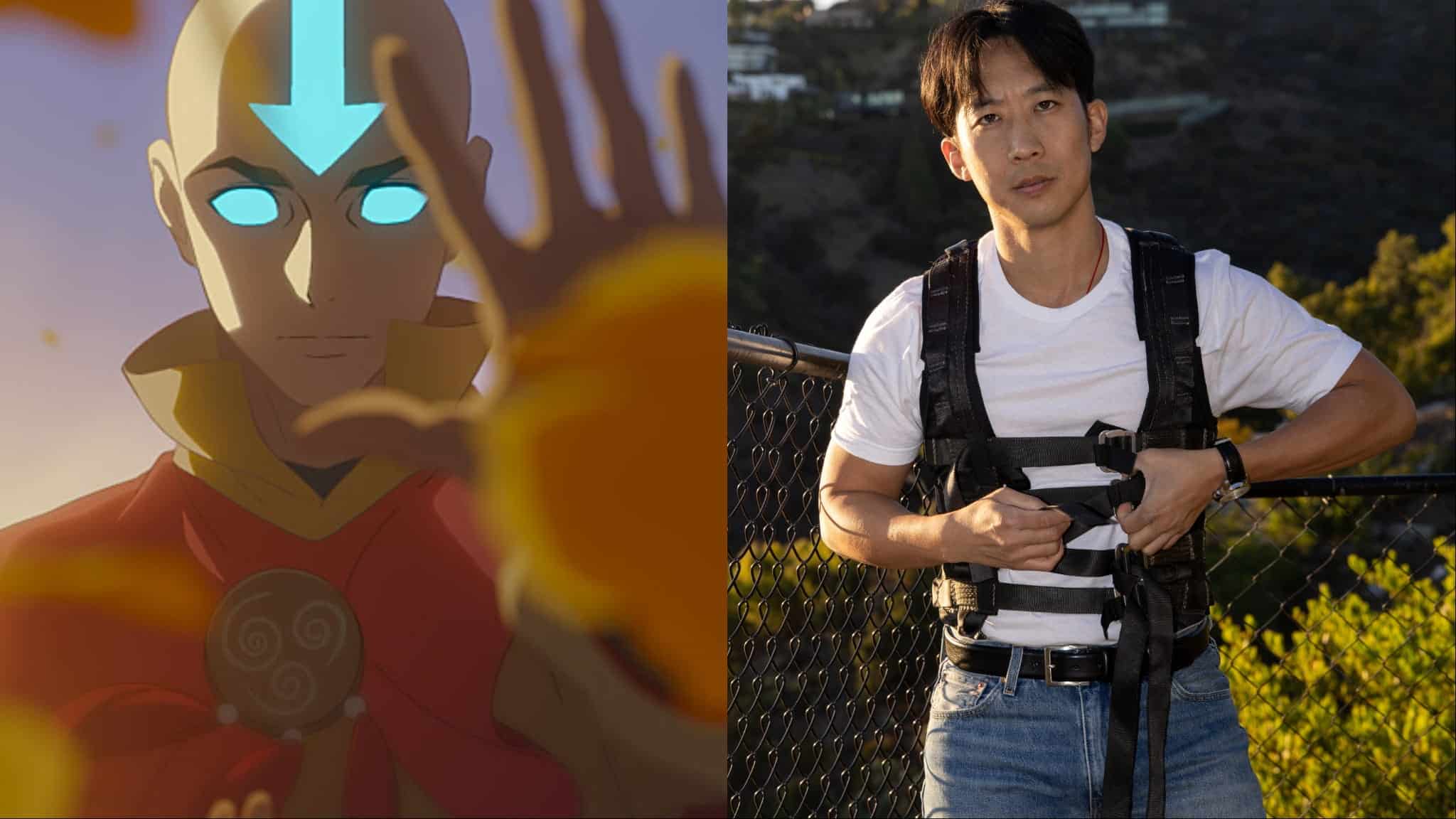
From left, Avatar Aang and fight choreographer Alfred Hsing who worked on the "Avatar Aang: The Last Airbender" film
Paramount & Diana Ragland

Words by Daniel Anderson
More than 20 years after Avatar: The Last Airbender first premiered in 2005 and more than a decade after The Legend of Korra concluded in 2014, the animated Avatar returns with Avatar Aang: The Last Airbender. The first major project from Avatar Studios—founded by original series creators Bryan Konietzko and Michael Dante DiMartino—the animated film follows an older Aang and his friends Zuko, Katara, Toph, and Sokka as they face a new threat in Tagah, an ancient airbender awakened after 5,000 years.
The film arrives after years of anticipation surrounding the return of the franchise. After departing Netflix’s live-action adaptation over creative differences, Konietzko and DiMartino launched Avatar Studios in 2021 to expand the world they created. Ahead of its release, the film faced an unexpected setback when it leaked online in its entirety, sparking renewed calls from fans for a theatrical release. Originally scheduled to debut on Paramount+ this month, the film’s release was moved up to July 25, with Paramount ultimately adding a limited theatrical run alongside its streaming release to make the film eligible for awards consideration.
Avatar Aang: The Last Airbender also introduced a divisive change among longtime fans with an entirely new voice cast for its main characters. Replacing the original animated series’ voice actors, the movie features an all-Asian cast including Eric Nam as Aang, Jessica Matten as Katara, Steven Yeun as Zuko, Dionne Quan as Toph Beifong, and Román Zaragoza as Sokka—a decision that drew both praise for its representation and criticism from fans who remained attached to the original performances.
Less debatable is the highly praised animation, world-building, and fight sequences, with much of the discussion centered on its detailed depiction of bending and martial arts. Helping bring those moments to life was Alfred Hsing, a world champion in wushu and the first American male to win gold in taolu at the World Wushu Championships. Hsing has trained extensively in the United States and China across multiple martial arts disciplines and brought his expertise to the project as a movement performer and choreographer. His credits also include stuntwork and acting roles across more than 80 projects, including the Oscar-nominated film Train Dreams, as well as collaborations with Jackie Chan, Jet Li, Donnie Yen, and James Hong.
Hsing led the action choreography and stunt coordination for the Avatar Aang film as well as Avatar Studios’ upcoming Avatar: Seven Havens series, taking place after the events of Legend of Korra. He spoke with JoySauce about designing the fight scenes for Avatar Aang movie and what went into creating new fighting styles for the film’s villains.
This interview has been edited for clarity and length.
Daniel Anderson: I’d love to first know how you became involved with the Avatar Aang: The Last Airbender movie.
Alfred Hsing: I first met Mike and Bryan about seven years ago through the Netflix team when they were developing the live-action series. At the time, I was only supposed to meet with some of the Netflix executives, but Bryan happened to join the meeting. We ended up talking about martial arts, action, Hong Kong cinema, and the films we loved.
After that, they asked me to put together some bending tests—firebending, waterbending, and a few other options. I worked with a small team to shoot them, present them, and they really liked what we did. From there, I came on to help develop the action and bending tests, including some that integrated visual effects to see how the bending would translate in live action.
When Mike and Bryan eventually left the Netflix project, that was my separation from it as well. But once they started Avatar Studios, they reached out to me again, and that's how I became involved with the Avatar Aang: The Last Airbender and Avatar: Seven Havens.
DA: Can you walk me through what that process actually looks like? I think when people hear action choreography or stunt work, they usually think of live action, not animation. How does that collaboration work on an animated film like Avatar Aang?
AH: One thing that's interesting about animation is there isn't really a standard workflow for working with stunt coordinators or fight choreographers the way there is in live action. On a live-action production, the stunt department is part of the process from the beginning. In animation, that's not always the case.
For the Avatar: Aang feature, we'd start with a concept meeting. Director Lauren Montgomery, the producers, and other key creatives would walk me through the scene—who was involved, what the emotional tone was, and what they wanted to accomplish. Then I'd ask a lot of questions about the environment, the characters, their weapons, their armor, and all the details that inform how someone would actually move.
From there, I'd develop the choreography. Sometimes I worked with a stunt team to design and perform scenes, especially when there were multiple characters interacting or complex timing involved. We'd shoot reference footage, essentially previs, to help communicate the choreography, even though those exact movements wouldn't necessarily appear on screen.
The animation team would then take those ideas and combine them with their own storyboards and creative input. Once the sequence was largely locked in, I'd go into the studio and perform the movements from the exact camera angles they needed. That way the animators could reference the rhythm, flow, hand shapes, and martial arts details that make the bending feel authentic. A real performer naturally creates transitions and movement that are difficult to invent from keyframes alone.
DA: Can you expand on some of the questions you like to ask or details that help you develop the choreography for a scene?
AH: The more information I have, the more immersed I am in the world. If I have reference photos, I want to know everything I can. Is the ground made of stone or metal? What's the environment like? Is the tone playful, or is it, "I'm here to kick your *ss?"
I also want to see the character designs. Are they wearing armor or not? What weapons are they using? Is it a guan dao or a small dagger? Even little details matter. If a sword has a tassel on it, that changes the balance and how you move with it.
All of those details inform the choreography. Is the armor heavy? Is the fighter bigger? Do I want to play against expectations by having a larger character move nimbly, or lean into those expectations and make them feel like a titan charging at you? How many people are in the fight? A one-on-one fight is very different from one person fighting six people or a battle involving hundreds.
Sometimes people think, "You're the choreographer, you can just make it up." Of course I can, but the more detail I have, the more authentic and specific the movement becomes.
DA: How was developing the choreography and fighting style for the film’s new antagonist, Tagah? He’s an airbender frozen for 5,000 years, likely has ancient techniques and has a more hawkish personality compared to the typical pacifistic airbenders from Aang’s time.
AH: Tagah was Sonam's strongest disciple before he ever had bending. He was out on peacekeeping missions, so imagine how skilled and disciplined he had to be to keep the peace without bending. That means he had to develop a fighting style rooted in martial arts first. Then, once he gained bending, he became even more powerful.
One thing I always wanted to see in the Avatar universe was more close-range kung fu. In the original series, bending was often the focus, partly because of the budget and partly because it was aimed at younger audiences. But with this feature film and the level of animation we have, it would have been a shame not to incorporate more martial arts movement.
So my approach was that Tagah—and The Denied (an extremist group of nonbenders) as well—were martial artists first. Even though all benders use martial arts principles, I wanted these characters to be high-level martial artists who understood every range of combat: bending range, close range, kicking, punching, and grappling. We stayed rooted in traditional Chinese martial arts rather than something like the MMA influence you see with Korra. I felt Tagah should be just as dangerous up close as he is at a distance because he originally learned to fight without bending.
DA: There was a lot of chatter online from fans who expressed disbelief that Tagah could take out Team Avatar: Katara, Toph, Zuko, Sokka and Aang so quickly.
AH: I'm a fan too, so I was asking myself all of those same questions while I was designing it. I'm really happy with the final film, but I also know there are always "what ifs." At the end of the day, there are practical realities—budget, time, and different creative voices—that shape what ends up on screen.
In my original action design, Tagah was never meant to overpower Team Avatar through sheer strength. He was able to handle them because of military strategy. He had the element of surprise, he separated them, and he played with them psychologically. I don't think there's a world where he could solo Team Avatar at full power.
One of the ideas I developed for him was an advanced, long-range version of chi blocking. I thought of it less like a projectile and more like a threaded needle. It had to be incredibly precise, requiring the right velocity and knowledge of chi points and meridians. It wasn't something anyone could just spam. It was a hidden technique that Team Avatar had never encountered before.
I also built a lot of strategy into the choreography. For example, Tagah intentionally maneuvered Katara and Sokka into position so he could strike them in a specific way. My interpretation was that the technique was powerful enough to incapacitate—or even kill—depending on how it was used, leaving room for Katara's healing to bring everyone back.
DA: There was also surprise from fans that The Denied could be so skilled in airbending after only gaining the ability to do so. Was their skill and threat for plot and pacing in the movie or did you have some more context you could add to explain?
AH: In my opinion, they were a little wobbly with their bending and certain things, but what they did have was weapons, and it all really tied in. In my ideal world, their weapons were designed to lend themselves to airbending later on. Even their weapons—like the spear-bladed kind of weapon we went through different iterations of—had almost like a sail element. Even the bow and arrows, they were going to use the weapons they were familiar with, but infuse and add airbending to them.
I was leaning into the idea that they are supposed to be very skilled, pure martial artists, not traditional bending martial artists. So they were going to infuse airbending into the tools they already used. It’s like if you’re already really good at tai chi, which is the basis of waterbending, then you develop waterbending—in theory, you’d be able to manage that, but there would still be a disconnect. You’d have to adjust from the martial art you know to the bending technique. But for the sake of time, they kind of have to get good. You can’t show a whole training arc of them learning. I think the practical result of what we see on screen is that they’re all of a sudden proficient.
DA: Lastly, what does it mean to you to be a part of this project in particular and help design something so integral to the Avatar franchise?
AH: I’ve reached a certain level of mastery in Wushu. I’m a gold medalist, world Wushu champion, the first American male to do so. I’ve trained in China, Hong Kong, and different parts of the world. Within Wushu, there are many styles—long fist, Southern style, broadsword, straight sword, staff, spear—and I’ve also done things like drunken sword, drunken fist, tai chi, Yang style, Chen style. But the reason I love martial arts so much is there’s no way any one single human being can master every single style of martial arts. I consider myself a lifelong fan of martial arts, and I’ve grown to love MMA and modern martial arts as well. I absorb information, and I have a wealth of interest, knowledge, and hands-on experience with a vast amount of styles.
So with this project, I’m not just a coordinator or choreographer, I’m also a reference and a performer. The cool thing is I’m technically every single character. Their movement is literally based on me. I bring a lot to it because I also bring in acting. When I’m performing as them, I try to genuinely move like the character, because not everyone should just have a clean, flawless movement. Different characters have different personalities. Aang is more of a pacifist, so maybe he’s dodging, spinning, using his bagua, but then when he finds an opening, that choice has a payoff because you understand why he made that move. I kind of get into the head of the characters and think about how movement conveys personality, story, and feeling. I’m combining my martial arts background, my movement performance, and my understanding of action filmmaking.
Published on October 19, 2026
Words by Daniel Anderson
Daniel Anderson is a disabled Chinese American adoptee based in Seattle. His freelance writing specialties include K-pop, entertainment, and food. He believes that any restaurant can be a buffet, and the key to success is to take a nap each day. Follow his adventures on Instagram @danzstan.