
How Scott Sodbiligt is bridging the gap between the world and Mongolia
Through social media, the content creator shares lessons on the country’s history and culture that most of us never learned in school
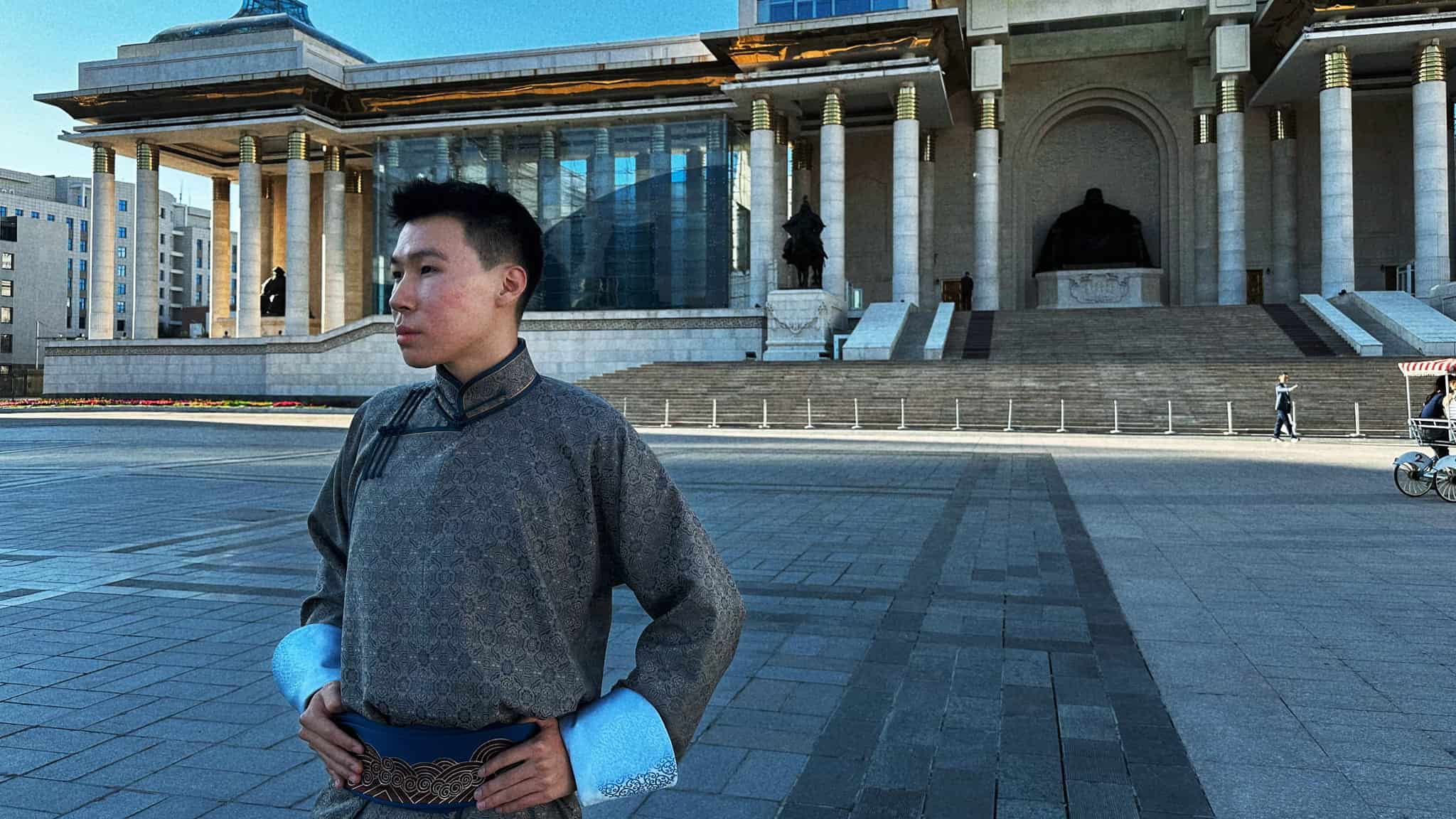
Scott Sodbiligt in Ulaanbaatar, Mongolia, standing in the main square in front of the city's parliament building.
Courtesy of Scott Sodbiligt
Words by Aleenah Ansari
You might recall the scene from Mulan (1998) in which the titular character is feuding with Shan Yu, the leader of the Hun army, on the roof of a temple while everyone is celebrating Capt. Li Shang and his military’s supposed victory. There’s a moment when Mulan gets Shan Yu’s attention by pulling up her hair to reveal that she was the one who caused the avalanche that buried most of his army. Shan Yu acknowledges her as “the soldier from the mountains.” It’s clear that Shan Yu doesn’t care that she’s female, just that she’s a warrior.
This is something that Mongolian content creator and digital nomad Scott Sodbiligt points out in one of his videos on Instagram. His content covers many aspects of Mongolian culture, including information about things people may not know, such as camel coaxing, how hats serve as symbols of honor and status, the conventions of nomadic culture, and how women on the steppe often ruled and fought in wars.
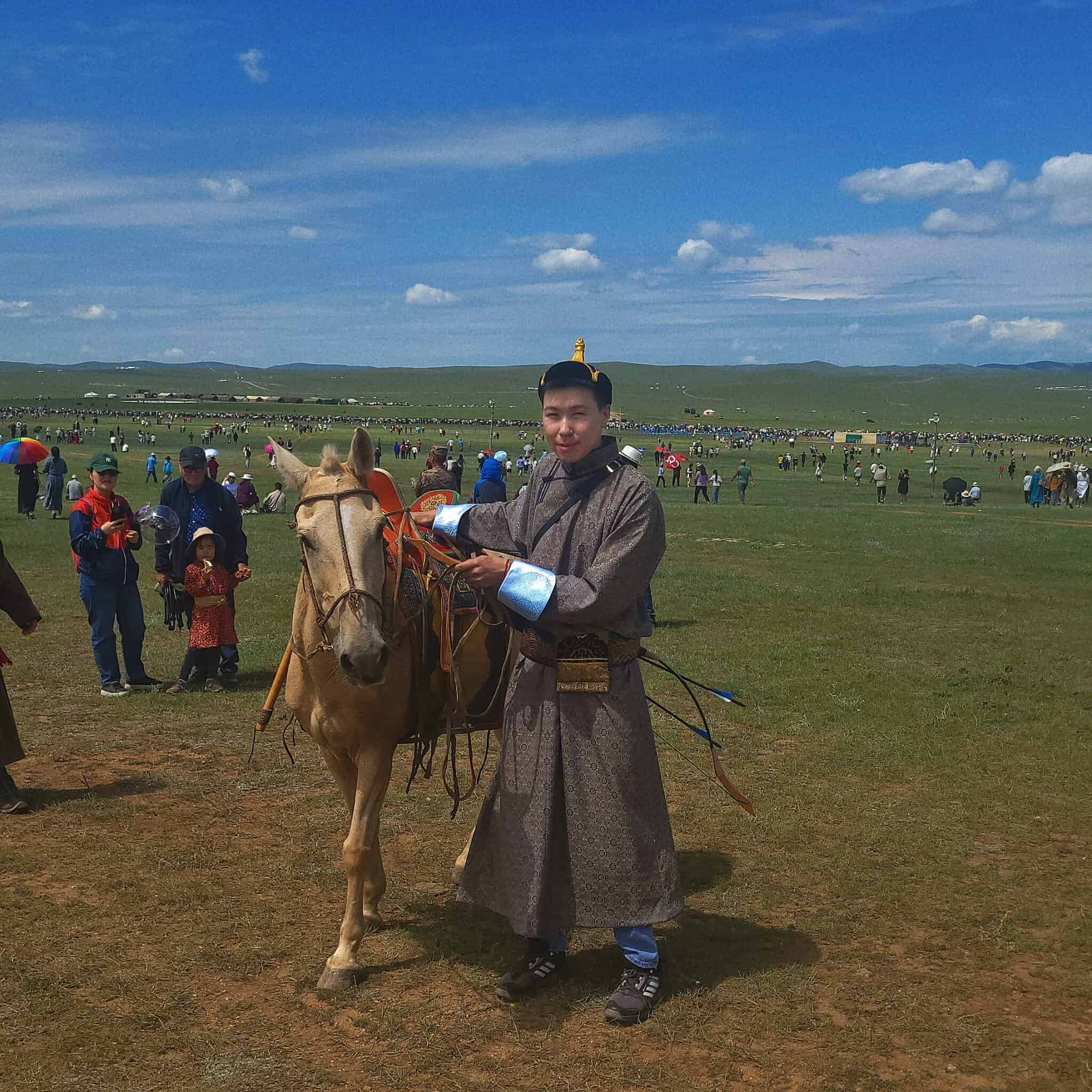
Sodbiligt at the Naadam Festival, Mongolia's biggest festival celebrated every year from July 11 to July 13.
Courtesy of Scott Sodbiligt
I sat down with Sodbiligt to chat about the catalyst for sharing his culture through educational content, what it means to come from a nomadic culture, and what he wishes people knew about Mongolia.
This conversation has been edited for clarity and length.
Aleenah Ansari: What led you to start creating content about Mongolian culture?
Scott Sodbiligt: I made a video of myself bowing to the statue of Chinggis Khaan (Genghis Khan), which is a sign of respect in Mongolia, and I got a lot of mixed comments. I think Chinggis Khaan is one of the most misunderstood people in history, and it may be because of one-sided narratives that made him look like a conqueror who destroyed everything in his path. In Mongolia, we see Chinggis Khaan as the founder of our nation, so he’s the most respected historical figure in Mongolia. He’s on our banknotes and has a statue in front of the parliamentary building, our airport is named after him, and we cannot imagine Mongolia without him. After making the video, I started posting more content, and people all around the world began to understand Mongolian culture more deeply. I continue to see my platform as a bridge between the world and Mongolia.
AA: How do you explore the complexity of Mongolia’s history in your content?
SS: Every civilization has positive and negative legacies. With my platform, I’m not here to rewrite history or leave out the difficult parts. I believe history should be understood through different perspectives. For centuries, historical documents were written by people fighting against the Mongols, but that’s not the only perspective. I also want people to hear stories from the perspective of Mongolians, and the legacy of what we’ve built including modern diplomacy, paper money, and the postal system.
AA: What do you share about the role of women in Mongolian culture, and the fact that they are often in positions of power?
SS: One thing I shared in my content was that in the Disney movie Mulan, Shan Yu sees Mulan and doesn’t mention that she’s a woman. Instead, he sees her as a soldier because that’s what matters to him, not her gender. Similar to other Indigenous cultures, nomadic steppe history respects women and often puts them in positions of power.
In Mongolian history, there have been many women rulers, and it was normal for women to go to war and take control of the empire. The nomadic lifestyle requires both genders to be equal and contribute, and that’s how people survived. If there were a slight inequality, it would impact the chance of survival. Historians say that Chinggis Khaan’s main adviser was his wife Börte, and Mongols have always respected women and held them in high regard as partners. That’s something I wanted to share through my platform. In modern Mongolia, there are women leaders in entrepreneurship, parliament, and other fields, but there’s still work to be done on gender equality.
AA: You’ve talked about Mongolian culture being nomadic and the relationship between people and nature. What does that look like?
SS: Nomadism is how humanity used to live before people became sedentary. There are many people who maintain a nomadic lifestyle, and up to 40 percent of Mongolian people are still nomadic. As a nomad, you live at the mercy of Mother Nature because your wealth and possessions are your sheep and flock. With one natural disaster, you could lose your whole flock. To be a nomad, you have to be able to connect with nature, which you can see in some of my content about camel coaxing. In the traditional sense of nomadism, land is not something to be owned because humans are visitors in the world. As a nomad, you have that understanding that land is not yours, and you also don’t get attached to many possessions. You only keep your essentials, and you move every season to raise your flock.
This deep connection to the land is also spiritual. Ancient Mongols practiced Tengrism, which is a form of Shamanism that held a reverence for the natural world. The entire lifestyle revolved around the understanding that the Earth was a sacred, living entity rather than a commodity to be owned.


At the same time, Mongolian nomadic culture is now very modernized because they have electricity, wi-fi, and phones, mostly powered by renewable energy. Some modern tents have solar panels, which provide electricity. When a nomadic family has children who need to go to school, they may need to go to a closer town for the winter, and the child would come back and still be a part of the nomadic culture.
AA: Some people think that you cannot evolve tradition for life today, but you definitely can while maintaining your roots.
SS: Absolutely, and Mongolia is a great example of that. There are children who learn to speak English in tents. Besides horses, people use cars and motorcycles to get around. Nomadic life is very communal, so whole families come together to maintain this tradition. Mongolians used to be completely nomadic several generations ago, but in the last 100 years, people have started coming to the city.
AA: What’s a piece of content that you’re especially proud of and that resonated widely?
SS: One of my most popular videos was about camel coaxing, a practice passed down for generations, where Mongolian nomads perform a musical ritual when herding camels. I made this video with a scene from the movie, The Story of the Weeping Camel, after having a dream about it, and it felt like it was something that the world should see. I cried while making the video because the connection between humans and nature touched my heart.
AA: What do you want people to learn or notice when they watch your content?
SS: Now that my platform has grown, I feel the responsibility to represent Mongolia because I might be the first Mongolian content creator that someone finds. While I cannot speak for every unique experience across Mongolia, I hope my platform inspires others to explore the diversity of our culture for themselves. I just share what I know. I also strive to encourage more people to do their own research about Mongolian history and culture.
Our culture has evolved throughout history, but we are still here. We are the successors of the ancient steppe nomads, carrying a tradition that continues to evolve rather than disappear. We see our past as our own and look forward to how we can keep this tradition alive.
Published on October 7, 2026
Words by Aleenah Ansari
Aleenah Ansari is a Seattle-based writer covering representation in media, holistic wellness, travel in the Pacific Northwest and beyond, and the non-linear career paths of BIPOC creatives, entrepreneurs, and authors. Her work has been featured in Insider, The Seattle Times, JoySauce, and more. When she's not writing, you can find her searching for murals, running after the bus, or planning her next trip to New York. Learn more at www.aleenahansari.com and follow along at @AleenahWrites on Instagram.