
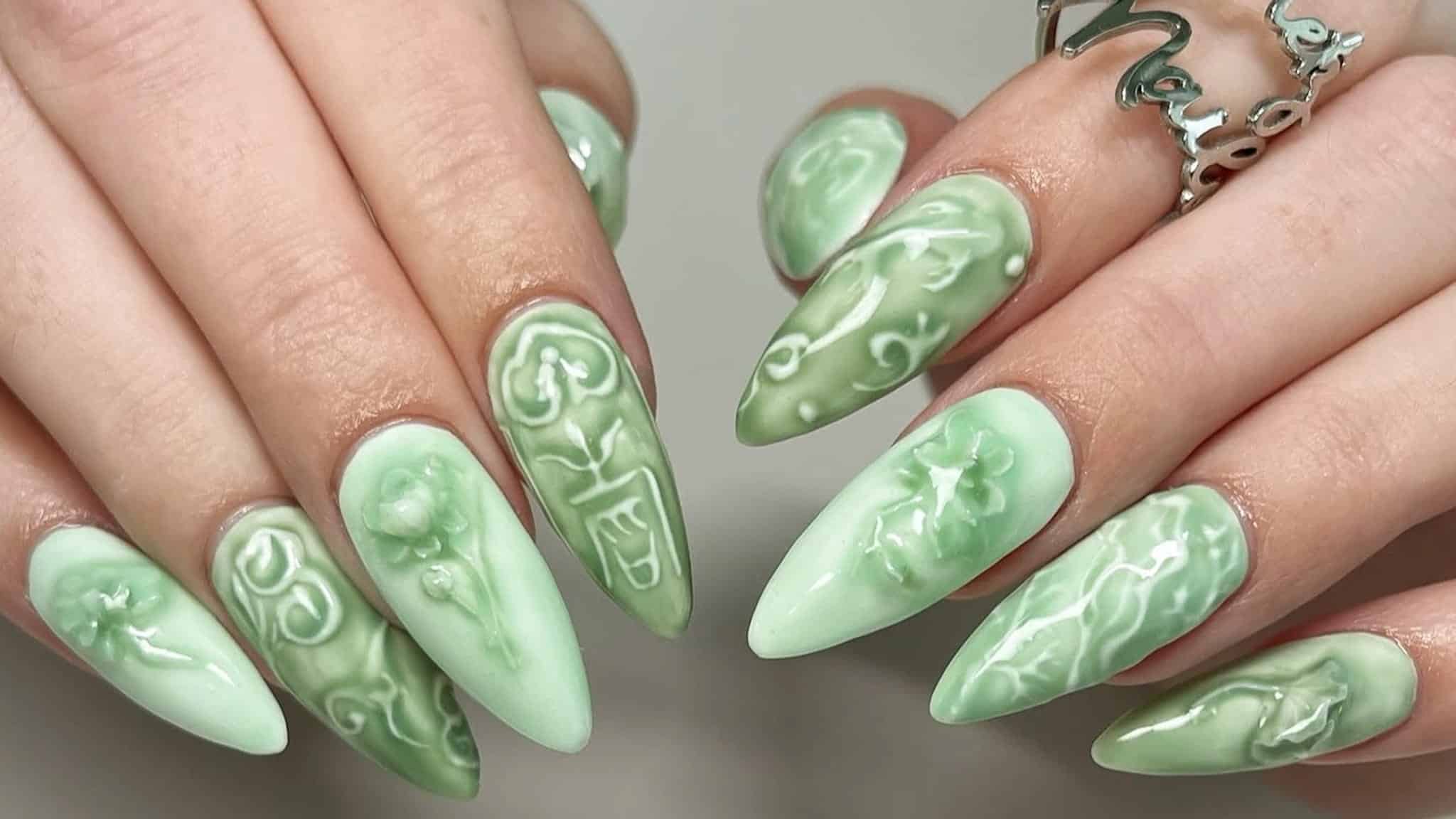
How Asian art traditions are transforming modern nail design
From Mughal miniatures to Chinese calligraphy, centuries of Asian art is finding a new canvas in manicured nails
Some nail artists are using their work to reference a long history of Asian art.
Janet Lau

Words by Janvi Sai
Custom nail and press-on nail artist Janet Lau’s clients come to her private studio in Vancouver, British Columbia. Like visitors going to a clairvoyant, they give her their hands to take in hers, not knowing the outcome. Much like receiving a fortune, there is a general anticipation of surprise, as well as the possibility of direction with more pointed requests, such as inquiries on a client’s love life or career prospects. Lau refers to this experience as getting a “mystery box,” although the mystery in question isn’t a client’s future per se, unless, perhaps, we’re talking about their future nails.
Lau’s proclaimed “mystery box” component comes from her practice being entirely unconventional: she creates on impulse with unexpected materials such as Chinese calligraphy brushes, watercolor and acrylic paints, and even Crayola colored pencils.
She describes adding sketch-like strippling, creating gradients, layering colors, and building texture on a canvas just as a fine artist would, using "canvas" not in a metaphorical sense, but literally. “Most people don't realize that once a nail is finished with a specific matte top coat,” Lau notes, referring to Korean gel matte drawing top coats, “it can behave like paper.”
By altering the smooth and hard nature of nail plates into what she credits as, “the tooth of the matte surface,” Lau engineers a canvas’ grip, allowing her to create painterly works steeped in Chinese art and aesthetic memory. “Traditional Chinese painting and calligraphy place a huge emphasis on brush control, movement, and the variation of line weight, and I wanted to bring some of that feeling into my work,” she illustrates. “A lot of my process involves looking beyond the nail industry and borrowing techniques from traditional art forms.”
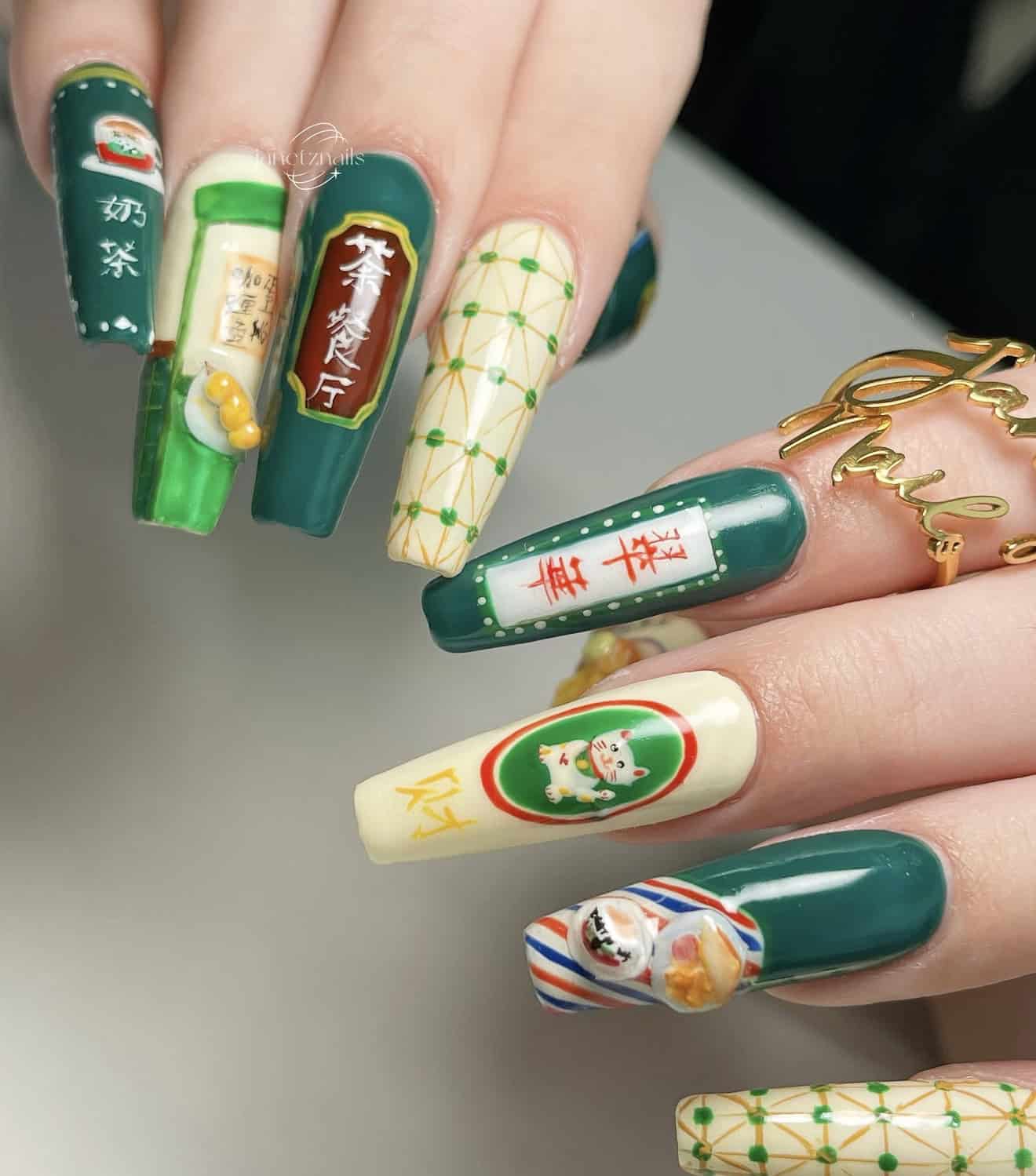
Nail artist Janet Lau treats her clients' nails like a canvas.
Janet Lau
A rising art form
Around the globe, a burgeoning movement in both nail design and Asian art emerges: Asian artwork and motif-inspired nails. Like the Asian artistic traditions they’re inspired by, the manicure art is meticulously hand painted and often bespoke.
While Chinese royalty and nobility donned long nails and decorative nail guards during the Qing and Ming dynasties as a social status symbol, and the first nail polish was created in China in 3000 B.C., the Chinese-rooted nail styling seen today is more akin to Chinese history that’s more miniature.
It was during a visit to the Hong Kong Museum of Art that Lau’s inclination towards Chinese nail art was reassured by the ancient Chinese miniature art on display. “Seeing these snuff bottles or intricately painted jewelry boxes reminded me that miniature art has a long history in Chinese craftsmanship,” she reflects. “Historical objects like these reinforce my appreciation for detail and remind me that small-scale art has always been valued within Chinese artistic traditions.”
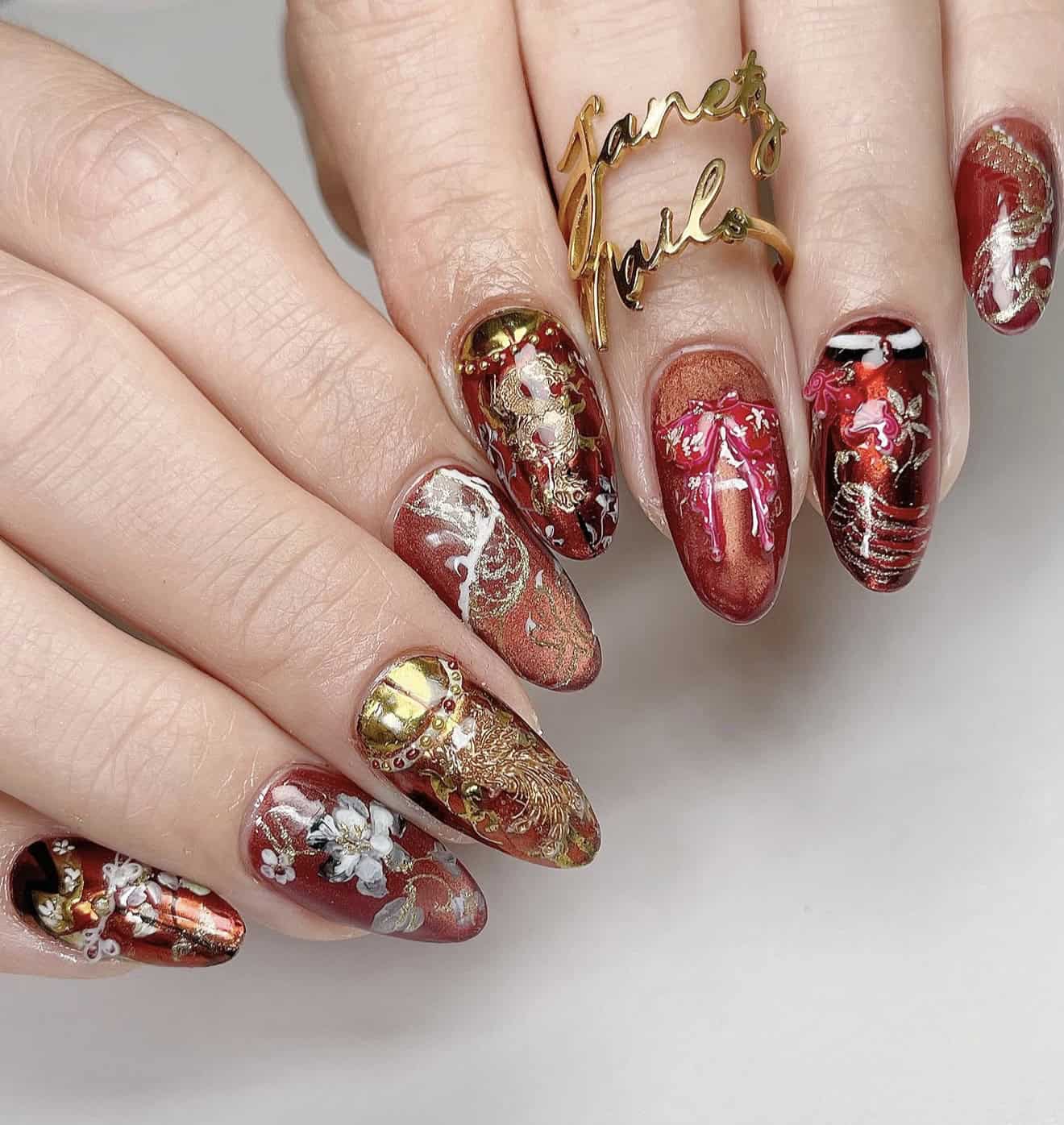
Lau found some inspiration at the Hong Kong Museum of Art, while looking at miniature art and other historical objects.
Janet Lau
In the same vein, while some of the earliest manicures were seen in Bronze Age India’s henna-stained nails, South Asian-inspired nails are closer to a different artistic tradition: South Asian miniature paintings. Known as South Asian miniatures, these miniature paintings were commissioned across the empires of the Indian subcontinent to depict epic scenes at a tiny scale. South Asian miniatures are recorded to be older than India’s use of paper, and so translating them onto nails is only fitting.
Across the pond in Manchester, England, Zahra Nadeem of ZHR Nail Artistry originated a niche in South Asian-inspired nails. “When I first began incorporating South Asian motifs into my work, I hadn’t seen anything like it before,” she recalls. “I was overwhelmed by how deeply it resonated with the South Asian community.”
Depicting elements such as scalloped arches, textile texture, Urdu calligraphy written in iridescent gold-colored pigment, and human and animal subjects all in a cohesive nail set or even a single nail, her creations capture the essence of both the rich iconography and ornateness of South Asian miniatures. “I’m especially inspired by traditional motifs and miniature portraiture,” Nadeem says about the millimeter-sized depth and intention. “A single lotus or peacock can carry centuries of symbolism, history and meaning. That’s what fascinates me.”
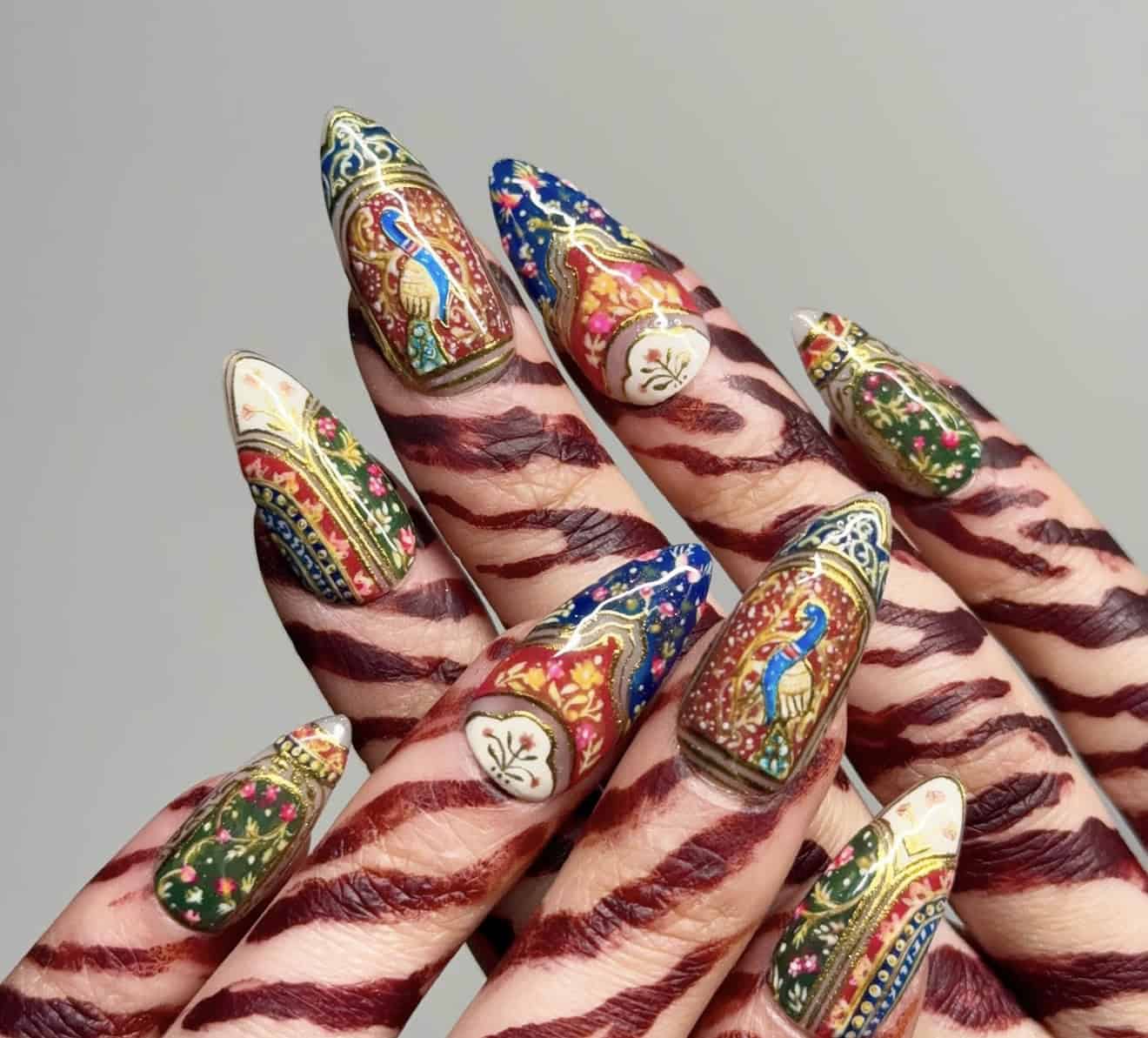
Zahra Nadeem of ZHR Nail Artistry originated a niche in South Asian-inspired nails.
Zahra Nadeem
And like the experience of viewing a South Asian miniature, each nail set carries a narrative with boundless opportunities for discovery and exploration with each look. “I immerse myself in the intricate details of Mughal architecture, miniature paintings, historic textiles and traditional craftsmanship before developing a concept built around layered storytelling,” Nadeem says.
She imparts, “Every brushstroke is painted by hand, and each piece can take anywhere from several hours to multiple days to complete.” Her process speaks to the artisanal craftsmanship involved in the minutiae, that nail art can be history, and that nail art is art.
Where nail art and culture intersect
Cultural institutions like The Smithsonian are carrying this sentiment forward.
The Smithsonian National Museum of African American History and Culture recognizes the Asian origins in nail history, in addition to Black American women’s adoption of acrylic nails as a redefining force in nail design as we know it today.
Golden Age Hollywood actress and Black entertainer Lena Horne’s nail care tools are housed in the museum, and decorated acrylic nail sets from 1993 are on display at The Smithsonian Anacostia Community Museum in Washington, D.C. The Smithsonian Institution even launched The Nail Art Project in 2025 to commission nail works inspired by the Smithsonian’s collections.
Manicures have received scholarly attention from beauty historians and researchers like Arabelle Sicardi, author of the book of essays, The House of Beauty: Lessons from the Image Industry, and founder of The Museum of Nails Foundation, an arts non-profit which she characterizes as, “dedicated to archiving and celebrating the impact of nail art around the world and the stories of the artists who create it.”
Sicardi speaks on the importance of highlighting nail artists’ stories, “Nail technicians are not just service providers, but cultural workers, and their work is deserving of care, consideration, and archiving.” And addressing why nail design gets and deserves our attention she says, “Nail art is so fascinating to me because it's decidedly feminine art—small canvas, ephemeral by nature, public presenting at all times but private by application. I think the work of women is frequently derided and dismissed and there should be more respect given to it.”
At The Smithsonian Institution, The Museum of Nails Foundation, and the at-home nail studios of Lau and Nadeem, nail art is art history.
Published on October 6, 2026
Words by Janvi Sai
Janvi Sai is a writer in New York covering culture and style through a sociopolitical lens, grounded in the human condition.