
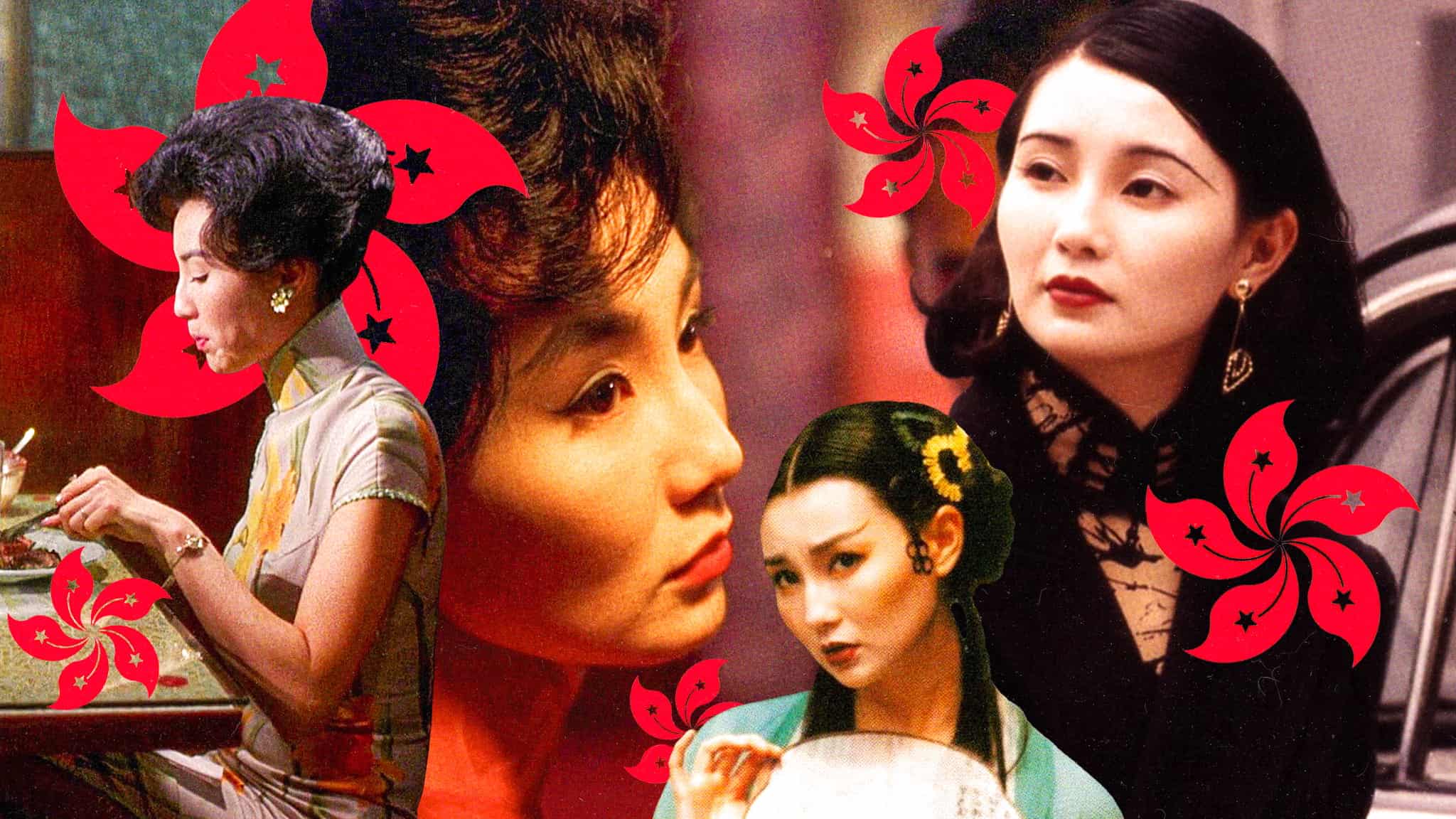
Happy birthday to the incomparable Maggie Cheung!
On her 62nd birthday, we're taking a look back at her career and awe-inspiring, chameleonic acting abilities
From left, Maggie Cheung in "In the Mood for Love", "Green Snake", and "Center Stage."
Graphic by Ryan Quan

Words by Andy Crump
Maggie Cheung is immortal.
In fairness she’s also only in her 60s, so it may be premature to suggest she is, in fact, an undying being. Consider, though, that her last substantial film roles were in 2004: 2046, by Wong Kar-wai, and Clean, by her ex-husband, Olivier Assayas. Additionally, consider that Cheung remains a luminary of international cinema despite stepping away from the film industry in the last decade. Identifying a specific date for her retirement is difficult, if not impossible, though as her final film appearances, ever—a cameo in Tony Chan and Wing Shya’s Hot Summer Days, and a performance as the Chinese sea goddess Mazu in Isaac Julien’s short Ten Thousand Waves—both fall in 2010, that should suffice.
It is a testament to the figure Cheung cuts though—the career she built, her on- and off-screen presence, and her extraordinary talent—that her name is still spoken in the sort of reverent, urgent tone typically applied to those still active in the business. Not often do artists retire young—and if 46 is, strictly speaking, middle age, it’s nonetheless “young” for creative fields—while reaching, or in Cheung’s case maintaining, legendary status. One could produce an appreciation of Cheung’s apropos of nothing save for her unassailable gifts as an actor. This year has, however, provided us with two very good reasons for commemorating her name: restorations of Tsui Hark’s Green Snake (1993) and Stanley Kwan’s Center Stage (1991).
The former served as a cornerstone for Days of Being Maggie Cheung, a month-long screening series programmed and exhibited by New York City’s Metrograph theater earlier this year; the latter bowed in August for the first time ever in U.S. theaters. This isn’t the first time that Metrograph, a landmark for independent theatrical exhibition, has made a showcase of Cheung’s filmography. One of its first screening programs in 2016, its inaugural year, paid tribute to her as a singular icon of Chinese cinema. Maybe a decade’s passage is reason enough to look back at her credits more than a decade deep into her post-movies life—though as it happens, Green Snake’s restoration actually spurred the occasion by itself.
“We had been waiting for that restoration for several years,” Metrograph’s director of programming Inge de Leeuw, told JoySauce earlier this year. “When we were finally able to screen the film, it felt like the perfect occasion to revisit her career in a comprehensive way.” A solo screening of Green Snake would emphasize the film in a vacuum, on its own merits, sans any greater connection to Cheung’s overarching body of work. She is arguably known foremost for her collaborations with Wong, and perhaps is so strongly associated with his cinema as to eclipse her work with other filmmakers. So, instead of exhibiting Green Snake alone, de Leeuw and her team chose to highlight its place among Cheung’s other roles. She is, after all, more than her performances in In the Mood for Love (2000), 2046 (2007), and Days of Being Wild (1990).
“Maggie Cheung moved effortlessly between genres—from action cinema, to melodrama, to international arthouse film—without repeating herself,” explains de Leeuw. “In Police Story (1985) and The Heroic Trio (1993), she is so playful, and in her collaborations with Wong Kar-wai, particularly Days of Being Wild and In the Mood for Love, she really embodies this longing and restraint, while in Irma Vep (1996) she becomes a meta-figure of cinema.” That chameleonic characteristic, what de Leeuw describes as “her capacity to transform,” is as essential to her longevity as her star power. There aren’t many actors of her day—any day, really—who knew how to act seamlessly across genres and styles. Michelle Yeoh and Anita Mui, two of her greatest contemporaries, come in a very close second, and even appeared with her in The Heroic Trio and its 1993 sequel, Executioners, both directed by Johnnie To, in which they effectively play kung fu superheroes teaming up to put a stop to a rash of baby kidnappings.
On the other hand, neither Yeoh nor Mui appear in a film that’s as outright strange as Clarence Fok’s 1989 martial arts fantasy The Iceman Cometh, in which Cheung plays Polly, a sex worker and smooth talker right out of a 1950s American film noir. In modern parlance, she serves major see you next Tuesday alongside Yuen Biao, playing Sau-ching, a Ming dynasty warrior who falls into a glacier in 16th Century China and is thawed out in the present day (meaning the 1980s), where he clashes with his likewise defrosted ancient foe, Feng San (Yuen Wah). Neither The Iceman Cometh nor Executioners featured in the Metrograph series, but the spots they occupy in Cheung’s filmography go straight to de Leeuw’s point about the actress’ malleability. She really could work on any set, in any storytelling mode, no matter how esoteric, artful, or plain old bizarre.
It’s a mild amusement that Irma Vep, Cheung’s first starring role outside Hong Kong’s movie industry, exemplifies this quality on holistic grounds. Playing a version of herself that is, in truth, just millimeters off from simply being “herself,” Cheung is cast by René Vidal (Jean-Pierre Léaud), a French has-been auteur, in a remake of Louis Feuillade’s 1915-16 silent serial Les vampires. The production is frantic bedlam, and everybody on set appears to have their own formulation about Cheung as a person and as an actress. Ultimately, the crew treat her as an object in their own ways. To Vidal she’s a vessel for his artistic ambitions. For costume designer Zoé (Nathalie Richard), she’s practically a fetish. (One might forgive the faux pas, since Cheung spends a chunk of the film sealed in a black skintight latex catsuit, which literalizes this fetishization.) Eventually Cheung, the character, goes method and burglarizes the hotel suite of an American woman who’s none the wiser to the crime—an instance of Cheung acting out after spending most of the movie being acted upon.
Irma Vep pairs well with Center Stage, both being self-reflexive examinations of movie stardom in which Cheung either considers her own status as an international star (as in the latter) or is confronted by that status by outside influences (as in the former). Taken in the grand scheme of her work, though, these two films vary wildly from, for instance, Zhang Yimou’s wuxia epic Hero (2002), from Police Story, and especially from the duo of In the Mood for Love and 2046, in which Wong’s direction for Cheung seems to come down to, “whatever, shut up, look lovelorn and sexy.” “We really wanted to show how (Cheung) moved between popular and arthouse cinema and how these performances continue to resonate today,” says de Leeuw of the Metrograph program. This is Cheung’s legacy: endurance. No matter the year, no matter how much time passes since she made the decision to step away from acting, Cheung’s star shines bright, and frankly seems to shine brighter with each year since.
Published on September 20, 2026
Words by Andy Crump
Bostonian culture journalist Andy Crump covers movies, beer, music, fatherhood, and way too many other subjects for way too many outlets, perhaps even yours: Paste Magazine, Inverse, The New York Times, Hop Culture, Polygon, and Men's Health, plus more. You can follow him on Bluesky and find his collected work at his personal blog. He’s composed of roughly 65 percent craft beer.

Art by Ryan Quan
Ryan Quan is JoySauce's social media manager, associate editor, and all-around visual eye. This queer, half-Chinese, half-Filipino writer and graphic designer loves everything related to music, creative nonfiction, and art. Based in Brooklyn, he spends most of his time dancing to hyperpop and accidentally falling asleep on the subway. Follow him on Instagram at @ryanquans, and check out his work on his website.