
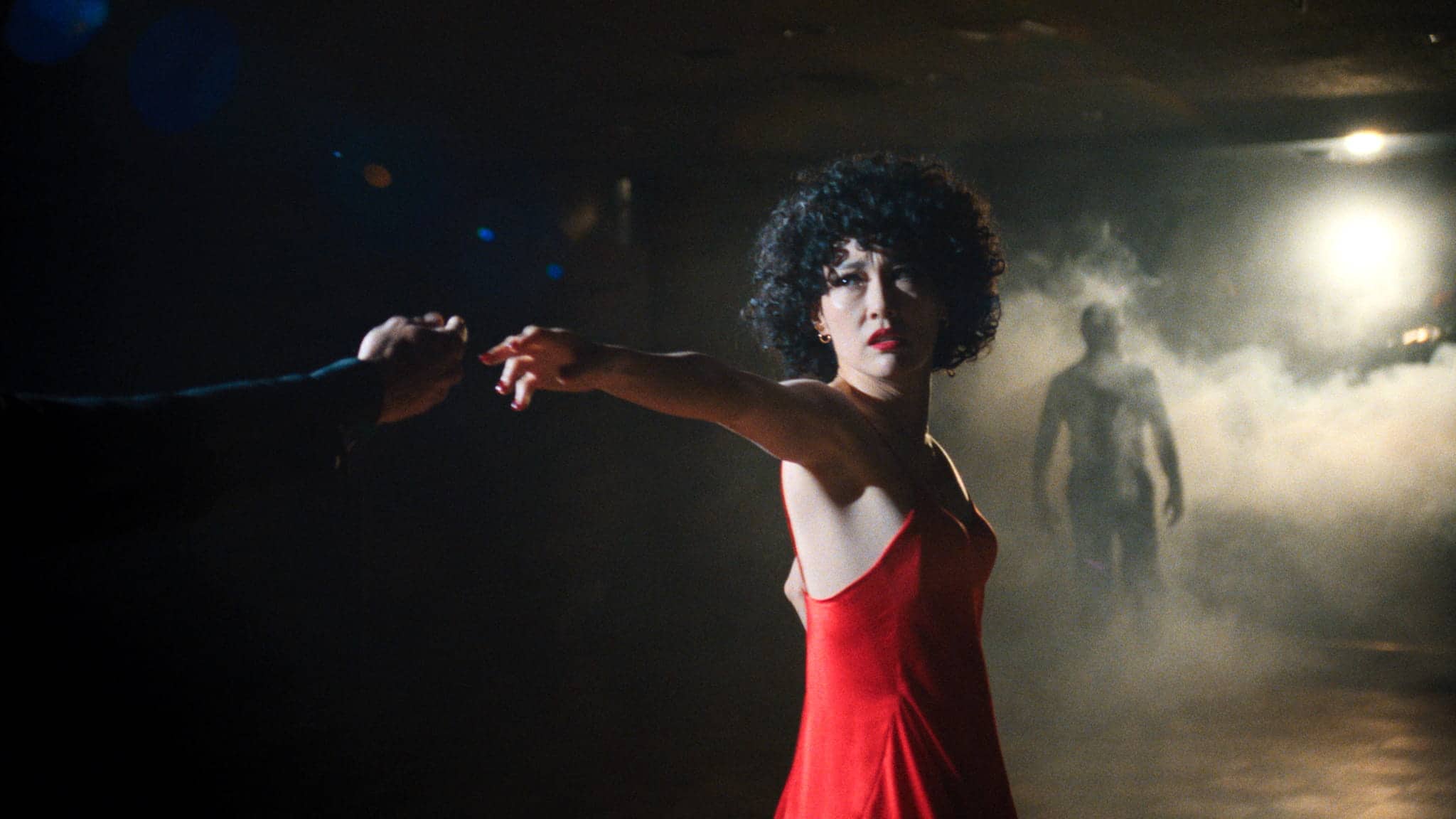
‘Ha-chan, Shake Your Booty!’ pays homage to filmmaker’s mother
The ballroom dance film reunites director Josef Kubota Wladyka and star Rinko Kikuchi on a film inspired by Wladyka's mother
Rinko Kikuchi as Haru in "Ha-Chan, Shake Your Booty!"
Courtesy of Sony Pictures Classics

Words by Devan Suber
Don’t be surprised if you see Rinko Kikuchi and Josef Kubota Wladyka collaborating again and again. The two first worked together on HBO Max’s crime drama Tokyo Vice and discovered that they clicked so well together that they simply had to reunite after it wrapped.
That film—Ha-chan, Shake Your Booty!—couldn’t be more different: a fantastical drama about a grieving Japanese woman attempting to rekindle her love of ballroom dancing and maybe even her love life. It might be a bit of a change for American audiences, who’ve likely seen her Academy Award-nominated performance in Babel or as Mako Mori in Pacific Rim, but Kikuchi shines in the role; just as often as she’s funny, she’s fearless in depicting the ups and downs of Ha-chan’s journey, aided by Wladyka’s direction and script.
Ahead of the film’s theatrical release on Friday, I spoke with Kikuchi and Wladkya on the film’s inspirations, juggling three languages, and the sweet sounds of The Cranberries.
This interview has been edited for clarity and length.
Devan Suber: What drew you both to this story, Josef in terms of the fictional autobiography, and Rinko in terms of the lead role?
Josef Kubota Wladyka: The film isn't biographical, but it's more an homage to the spirit of my mom. She's probably the main reason I became a filmmaker—her love of cinema, art, and of course, dancing. She's 82 years old and still competing in ballroom dancing. She was a single mother raising three boys on her own, and what helped her deal with the trials and tribulations was ballroom dancing. It literally saved her life.
Rinko Kikuchi: Even before I read the script, I knew I wanted to work with him again. And the script itself was very unique. There's dance, fantasy elements, a cute crow. More than the musical and dance aspects, I was really drawn to the script and the challenge of depicting the spirit of a real person rather than a biographically accurate portrayal. I was also really drawn to the fact that she’s not the Japanese ideal of being very subdued, as well as the elements of learning to heal through the relationship with the crow.
DS: The trailer features magical realist elements like Ha-chan and her husband Luis floating mid-dance, but it also feels indebted towards classical Hollywood musicals. Did you have many influences in that regard?
JKW: We wanted to have these fun dance sequences that we would break into while still remaining grounded to her journey. For example, the opening dance sequence at the competition, when they danced to “Nosotros” (by Eydie Gormé and Los Panchos), was inspired by my mom saying she felt like floating when she danced.
For inspiration, we looked at films like Punch Drunk Love (2002), All That Jazz (1979), Shall We Dance? (1996), and one of my mom’s all-time favorites, A Man and a Woman (1966). It’s a lot of me trying to be open and embrace what the film was telling me it needed to be as we were doing it.
DS: Among the music, “Stay With Me” by Miki Matsubara is featured. It’s gained popularity via the Western fascination with City Pop, but did you have any other resonance with it?
JKW: I love, love, love that song. She's a legend, such an iconic figure in Japan. We had an amazing music supervisor, Dina Juntila, who helped us get the rights to that because I believe the estate is very restrictive. I had known about City Pop from my cousins in Japan and I'm just so happy that we got to use it. It placed very well where it is because it’s about a stranger knocking on her door, similar to her infatuation with Fedir.
So much of the music is reflections of certain parts of my life. I have memories of my mom dancing rumba in a blue dress at competitions to “Nosotros.” When I would be writing this film or working on Tokyo Vice, I kept hearing The Cranberries. The beauty and the pain of Dolores O’Riordan’s voice felt linked to Ha-chan's journey.
RW: He actually wrote into the script that the ending would be a Cranberries song. I was excited because it was very cinematic and really worked well for the story itself. And to be able to have the whole script kind of lead up to that moment, I was really happy about it.

Director Josef Kubota Wladyka.
Courtesy of Sony Pictures Classics
DS: You both first met on the set of Tokyo Vice. How familiar with her work had you, Josef, been beforehand? What has your working relationship been like?
JKW: I was already a huge fan of her, obviously from Babel, but I love her in Kumiko The Treasure Hunter and Norwegian Wood. I was nervous to direct her because on a television show, you don't spend any time with the actors beforehand. You just show up, say “hi,” and direct them. But I remember the first day working with her, we were shooting this simple shot of her walking up to her apartment on this Tokyo street, and I could feel the power of her instrument.
I told her I have this strange, weird film inspired by my mom, and although the character was written to be older, I would rewrite it with her in mind. She said, “I'll do it.” She’s incredible to work with, extremely generous, so committed, really the heart of the film. I don’t think it would work without her.
RK: Josef and I are very similar people in personality. We spent a lot of time talking about whether something would communicate to the audience, what the ending should be, etc. He’s a flexible person, very open to collaboration, and that allowed me to expand on the script. It was a very fun, new process for me and I hope it shows in the film.
DS: One of the more unique things about the film is showcasing Latino expats in Japan. What were some things you learned about the community?
JKW: Most films about foreigners in Japan are about an American person, but the reality is there's people from all over the world there. There's Club Havana, a Cuban salsa club in the middle of Tokyo, all these restaurants and stuff. But really, I'm a creature of comfort. I want to work with people that I've worked with before. I shot my first film (Manos Sucias) in Colombia and then I shot a lot in Mexico on shows like Narcos and worked with these extraordinary actors; Alejandro Edda was one of them, Damián Alcázar was another. So my writing partner and I knew we wanted her husband to be from Latin America, and also because I come from two different cultures. I just feel like that's the way the world is now.
RK: There's not a huge community of Mexican people in Japan, but you can still get a lot of yummy tacos [Laughs].
DS: There’s also a lot of anime fans within Mexico and Latin America more broadly. I’ve seen clips of this Norteño group that does anime covers.
RK: Oh, really?
DS: I don’t remember the name but I love the concept.
RK: It sounds like a good collaboration. But yeah, I feel like there’s a bit of a closeness with Mexican culture for me. I don’t know why, but it seems very warm and inviting.
DS: So I'm guessing it wasn't too difficult juggling three separate languages on set.
JKW: You would think it is, but I've done all these shows in different languages and it's never that bad. Like I said, we would go through the script and with the cast and kind of talk about the lines, and they would have their ideas of what to say in their language and how.
RK: Obviously, maybe it's not the easiest thing, but for me, acting is more about motivation rather than language itself. And I’ve also acted in a lot of English-language films, as well as productions where Spanish was spoken.

In "Ha-Chan, Shake Your Booty!", Rinko Kikuchi plays Haru, a dancer in Tokyo's ballroom dance scene.
Courtesy of Sony Pictures Classics
DS: I’m sure being in two out of three of the Three Amigos’ (Alfonso Cúaron, Alejandro González Iñárritu, and Guillermo Del Toro) films helps.
RK: Yes, I’m trying to complete the card [Laughs]. But I would say it was more fun to be immersed in a different culture through language rather than difficult.
DS: You’ve tended to do more work on the television side in the U.S. Is there something about American TV specifically that appeals to you?
RK: A lot of American storylines—or ones overseas—tend to feature stronger female leads. Whereas in Japan, it’s usually a male lead and a supporting female. But ironically, when you look at anime, there's a lot of strong female leads.
DS: You've been an actor since you were a teenager, earning an Academy Award nomination for Babel. Do you feel like you’ve grown up onscreen, and that Ha-chan is a way to showcase a new phase of life?
RK: When you get older, you have more of an opportunity to lose things. This is a story about family but also about losing it. The role also comes from more of a deeper, internal place so that really helps bring about a different side of me.
DS: Do you have a preference between more stuntwork and action roles or these more internal performances.
RK: I’m open to all kinds of roles. I really enjoy grappling and figuring out what to do in a performance. It really enriches my life. It’s about the process for me rather than what the role itself is.
DS: Josef, were there things about Japanese culture that you didn’t quite grasp since you didn’t grow up in Japan?
JKW: The beautiful thing about say, 95 percent of the crew being people I worked with on Tokyo Vice meant there was already trust there. Our Japanese producer, Mao Nagakuro, for instance, is incredible. I was very open to what the film was telling us it needed to be. If something didn't feel right, I would listen and adjust.
DS: What do you ultimately hope the audience takes away from the film?
JKW: I used to be a b-boy and a break dancer. My mom danced her whole entire life. And the thing that she always told me and my brothers was, no matter how difficult life gets, never stop dancing. I hope that the audiences take that away from the film and appreciate this really special, magical performance from Rinko. There've been some really beautiful reactions from people saying they're going through some sort of grief and then this film made them feel something. They can't really articulate it, but they just need to get out of their funk.
RK: I hope people can be imbued with the spirit that allows Haru to overcome her pain through dance. The crow staring at me throughout the film also really left a mark on me, so I hope that leaves a mark on the audience as well.
Published on September 22, 2026
Words by Devan Suber
Devan Suber is a Philadelphia-based freelance film and TV critic whose work has appeared in such outlets as IGN, The AV Club, Polygon, The Film Stage, and many more. You can find him on Twitter @therealdsube or Bluesky @therealdsube.bsky.