

Double-eyelid surgery: Removing East Asian features, or just personal preference?
A brief look at the procedure's beginnings, and how a complicated history can affect how we see ourselves today
Double-eyelid surgery was developed by Dr. Ralph Millard during his time as a reconstructive surgeon in South Korea.
Graphic by Ryan Quan

Words by Ruth Moon Lopez
A “slant-eyed Korean interpreter” walks into the operating room of Dr. Ralph Millard, chief plastic surgeon for the U.S. Marine Corps, with an unusual request. He wants his eyes to look less Asian.
Millard recalled that the interpreter asked him to create a crease in his upper eyelids—a procedure now known as blepharoplasty or double-eyelid surgery—believing, according to Millard's own terminology, it would make him appear less "Oriental."
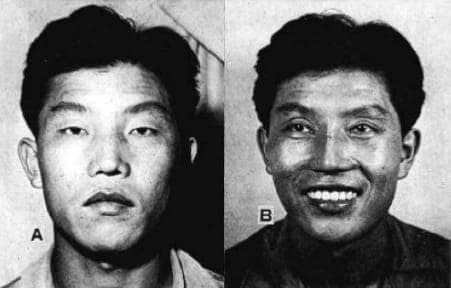
Serving from 1954-55, Millard was in South Korea primarily as a reconstructive surgeon, treating Marines injured in combat and South Korean civilians born with facial deformities such as cleft lips and palates. Drawing on reconstructive techniques he had developed for the latter patients, he adapted the procedure to create an upper eyelid crease. In his memoir, Millard described the operation as a way to help him navigate what he saw as a growing cultural divide between East and West. Yet for Millard, the responsibility for bridging that gap appeared to fall exclusively on South Koreans, who were expected to alter their appearance rather than the society around them change.
“The monolid gives the effect of an expressionless eye sneaking a peep through a slit, a characteristic which through fact and fiction has become associated with mystery and intrigue,” Millard writes in his memoir.
Millard’s accounts reflected longstanding Western stereotypes about East Asian appearances. Such characterizations echoed ideas associated with the "Yellow Peril," a racist ideology that portrayed Asians as scary, foreign, and fundamentally different from the West, and framed East Asian features as traits to be corrected or softened.
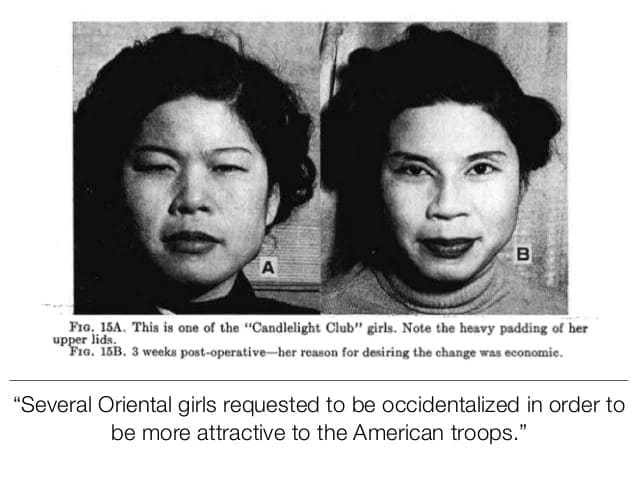
Millard’s double-eyelid procedure did not end with a single patient. South Korean women soon began requesting the same operation. Over the course of his year in South Korea, Millard continued performing double-eyelid surgery on a number of patients, including women working in the country's sex trade who hoped larger, rounder eyes would make them more appealing to American servicemen stationed there. Their decisions unfolded against the backdrop of a country devastated by war, where widespread poverty and the growing presence of U.S. military bases created an economy in which many women depended on relationships with American soldiers for financial survival.
Today, South Korea has one of the highest rates of plastic surgery per capita in the world, with double-eyelid surgery remaining among its most common procedures. Seoul attracts patients from across Asia and the global diaspora, including many Asian Americans who travel there seeking specialized procedures or world-renowned surgeons. According to the American Society of Plastic Surgeons, more than 10,000 people of Asian descent have the double-eyelid procedure done each year, making it one of the most frequently requested cosmetic procedures among patients of Asian descent in the United States.
The popularity of these surgeries raises questions that extend far beyond aesthetics. Why have procedures such as double-eyelid surgery, rhinoplasty, and jaw contouring become so common among East Asian communities? When members of the East Asian diaspora choose cosmetic surgery today, whose standards of beauty are they pursuing?
There is no simple answer. Most Asian American patients reject the suggestion that they want to "look white." Instead, many describe wanting to appear more awake, youthful, balanced, or conventionally attractive according to contemporary East Asian beauty ideals. Likewise, many surgeons argue that modern Asian blepharoplasty is not intended to create Caucasian features, but rather to enhance facial characteristics while preserving ethnic identity.
The tagline for a plastic surgery clinic near my city offering the double-eyelid procedure reads: “The goal is not to ‘Westernize’ the eye, but rather to enhance its natural shape while maintaining ethnic harmony and individuality.” Stanford Medicine’s Cosmetic Surgery Division presents the procedure as an option for those who are simply, “unsatisfied with the shape of (their) eyelids.”
Such language illustrates how the procedure has been reframed from an operation born from a desire to conform to Western ideals, to one marketed as an enhancement of distinctly East Asian features. Even if today's patients are motivated by different aspirations, can we say their choices are truly made in a vacuum when we consider the historical context of how the procedure was developed?
The history of double-eyelid surgery complicates any attempt to separate personal choice from the social forces that shape it. While today's patients may pursue the procedure for reasons that differ dramatically from those of Millard's first patients in a postwar South Korea, their decisions are not entirely independent of Western influence.
In his book Asian/American, David Palumbo-Liu argues that Millard’s work implied “a defect inherent in the Asian face.” When patients describe cosmetic surgery as simply a matter of personal preference, the more revealing question may be why that preference exists in the first place. Even if the decision is rooted in a desire to simply feel more confident, it is worth asking what external forces have shaped a person’s belief that their natural features are somehow lacking. Beauty is often described as a matter of individual taste. History suggests otherwise.
Published on September 16, 2026
Words by Ruth Moon Lopez
Ruth Moon Lopez is a part-time journalist and full-time Hi-Chew addict. Writing on intersections between music, film and history, she has interviewed award-winning artists and been a part of competitive programs such as TIFF’s Media Inclusion Initiative and RTDNA Canada’s Future Journalist Program. You can find more of her work at ruthmoonlopez.com.

Art by Ryan Quan
Ryan Quan is JoySauce's social media manager, associate editor, and all-around visual eye. This queer, half-Chinese, half-Filipino writer and graphic designer loves everything related to music, creative nonfiction, and art. Based in Brooklyn, he spends most of his time dancing to hyperpop and accidentally falling asleep on the subway. Follow him on Instagram at @ryanquans, and check out his work on his website.