
Brittany Ishibashi lets the spirit of play take over in ‘Brothers’
The actress on her role in the Apple TV+ series and playing the wife of a heightened version of Woody Harrelson
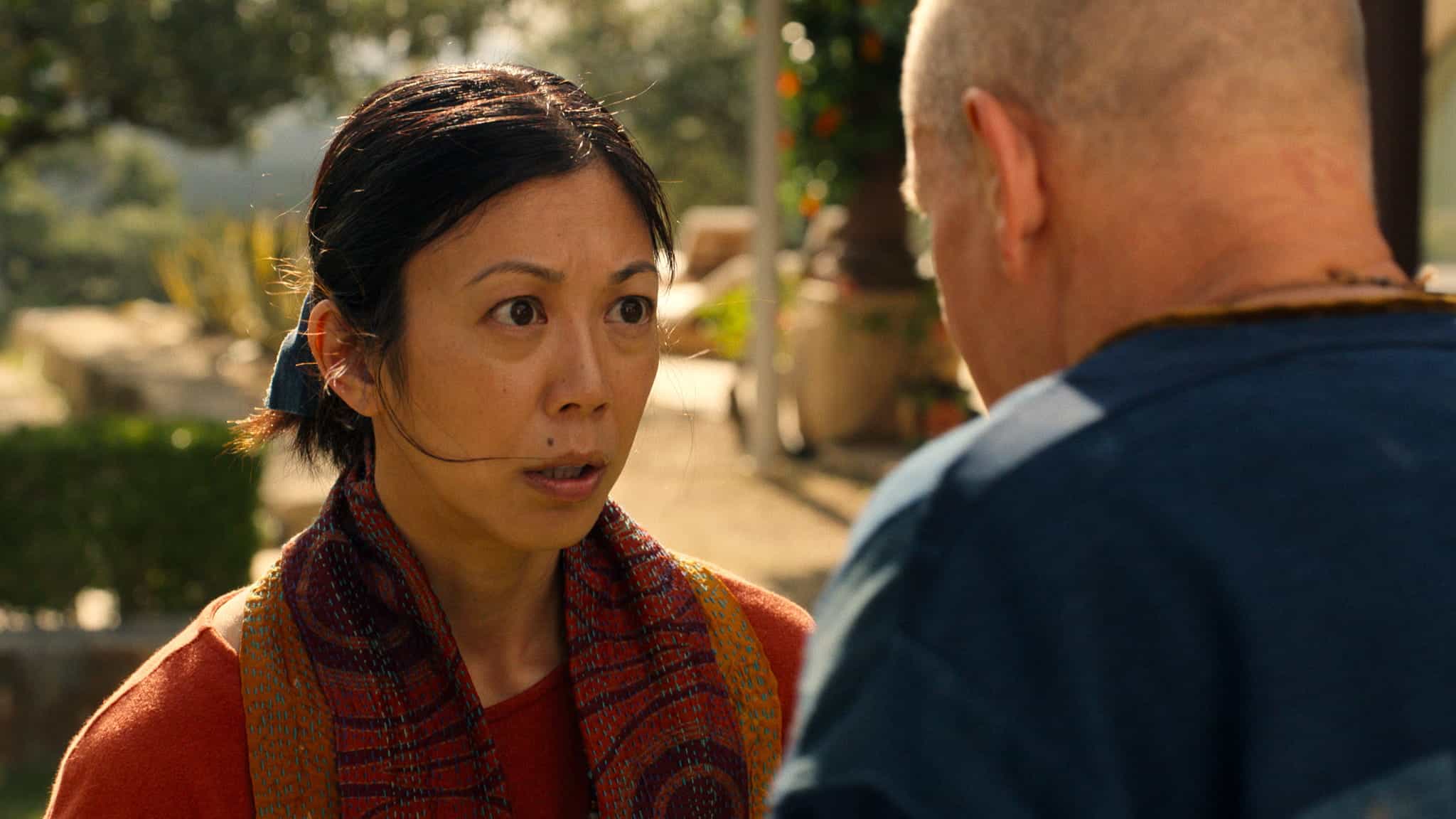
Brittany Ishibashi as Joy Harrelson in "Brothers."
Apple TV

Words by Andy Crump
On the Apple TV+ series Brothers, narrative fiction and real-life murmurs wind around one another like an Ouroboros: it is based on a rumor, explores that rumor, and is both created and produced by the subjects of that rumor, Matthew McConaughey and Woody Harrelson. Roughly nine years back, McConaughey’s mother, Kay, let it slip while on vacation that she “knew” Harrelson’s father, a revelation that spurred the dudes’ assembled families to do some frantic ad hoc sleuthing; lo and behold, an Internet meme was born. As of today, neither McConaughey nor Harrelson have submitted to a DNA test, because why verify the truth when they could make art instead?
Brothers casts the existential question mark looming over the actors’ possible siblinghood in the mold of a sitcom. They’re best friends, they could be related, and in keeping with the tradition of all odd couples, from Felix Unger and Oscar Madison to Bert and Ernie, they each work the other’s last nerve (though, to be fair with the latter pair, it’s usually Ernie annoying Bert, not the other way around). From the sidelines, their wives and children can only observe and react to their fruitless hijinks—most notably Brittany Ishibashi, playing Harrelson’s TV spouse, Joy, in a nigh-endless state of bewilderment at his choices: prototypical male ones, like attempting to duck and cover when their eldest daughter, Olive (Highdee Kuan), dissolves her engagement to her fiancé, Jimmy (Skyler Gisondo), instead of comforting her, or suckering permission out of McConaughey to stay on his ranch by adopting a puppy for his own kids.
Harrelson’s a cad, though a loveable and well-intended one, which, to Ishibashi, is why Joy stays with him, even if the expressions on her face at times communicate a sincere wish not to live on the same planet as him anymore. I had the pleasure of speaking with her about meeting McConaughey and Harrelson where they’re at in a show where they play themselves, life lessons she learned from playing Joy, and how she approached a role in which her chief responsibility is reacting to over-the-top macho absurdity.
This interview has been edited for clarity and length.
Andy Crump: I feel bad for everybody in the cast who is neither Matthew McConaughey nor Woody Harrelson. They get to play versions of themselves; they have a cheat code for the show where everybody is playing a character spun from whole cloth. I'm curious if you found ways to bring bits of Brittany into Joy?
Brittany Ishibashi: That's really funny. The cool thing about this whole construct of Woody Harrelson and Matthew McConaughey playing heightened versions of themselves is that it gave everyone freedom to take wild swings and get messy, and it was okay, because it gave a human element to the whole show. (Woody and Matthew) were having so much fun and playing so much that it let everyone else say, "Okay, let's try this and see what happens."
AC: Why not us?
BI: Right? That was a wonderful permission, that that gave us. As far as bringing Brittany to Joy, I'm flipping it, and bringing some Joy to Brittany. That's where it crossed over, where there were things Joy would do, and how she would handle family dynamics, that I was absolutely learning from, and realizing could be more efficient ways of mothering or wifing at home. She has this wonderful way of being a little bit more, not hands off, but giving a little bit more rope to her family, letting them be themselves, and not having to be so, "Here's your schedule for the day and here's the way everything is to go, and if it doesn't, then everything's going to fall off the rails.”
AC: The brief set for the non-Woody, non-Matthew cast is to react to whatever crazy sh*t it is they're doing.
BI: There’s a lot!

From left, Natalie Martinez as Valentina McConaughey and Brittany Ishibashi as Joy Harrelson.
Apple TV
AC: There is! The way you react is, to me, funnier than how in that scene, and others, Woody and Matthew don’t rise to the occasion to be good fathers, or husbands, in the moment. They figure it out afterwards. But the real comedy really comes from the reactions. How do you inform those moments?
BI: It’s funny, because here's this couple who’ve had decades together, so there is an element of, “This, again? Didn't you learn from the several hundred times before that?” But I also feel like really what it comes down to is, why does Joy stay? What is she getting out of this? There's obviously something that's bringing Joy joy. Obviously, one of the reasons why she fell in love with him is that he's a big kid, and I think his childlike spirit and being able to look at the world through that lens ultimately is the heart of everything that she believes and probably what unites them. If you look at the world with curiosity and with an open heart and mind, and you truly listen, and you're present, everything will be healed. That's the essence of who they are together as a couple, but also who they are individually.
Over the course of filming this show, we would get little and big stories shared from both Woody and Matthew, and some of the things that they would share, we’d say, “That did not happen. There's no possible way that happened.” And some things that they did ultimately were cut out of the show, because nobody’s actually going to believe them. These two on their own, and also together, what they bring out in each other is wild. So there is this wonderful thing of being truly present in the moment and watching them do these things; there's an incredulousness, and also a strange, tickly enjoyment from it, because it's unreal. What these guys do and get into is unbelievable.
AC: You used the word “heightened.” That's a great way to describe it, as opposed to something like The Office, where naturalism makes (the comedy) uncomfortable. What inspirations did you derive from to shape that dynamic, highlight the absurdity, and communicate the fact that Joy loves Woody, even though he's kind of a schmuck?
BI: You said it!

From left, Oona Yaffe, Highdee Kuan, and Brittany Ishibashi in "Brothers."
Apple TV
AC: I love him, too, but I want to smack him with a rolled up newspaper.
BI: What it all comes back to for me is the emotional part, as opposed to being headier and breaking it down that way. It varies project to project and role to role, but for this one specifically, I immediately thought, “This is the way this show is going to work and the way these dynamics are going to work.” It truly was about letting the spirit of play take over, and the unexpected that comes from that, which was such a wonderful life lesson in addition to getting to work that way. For those reactions, and the characters, I couldn't look at them from the outside in. Sometimes I like to approach a role that way, but this one was generally about being there with the absurdity and insanity of the things he brings into our lives. Joy is constantly surprised—Brittany was constantly surprised—by what Woody brings to the moment.
AC: In the finale, you let Woody have it. Joy and Brittany both finally tap out and pull the release valve. How satisfying was that moment to shoot? How did you think about shaping that moment in terms of the emotional notes you wanted to hit?
BI: When Joy finally gets to say everything that she's been holding in, that was the very last scene we shot. It was about 11 p.m. on the last day of shooting when we filmed that. So it was wonderful and timely over the course of the season to have that be the very last thing that I got to do. My love for what Joy's been holding onto over the course of this season has been, she’s the grounding force for everyone in her life. I think she sees herself as the one who's holding all the ropes and saying, “Go, fly. I got you. No, really, I got this. Go do your thing, I'm cool here.”
But I think she's being pulled in so many directions so intensely by all these people that she loves that she's lost her center, right? Joy realizes that in order for her to be the best person she can be for the people that she loves, and also to kind of get back to, “Hey, I matter too,” she needs to put her foot down, in the sense that she needs to get grounded again in a new way. She's been pulled so off-center by these lovely people in her life. I love that it all came out like that; she calls all of them *ssholes because that's how they were all behaving! They were being really selfish. I think you need those people in your life to hold you to account and shake them out of it—and she did. I think she got through to them.
Published on November 3, 2026
Words by Andy Crump
Bostonian culture journalist Andy Crump covers movies, beer, music, fatherhood, and way too many other subjects for way too many outlets, perhaps even yours: Paste Magazine, Inverse, The New York Times, Hop Culture, Polygon, and Men's Health, plus more. You can follow him on Bluesky and find his collected work at his personal blog. He’s composed of roughly 65 percent craft beer.