
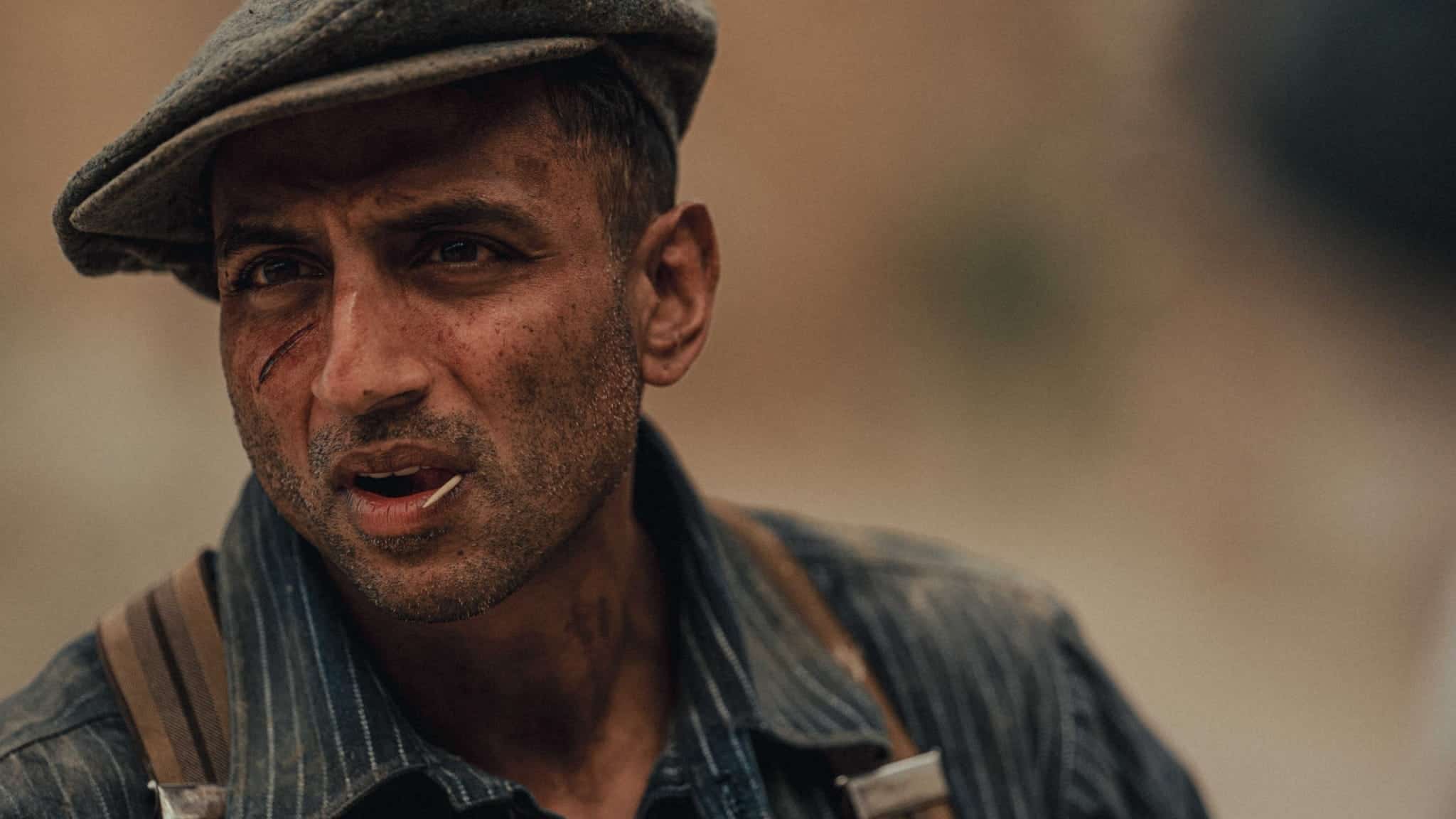
Avi Nash on ‘The Weight’: ‘We all have a great capacity for good’
The actor discusses his latest role, the film's rugged old-school style, and why art can change how we see one another
Avi Nash as Singh
Vertical

Words by Daniel Anderson
There’s something satisfyingly old-school about The Weight. Set in Oregon in 1933, Padraic McKinley’s feature directorial debut follows Samuel Murphy (Ethan Hawke), a widower and veteran who is separated from his daughter and sent to a brutal labor camp. When the camp’s ruthless warden, Clancy (Russell Crowe), offers Murphy a chance at freedom, he must lead a group of prisoners more than 100 miles through unforgiving wilderness to smuggle gold. But the deeper they venture into the wilderness, the more dangerous the men around them become.
With its rugged landscapes, desperate men and increasingly perilous journey, The Weight evokes the gritty survival films of the 1970s, like Sorcerer and Deliverance. It has the kind of character-driven, practical adventure filmmaking that feels increasingly rare. Among Murphy’s fellow prisoners is Singh, played by Avi Nash, best known for The Walking Dead and Apple TV+’s Silo. Following the film’s release, Nash spoke with JoySauce about finding his way to The Weight, the real history he discovered while researching Singh and what a film like this means in today's world.
This interview has been edited for clarity and length.
Daniel Anderson: To start, how did the script find its way to you, and what was that audition process like?
Avi Nash: I got a call from Padraic McKinley in 2024. In 2023, I broke up with my girlfriend—we’re back together now, so it’s a happy ending—and I went on like an 18-month, really sad boy phase of life. I’d always wanted to do a hike in Japan called the Kumano Kodo. I’m in Japan in a really cold, sad January. I’d just been on this hike carrying my backpack for two weeks, and I get an email from my agents that this director wants to Zoom with me. I read the script for The Weight, and I was blown away—not just by the leanness and meanness of the script, but also by the fact that I’d sort of just been doing that: walking around the forest, carrying my belongings on my back, questioning what I’d done in my life, and literally carrying the weight of a broken heart.
Padraic calls me while I'm on a roof in Tokyo with this huge beard, and we hit it off right away. He said, “I love it, man! You’re the only guy I’ve ever wanted for this job. My wife showed me Silo one day, and I was like, ‘That’s the man for the job.’ Now I’m talking to you on the phone and you’re literally backpacking around Japan with the weight of the world on your shoulders. Do you want to do this thing with me?” And I was like, “Yeah, man, I can’t wait.” That was January of 2024.
Then the movie business, as you know, is extremely touch and go. The movie lost funding, then got funding back, then was going to go, then lost funding again. Luckily, they got the money during the summer of 2025. I’d just finished season three of Silo, and we had about two months before season four was going to start. It fit right in the middle.
DA: One of the things I really liked in the movie is the dialogue where Singh says, “ignorant white folk,” and ,“I’m just in here, same as the rest of you.” I liked that Singh could just exist as a character. How was that for you?
AN: A lot of that historical dialog was in the script to begin with. When I started to research this character, I learned that there were first-generation Americans of Indian descent in the United States as early as the late 1800s. Actually, the Indian independence movement, which began in the 1940s, was born in the United States in Oregon. There was a group of what today would be Indians, Pakistanis, and Bangladeshis writing pamphlets because they were living in a country that had thrown off the British in 1776. They were like, "If these guys did it, we could do it."
Singh was born in America. He grew up with this philosophy of throwing off the shackles of colonialism, which was a real thing. It was really cool for me to have the opportunity to play a character that is fundamentally 100 percent American, who can say these things and talk about these things to a modern audience without identity politics. They weren’t trying to shoehorn in a brown character so they could get funding. This was a real thing. My mother is from India, so that is part of my cultural makeup, and it's always cool to be able to give a voice to those types of characters.

From left, Austin Amelio as Rankin, Ethan Hawke as Samuel Murphy, Avi Nash as Singh and Lucas Lynggaard Tønnesen as Olson.
Vertical
DA: Were you able to tailor anything in the script to you?
AN: The script is pretty minimal in terms of dialog, so there were scenes that we, as actors with Padraic, improvised leading up to filming while we were together in Germany. There were also scenes that we looked at together. I sat down with the writer, Shelby Gaines, particularly on Singh’s speech where he talks about why he’s in prison. In the version of the script I was given, the backstory was a little bit different. Partially, I didn’t want Singh to be a soft boy, because he’s still a prisoner. I wanted to avoid that stereotype of the ethnic character not being as tough as everyone else, so we figured that out.
DA: The audience is constantly wondering if anyone will betray anyone else. As an actor, what emotional truth do you hold onto in that environment? Are you playing Singh sincerely, or leaning into the possibility of betrayal?
AN: There are two ways I tend to approach work. One is the emotional truth of the moment and of the story. I had a pretty clear through line for myself that Singh really felt being in this jail was a great opportunity, because everyone in the jail was the perfect person he could convert to the cause of socialism—to the cause of, "You have been treated poorly by the government or the state; let’s band together."
Of all of them, Rankin was actually the perfect candidate for him. He was like, "You have been in the system since you were a young child. I can try and convert you." That was the emotional truth I tried to play throughout: Singh is bonded to these other men because he feels like eventually they’re going to get out and maybe he can convert them to a cause, and that’s worth it.
Then there’s the part of you as an actor where you ask, "How do I serve the picture that we’re painting in the best way?" Austin, Emilio, and I know each other from The Walking Dead days, and we’re friends. We talked a lot about wanting to try and actually increase the threat and the doubt that the audience had about our characters, because we thought, "What’s stopping us from grabbing one bar of gold and f*cking off in the middle of the night?" One bar of gold for us is a huge thing, and we’re in the middle of nowhere. We’re not at the prison anymore; we’re in a forest.
We tried to get that pumped up even more in the script. We wanted to add a scene where we discussed late at night whether or not we could run away. We didn’t have the time to film it. Padraic sort of liked the idea, but he also felt strongly that keeping the thing as bare-bones as possible was best.

The film had its world premiere at the 2026 Sundance Film Festival.
Vertical
DA: The technical craft—the editing, the score, and sound design—adds so much tension. What was your perspective on how those elements were constructed?
AN: This movie is an amazing example of the sum being greater than the parts. That’s true for us as individual actors, it’s true for the script by itself, and it’s true for the score. Shelby, who wrote the latest draft of the script, did the score, and he invents instruments to make that music. He’s attaching a slipper to a steel rod and smacking a glass bottle—I don’t even know what he’s doing!
There was such a strong creative impulse from everyone in every department, down to props, costume, and set design. People really wanted to elevate that story in every way possible, and the resulting film is greater than any one department. I don’t often get that truly creative feeling when I work. Sometimes it’s "one for you, one for them," or there are a lot of cooks in the kitchen because it’s a big TV show, a big studio, or there's a big actor. In this, Ethan Hawke and Russell Crowe couldn’t be more generous. They’re actors at the top of their game and have been for 30 years, yet they’re still willing to get down literally in the dirt and in the river with you and play. It’s a very special movie.
DA: The physical environment feels like its own character in the movie. How was the shoot practically, and how cooperative was Mother Nature?
AN: You just do it for real. We thought it was going to be a sunny movie. We thought it was summertime in Bavaria—it was supposed to be bright out and hot. I remember I did all this prep about how hot and sticky I was going to be, and then it turned out it was cold and rainy for six weeks, except for one day. That one day on the shoot when we were out on the water in the boats, the sun came out, and it was perfect for the movie. Tonally, it’s this gray, oppressive storm cloud, and then the day you see the sun is the day the greatest tragedy occurs. That’s something you can’t plan; that’s the magic of making the thing outside. I’ve done stuff on green screen, and there’s an artistry there that is incredible to merge the truly fantastical with the practical, but then there’s another thing where you capture the magic of what is outside for six weeks and you have to make it work. In this movie, it really does work.

"The Weight" marks Padraic McKinley's directorial debut.
Vertical
DA: There’s an old-fashioned code of ethics to these characters—even though they’re criminals, they retain a core decency. How was it playing into that theme in today's world?
AN: It’s a really important message to remember: we all have a great capacity for good, and even if we have made mistakes in the past and been penalized for them, and been "criminals," we are not beyond doing the right thing. You always have the ability to make that choice, no matter who you are.
That’s something we really need to remember in today’s world. You can’t open up the newspaper without seeing disaster. Within all that disaster, we forget that we, as human beings, still have a choice to live a certain type of life.
For as little or as much as art can affect people’s thoughts, it’s very much part and parcel of why I do this. I’ve always felt that art—cinema, painting, music, food—has the ability to get inside people’s brains and hearts in a way they’re not conscious of, so their conscious biases can’t block it. We can affect and maybe change the way people behave, think, relate, and have empathy for each other.
That’s all a bit pooh-pooh, but I do believe it. I think it’s pretty cool that I’ll be able to one day lay on my deathbed and say I was part of something I’m really proud to be part of—something that is a piece of art and really shot its shot at telling a story worth telling.
Published on October 13, 2026
Words by Daniel Anderson
Daniel Anderson is a disabled Chinese American adoptee based in Seattle. His freelance writing specialties include K-pop, entertainment, and food. He believes that any restaurant can be a buffet, and the key to success is to take a nap each day. Follow his adventures on Instagram @danzstan.