
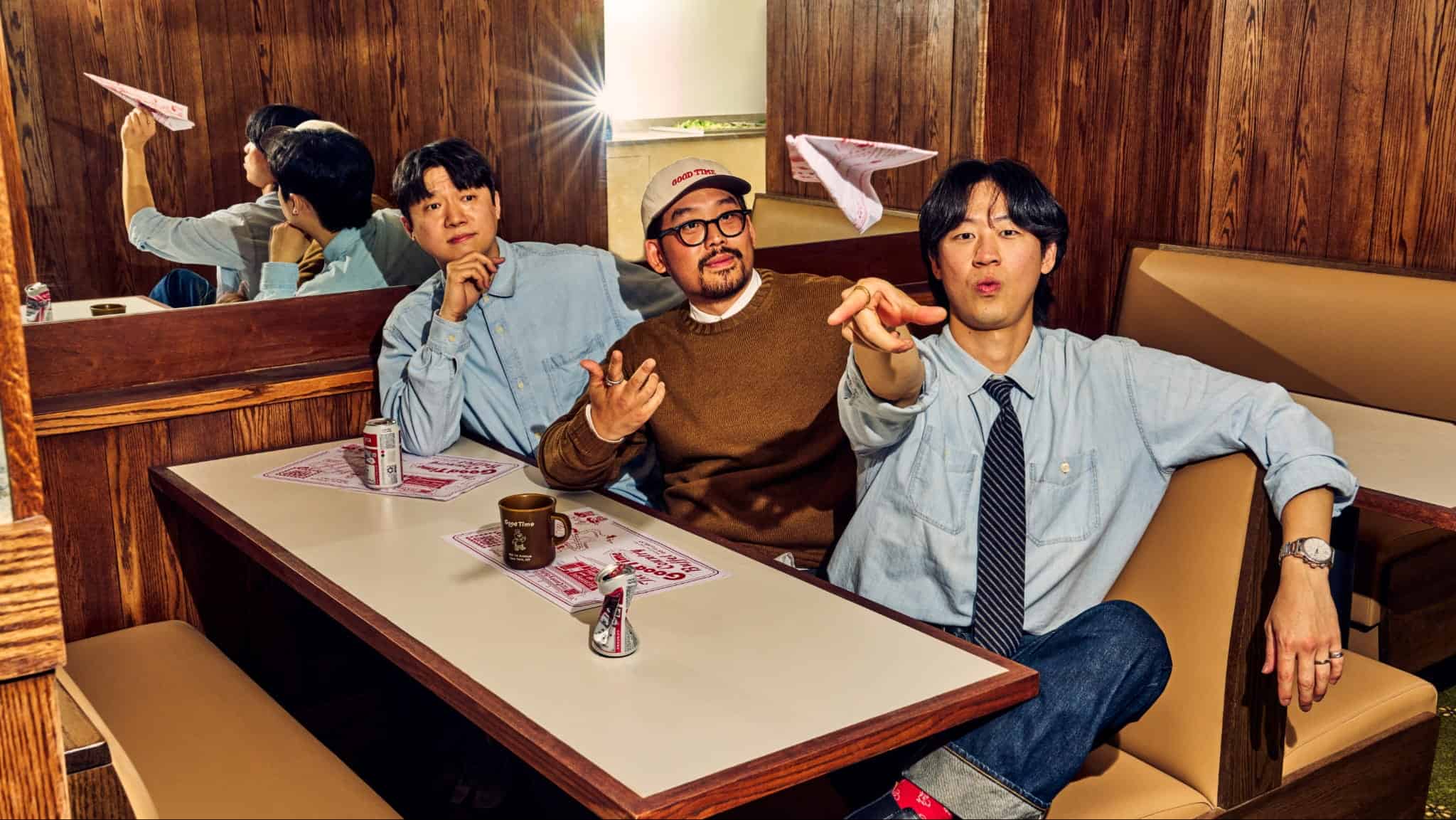
At Good Time Hospitality, every restaurant tells a personal story
From C as in Charlie, to Kisa and Good Time Country Buffet, David JoonWoo Yun is turning nostalgia into a new vision for New York dining
Yong Min Kim, David Yun, Steve Choi
Scott Semler

Words by Daniel Anderson
David JoonWoo Yun and his co-founders—brothers Steve Choi and Eric Choi—first crossed paths as childhood friends at a small Korean church in Atlanta. Raised around the food industry (Steve and Eric’s parents ran a Chinese restaurant, while Yun’s father distributed goods to local buffets), the group developed an early dynamic while living together as roommates: Eric was the dedicated cook, Steve was on dish duty, and Yun managed front-of-house organization. After honing their skills at New York’s Kristalbelli under chef David Shim, the trio took a leap in 2020 by renovating a turnkey spot to launch C as in Charlie, a Korean-Southern hybrid that quickly earned a prestigious Michelin Bib Gourmand designation.
Expanding their narrative-driven hospitality group, Good Time Hospitality, the team went on to open Kisa in New York’s Lower East Side—a tribute to South Korea’s disappearing gisa sikdang (driver diners), serving hyper-authentic baekban spreads. Now, with their latest venture, Good Time Country Buffet, they’ve brought their story full circle. Paying homage to the immigrant-owned Southern buffets of their Atlanta upbringing, the concept offers an abundant, rotating spread of nostalgic comfort food for $26.99 per person for adults—bringing affordable, soul-fulfilling dining back to Manhattan.
Yun spoke with JoySauce following the opening of Good Time Country Buffet to discuss the launch of Good Time Hospitality, storytelling through restaurant concepts, and what authenticity means in modern dining.
This interview has been edited for clarity and length.

Exterior of Good Time Country Buffet.
Scott Semler
Daniel Anderson: What strikes me about your restaurants is how personal every concept feels. They play with memory and time, almost feeling autobiographical. How intentional is that storytelling, or is it just a natural extension of concepts you have a personal attachment to?
David JoonWoo Yun: New York is an incredibly competitive market, so to be successful, a concept has to be authentic and original to who you are. When we first opened, we looked through dozens of ideas and ultimately chose the one that best represented our identity as Korean Americans who grew up in Atlanta.
C as in Charlie was built around our unique immigrant experience. For example, our ox bone marrow pasta was inspired by a childhood memory. When my family first moved to Maryland, there were no Korean supermarkets nearby. My mom wanted to make seollongtang (ox bone soup), which traditionally uses wheat noodles (somyeon). Since she couldn't find them, she substituted spaghetti noodles from the local supermarket. Another dish, our Salisbury steak, came from Steve’s childhood—his parents used leftover hamburger patties from their restaurant to make tteok-galbi at home.
DA: How did that storytelling lead into your next concepts, Kisa and Good Time Country Buffet?
DJY: While running C as in Charlie, guests would often tell us it was their first time having Korean food. We appreciated the love, but we realized our menu wasn't 100 percent traditional Korean food and didn't want to be misleading. At the same time, we noticed authentic, mom-and-pop Korean restaurants in Korea were disappearing because younger generations didn't want to run them—they're labor-intensive and hard to make profitable. We wanted to pay tribute to those roots with a hyper-authentic Korean concept outside of Koreatown, which led us to open Kisa.
After Kisa blew up in the media, we didn't want to limit our portfolio strictly to traditional Korean concepts. We thought about Atlanta—our "mother state"—and realized what we missed most from the 2000s were the country buffets. Back then, many affordable regional buffets were run by Korean immigrants competing with larger chains. They offered rotating daily menus to serve local communities and seniors. Post-COVID, all-you-can-eat buffets in Manhattan largely disappeared. We wanted to bring back that sense of affordability, abundance, and nostalgia to New York, which is how Good Time Country Buffet was born.
DA: Many chefs navigate a tension between their cultural heritage and their American upbringing. Did you ever feel caught between a Korean identity and an American identity growing up, or did you always have a clear sense of self?
DY: Honestly, it went in reverse for me. Having lived in the U.S. since 2000, I always identified as more Korean than American. But when we opened Kisa, while many people were supportive, a portion of the online community questioned our background as Korean Americans doing a traditional concept. That was the first time I had to recategorize myself.
I’m 36 now, and while that realization was initially shocking, I now see it as a major advantage. I don't have to choose one or the other—I am both Korean and American. It allows me to serve as a bridge between two cultures.

The buffet selection at Good Time Country Buffet.
Scott Semler
DA: How do you translate that nostalgia and authenticity into the design and atmosphere of your spaces without making them feel staged?
DY: We always focus on functionality first so the space doesn't feel like a museum. At Good Time, for instance, we used carpeting—not just for aesthetics, but because historically, 80 percent of country buffet patrons were seniors. Carpeting prevented slipping, which was a safety priority for those owners. We also installed drop-in office ceilings rather than expensive wood paneling because those immigrant-owned buffets worked within practical budgets. At Kisa, we put a CRT TV in the corner because solo taxi drivers traditionally watched TV while eating. We constantly ask ourselves: Are we doing this just because it looks cool, or does it serve a real, authentic function?
DA: Could you explain more about the regional nuance of Southern, Korean-owned country buffets and how they differed from major corporate chains?
DY: Major chains like Golden Corral had massive scale and variety, like prime rib carving stations. The smaller, Korean-owned country buffets in Atlanta were much more personal and affordable. Owners established a model that others in the immigrant community replicated. Because they served a core group of local seniors, they relied on rotating daily menus—Fried Fish Mondays, Hot Wing Wednesdays—so people had a reason to return daily. Seniors would literally keep the weekly menu pinned to their fridges. It felt like eating at home.
DA: Now that you've officially formed your hospitality group, what is the core ethos and leadership culture you're trying to build?
DY: We created Good Time Hospitality because, at the end of the day, our goal is simply to give people a good time—whether through food, service, or atmosphere.
Most of our leadership team—our director of operations, general managers—started as servers with us at C as in Charlie or at previous restaurants where we managed. In many Asian households, parents push for corporate, medical, or legal careers. Hospitality isn't always presented as a viable career path. I want to show people that working in restaurants isn't just blue-collar labor; it can be a rewarding career where you express your identity, build community, and take pride in your work.

A plate at Good Time Country Buffet.
Scott Semler
DA: Opening non-traditional or unexpected concepts often invites strong opinions and Internet feedback. How do you handle that noise as operators?
DY: Online feedback has been mixed—especially around the country buffet concept—and some people have questioned what we represent. But we went through the same thing with Kisa. I’m not trying to imitate anyone’s culture; this is literally what I grew up with. If people don't understand it right away, that's fine. The fact that so many people are still curious and supportive is what keeps us moving forward. You can't let Internet noise stop you from doing what you believe in.
We knew this reaction would happen when we chose a country buffet format. We even asked ourselves: Should we hide behind the concept and keep our personal identities off the marquee like we did at C as in Charlie and Kisa? Or should we stand up and own it as Korean immigrants who grew up on this? We chose to stand up and own it. We’re not lying about any part of our story, so why should we hide it?
Published on November 3, 2026
Words by Daniel Anderson
Daniel Anderson is a disabled Chinese American adoptee based in Seattle. His freelance writing specialties include K-pop, entertainment, and food. He believes that any restaurant can be a buffet, and the key to success is to take a nap each day. Follow his adventures on Instagram @danzstan.