
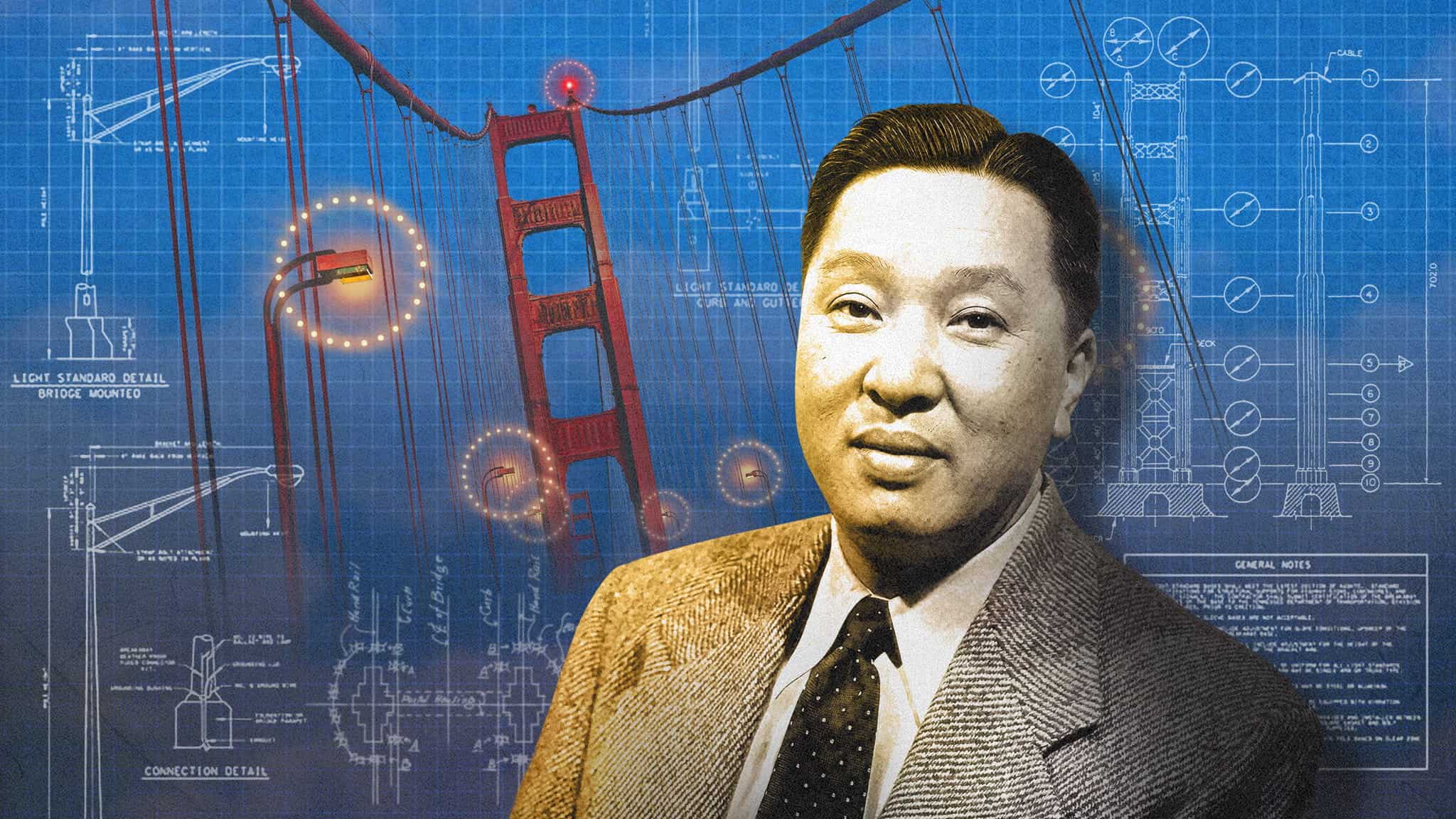
442: How Wallace Fong helped bring the Golden Gate Bridge into the light
Despite playing a key role in lighting the iconic San Francisco landmark, records barely captured Fong's contributions
Wallace Bing Fong
Graphic by Vivian Lai
Words by Sanaphay Rattanavong
The 442: A JoySauce column named after the military unit, designed to school you (in all the best ways) on accomplished Asian Americans and Pacific Islanders of the past. Asians have been shaping American history, culture, food, politics, identity, and more for centuries—it’s time we acknowledge what’s been left out of most textbooks.
Have a historical tidbit you’d like to share? Let us know!
When the Golden Gate Bridge opened to foot traffic on May 27, 1937, Wallace Bing Fong walked across it with his wife, Louise, and their two daughters. Three decades earlier, when he was a small child, Fong’s family had been forced from San Francisco's Chinatown on the heels of the great earthquake and consequent fires, riding in the back of a wagon to shelter in what relatives remembered only as a park. Which park, the family cannot say. Chinese refugees had been placed in a segregated camp in the Presidio (then a military base, whose management was officially transferred to the U.S. National Park Service in 1994), near Fort Point (a national historic site underneath the southern arch of the bridge), but the household did not carry that knowledge. Fong's granddaughter, Katherine Toy, who was born after he died and knows him entirely through other people's memory, learned it decades later in the course of her own working life.
"Growing up, my mother and aunts didn't know the relocation camp for Chinatown was the Presidio, so I'm pretty sure they didn't think about it," Toy says. "I only found out that was the location relatively recently, when I worked for the Golden Gate National Parks Conservancy. And then I did think that was a pretty cool connection with his work on the bridge, but also my own work with an organization whose mission includes helping to preserve and protect the Presidio."
Fong was born Fong Bing Wah in 1903 in San Francisco, into a country that had just renewed Chinese exclusion, with no end date attached—the Chinese Exclusion Act would stay on the books for another four decades. Within this context, Fong graduated from UC Berkeley's College of Engineering in 1923. If the bridge’s history later made room for an engineer named Fong only in fragments, the photograph from his graduating class at Berkeley shows how unusual his presence in the profession could look even before he entered it.
Fong's route from Berkeley to the Golden Gate Bridge was not a straight professional climb. Pacific Gas and Electric Company (PG&E) hired him as a draftsman, and even that work waned during the Great Depression. Family memory, relayed by Toy from her mother and aunts, places him and his brothers in Sacramento during those years—an aunt recalling him working with his brothers at a wholesale meat market—before he returned to San Francisco and PG&E by 1936. That was when his bridge work began.
While Fong had graduated from Berkeley as an engineer, PG&E hired him as a draftsman. Toy’s mother and two aunts told her that he watched white men in his department get better titles, and the raises that came with them, while doing the same work he was. Toy calls it their general sense rather than a specific story, though it was one she also heard growing up. One aunt remembers a supervisor who meant to push for engineer status on his behalf, but the family's account stops there.
A project that commissions a report on its own color and lighting already knows it is building a monument. Irving Morrow, the consulting architect, delivered his in 1935, and that document is why the vision has a name attached to it in the public record. Morrow's roadway plan called for low-pressure sodium vapor lamps, then a new technology, for their warm, non-glare amber light. The vision was elegant; making it work across the full length of the roadway was unprecedented. The technology was barely five years old in commercial form at this point: Philips began selling the bulbs in 1932, and the first road test for street lighting came in 1933.
According to family memory, Fong helped design and draw the circuitry for the original lights while working through PG&E. Toy is careful about the wording as the family does not know his precise role, only the story that’s been handed down. That uncertainty matters. Morrow’s report survives; the technical drawings associated with Fong do not. That gap is evidence of the uneven way public works preserve authorship, especially the difference between "men of vision" (and they are usually men) and the many forms of expertise that make such things real.
In this way, Fong's story runs parallel to the broader labor history of the bridge. Eleven workers died during its construction, including 10 men who were killed when scaffolding fell through a safety net in February 1937. It'd be disingenuous to suggest that Fong is the bridge’s forgotten singular hero. But his story shows how a monument can preserve architects and chief engineers while obscuring both the technical workers who made it operate and the laborers who risked their lives to build it.
The lights on the bridge turned on in 1937. Eighteen years later, when Toy's mother was about 10, the family left San Francisco and bought their first house, in Palo Alto, California. It was an Eichler, one of the mid-century tract homes now traded as design objects. The architecture was not the point. Toy says her grandfather bought it because Joseph Eichler was Jewish and would sell homes to Chinese people when other builders would not. Fong had helped bring light to a monument the state would spend the next century photographing. He still had to choose his street according to who would have him.
When Toy began her career as a history teacher, she would tell her students everyday people make history every day. She applies it to her grandfather without much ceremony. "I think most people don't realize they're historical figures," she says. "Only in our remembrance, or sort of understanding of the context, do later generations of us perhaps think of the roles they played and what that might represent." When the Parks Conservancy published its profile of Fong, Toy’s mother and aunts had the same reaction: he would have hated any kind of notoriety.
The drawings are gone. The hard hat is not. It has been passed around the family for years and now belongs to Toy's cousin's grandson. As Toy puts it, it's pretty cool that a little boy now has a hard hat that belonged to his great-great grandfather.
Published on October 6, 2026
Words by Sanaphay Rattanavong
Sanaphay Rattanavong is a versatile writer and educator with a deep passion for arts and culture. With a diverse background in arts, culture, mental health, science communication, and technology, his work spans from journalism to fiction writing. He has received various grants and awards for his contributions to the arts and cultural discourse, including the Walker Art Center Twin Cities BIPOC Artist Grant, selected by The SEAD Project (Southeast Asian Diaspora), and the Artist's Initiative Grantee from the Minnesota State Arts Board. He currently resides in Toronto, Ontario. More of his work can be enjoyed at: https://sanaphay.portfolio.site/.