
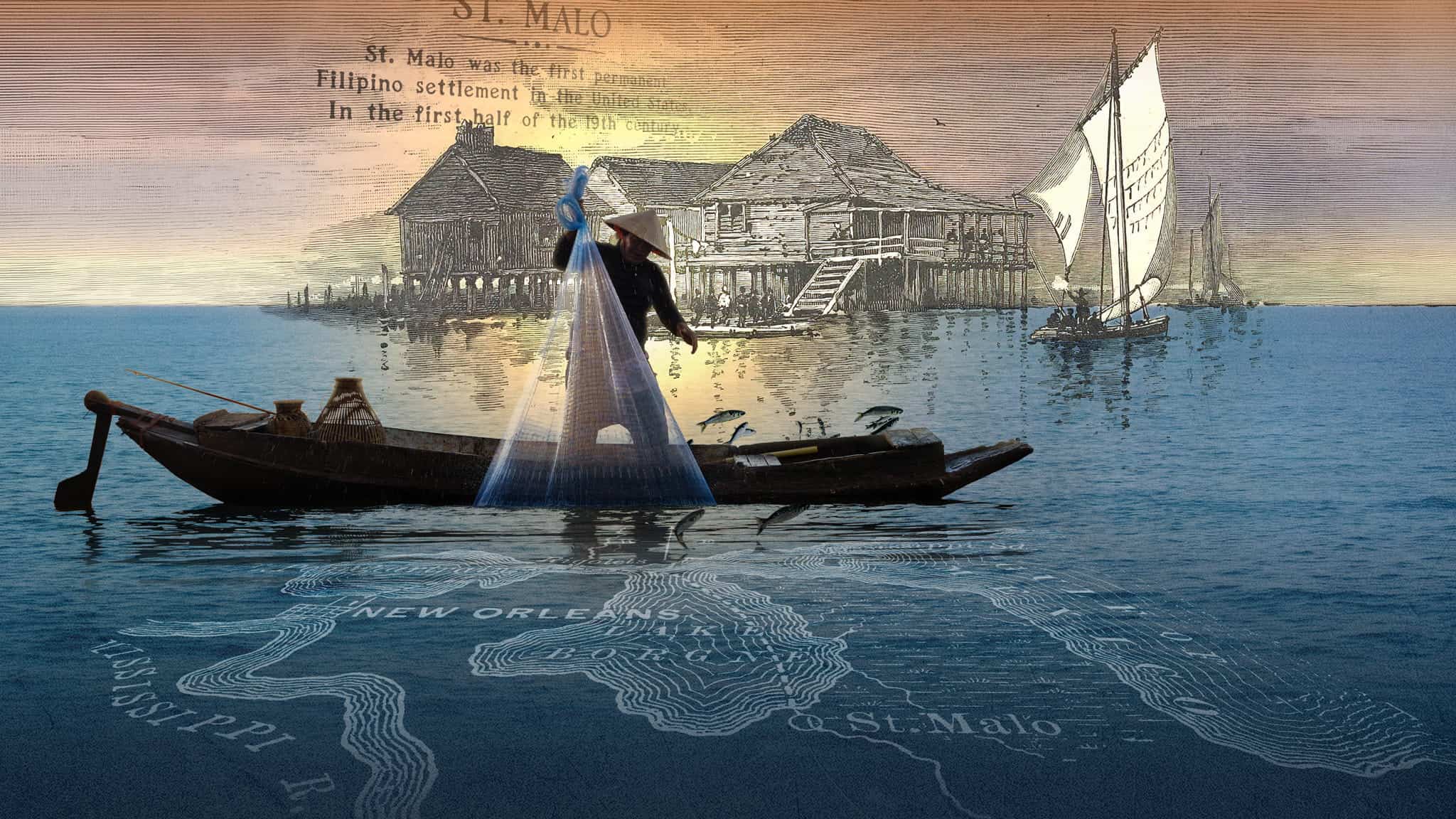
442: How Manilamen established the first Asian American settlement
In the 1760s, Filipino sailors escaped dehumanizing conditions with the Spanish, to settle in Louisiana's bayou
The first Asian American settlement in the United States was established by Filipino men in Louisiana.
Graphic by Vivian Lai

Words by Andy Crump
Home can be a place of origin. Often, and particularly for ethnic diasporas, home is a time, and times come as easily as they go. But home can also be wherever a displaced population lays roots. It isn’t always the case that new cultures and societies enter the historical record for happy reasons. Persecuted minorities may flee their country of origin, or may be forced out of them entirely by colonial projects. However a civilization forms, and for that matter wherever, people make up its component parts, so it stands to reason that what defines “home” is as much about the location as the occupants.
Mention of Louisiana typically calls to mind images of Mardi Gras soirees, the sounds of the blues echoing around the French Quarter and Tremé, perhaps a few too many urban legends about alligators, and the thick-aired atmosphere of the bayou. But Louisiana has its share of paths less tread and stories less told, too, and among the most overlooked pockets of life in the state’s history is the account of the Manilamen—Filipino sailors and indentured servants who established Saint Malo village in the United Colonies in 1763, 13 years before our then-latent nation declared its independence from British rule.
Saint Malo holds distinction as the first permanent Asian American settlement in the United States, though it no longer exists today as it did in the 1760s. In keeping with the merciless weather patterns we know well from the 2000s, the New Orleans hurricane of 1915 just about took the village off the map. Winds hit 145 miles per hour; the storm surge peaked at 13 feet; hundreds drowned; other communities besides Saint Malo, like Breton Island, were also obliterated. Maybe, for the Manilamen, the devastation was just par for the course. Storms were a part of life in the region where they built their townlet, not to mention the mosquitos, for whom the surrounding marshlands were a breeding ground. No surprise, then, that raging waters and furious winds bring stilt houses to ruin. We should consider ourselves lucky that historical research and oral tradition preserved the memory of Saint Malo at all.
Easy to say, of course, for an author living in 2026. Likewise, it’s easy to cite the story of the Manilamen as one of resilience—not to mention cheap. Truthfully, theirs is a story of resistance, not just endurance. The Philippines was seized by the Spanish Empire as one of its colonies starting in the 1500s, and served as one axis in the Manila Galleon trade, the maritime system connecting Manila, the Philippines’ capital, to Acapulco in Mexico. For utmost clarity: the system worked out badly for Filipinos, economically as well as humanitarianly, as their Spanish overseers regarded them as less than and treated them accordingly. Human rights violations and abuses are a tragic piece of Filipino heritage, the same song played in a different key across instance after instance of colonial cruelty throughout history.
So the urge to break out of their circumstances was strong among Filipino sailors, who absconded from their ships and into Louisiana’s bayous in 1763; one might say that they jumped ship, but one might think twice, because that’s the language of their Spanish captors. Better to accept that the sailors ran from dehumanizing brutality than simply deserted their posts. Life in a harsh natural environment is preferable, after all, to life in a harsh hierarchical system, and besides, for the Filipino escapees, the buggy, humid, low-lying qualities of the marsh felt an awful lot like home—the place they were yanked from against their will. As unpleasant as such an ecosystem sounds, it’s one with which the Manilamen were familiar, to say nothing of how their lives at sea and in Southeast Asia acclimated them well to rough weather.
As Saint Malo—named for Juan San Maló, who led the Filipino sailors off of Spanish ships and onto Louisiana’s grounds—grew, the Manilamen contributed to the area’s fishing industries via the shrimp dance: a method of peeling shrimp after drying them out, which is more or less exactly what it sounds like on paper. Don’t laugh at how silly the name sounds; it worked remarkably well, and introduced neighboring cultures, a’la Cajun and Creole, to preservation techniques well before the invention of refrigeration. Hard as it is to imagine keeping food without artificially cooled storage now, the shrimp dance, and drying, were downright revolutionary concepts in the 1700s. Sharing of such skills, as well as intermarriage between Manilamen and Louisiana’s other ethnic groups, helped solidify their place in the Pontchartrain Basin.
Of course, that place wasn’t to last, because nature got the last word on the Manilamen’s adopted home. But the loss of Saint Malo doesn’t denote the loss of their influence upon Louisiana’s polycultural identity. The effect the Manilamen had on the state’s growth in the years between 1763 and 1915, and all the years after, can’t be erased even by a storm as bad as the New Orleans hurricane. Commemorative markers installed in 2012 and 2019 provide physical reminders of the village’s existence, but it’s the descendants of the village’s occupants who truly keep Saint Malo’s memory alive—as a place, as a time, and as a home.
Published on October 17, 2026
Words by Andy Crump
Bostonian culture journalist Andy Crump covers movies, beer, music, fatherhood, and way too many other subjects for way too many outlets, perhaps even yours: Paste Magazine, Inverse, The New York Times, Hop Culture, Polygon, and Men's Health, plus more. You can follow him on Bluesky and find his collected work at his personal blog. He’s composed of roughly 65 percent craft beer.